Key Takeaways
- 1. Offshore development can help businesses access specialized MCP and AI integration expertise.
- 2. Clear project scope, documentation, and communication routines support smoother collaboration across time zones.
- 3. Security, access control, testing, and intellectual property requirements should be agreed upon before development begins.
- 4. A small pilot project can help validate technical capabilities and working practices before a larger engagement.
- 5. Long-term success depends on maintainable code, clear ownership, and reliable post-launch support.
Introduction
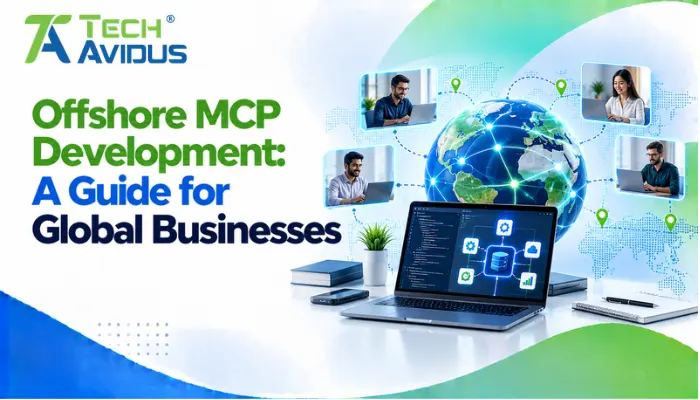
Offshore MCP development allows businesses to work with a development team in another country to build integrations using the Model Context Protocol (MCP). For companies developing AI-powered products, this approach can provide access to specialized engineering skills while allowing internal teams to focus on product strategy and core business operations.
However, successful offshore development requires more than choosing a team with technical experience. Businesses need clear requirements, effective communication, secure access to systems, transparent delivery processes, and a plan for ongoing maintenance.
The right engagement model helps global businesses coordinate development across locations without losing control over product quality, security, or priorities.
What Does Offshore MCP Development Involve?
Offshore MCP development involves working with a geographically distant technical team to design, build, test, or maintain an MCP-based integration. The scope can range from a focused prototype to a production-ready server connected to business applications.
A development engagement may include:
- Technical discovery and architecture: The team reviews existing APIs, business workflows, target AI clients, and system constraints. This helps define the server capabilities, integration boundaries, and implementation plan before development starts.
- MCP server development: Engineers implement the required tools, resources, prompts, and connections to existing backend services. The work should follow the relevant protocol specification and the product’s own business rules.
- Security and quality assurance: The team tests authentication, authorization, input validation, error handling, and access restrictions. Testing should reflect the risks and data sensitivity of the actual application.
- Deployment and maintenance: The engagement may include environment configuration, documentation, monitoring, bug fixes, and future updates. These responsibilities should be explicitly defined rather than assumed to be included.
The official Model Context Protocol documentation provides a technical starting point for understanding the protocol and its implementation requirements.
Why Do Global Businesses Choose Offshore MCP Development?
Offshore development can be useful when a business needs specialist engineering support without building every capability internally. Its effectiveness depends on the complexity of the project, the team’s experience, and the quality of collaboration.
- Access to specialized skills: Businesses can work with developers familiar with AI integrations, backend architecture, APIs, and MCP implementation. Evaluate practical experience through technical discussions, code reviews, and a small proof of concept.
- Flexible team capacity: An offshore team can provide additional development resources as project needs change. Clear ownership and defined responsibilities help prevent overlap between internal and external teams.
- More focus for internal teams: Product managers and in-house engineers can concentrate on core business priorities while the offshore team handles agreed technical work. This works best when internal stakeholders remain involved in requirements and technical decisions.
How Should You Select an Offshore MCP Development Partner?
Choose a partner based on technical capability, communication, security practices, and delivery transparency not location alone.
1. Assess relevant technical expertise
Ask how the team approaches MCP server architecture, existing API integrations, authorization, testing, and deployment. A capable partner should explain technical trade-offs and identify risks rather than promise that every integration will be straightforward.
2. Establish communication and project ownership
Agree on a primary point of contact, meeting cadence, documentation standards, task tracking, and escalation procedures. Shared project tools and written decisions help teams collaborate across time zones without relying on constant meetings.
3. Verify security and intellectual property practices
Before granting system access, agree on confidentiality, source-code ownership, credential management, data handling, and access permissions. Use least-privilege access and approved development environments, particularly when the project involves customer or enterprise data.
4. Define scope and delivery expectations
Document the deliverables, milestones, dependencies, acceptance criteria, and process for handling changes. If you are considering fixed price MCP development, make sure the scope is specific enough to estimate responsibly and explain how newly discovered requirements will be managed.
How Can Offshore Teams Maintain Quality Across Time Zones?
Offshore teams can maintain quality through documented workflows, shared acceptance criteria, and predictable communication. Time-zone differences become easier to manage when progress does not depend on every decision being made in a live meeting.
Practical measures include:
- Use asynchronous documentation: Record technical decisions, setup instructions, API assumptions, and unresolved questions in a shared workspace. This lets team members continue work without waiting for another location to come online.
- Review work incrementally: Use version control, pull requests, automated tests, and regular demonstrations. Small reviews make it easier to catch misunderstandings before they affect multiple components.
- Define measurable acceptance criteria: Specify how each tool or integration should behave, including expected outputs and failure cases. Both teams should use the same criteria when reviewing completed work.
- Keep security in the development workflow: Review access permissions, dependency updates, secrets handling, and logs as part of regular development. Security should not be postponed until the final deployment stage.
Advantages and Limitations of Offshore MCP Development
Offshore development can extend a business’s engineering capacity, but it introduces coordination and governance responsibilities that must be managed deliberately.
Advantages
- Access to broader technical expertise: Businesses can evaluate teams with relevant integration and AI engineering skills beyond their immediate hiring market. The right fit depends on demonstrated capability rather than geography.
- Scalable collaboration: External developers can support a defined phase of work or a longer development roadmap. Clear documentation and ownership help preserve continuity as team composition changes.
Limitations
- Communication and coordination overhead: Different working hours, unclear requirements, and delayed feedback can slow decisions. Shared documentation, agreed overlap hours, and prompt stakeholder reviews help reduce these issues.
- Data and delivery risks: Poorly managed access, unclear code ownership, or weak quality controls can create problems regardless of where the team is located. Contractual clarity and technical safeguards are essential.
A Practical Example: Building an MCP Integration for a B2B Product
Consider a software company that wants an AI assistant to retrieve approved customer records and prepare internal reports. The company’s product team understands the workflows but needs additional engineering capacity to implement the integration.
An offshore team could begin by reviewing the APIs, documenting access rules, and defining the tools the assistant will need. It could then develop a limited implementation, test it against representative scenarios, and share progress through code reviews and demonstrations.
For a mcp server for b2b companies, the team should pay particular attention to tenant isolation, user permissions, audit requirements, and the handling of sensitive records. The internal product team should validate the business behavior before the integration is released.
Starting with a focused workflow allows both teams to evaluate collaboration, technical quality, and operational readiness before expanding the scope.

Best Practices for a Successful Offshore Engagement
A successful engagement combines a clear business objective with sound engineering and reliable communication.
- Start with a focused pilot: Select one workflow with clear requirements and measurable acceptance criteria. Use the pilot to assess technical execution, collaboration, and documentation before committing to a broader roadmap.
- Choose the right integration approach: During an mcp vs api assessment, determine whether AI-client interoperability is genuinely needed or whether a conventional API connection is sufficient. The chosen architecture should solve the business problem without adding unnecessary complexity.
- Agree on ownership early: Clarify who manages requirements, reviews code, approves releases, and responds to production issues. Define source-code ownership and maintenance responsibilities in the engagement agreement.
- Plan for ongoing support: Establish how defects, security updates, compatibility changes, and future enhancements will be handled. A clear handover and maintenance plan help prevent the integration from becoming difficult to operate after launch.
Recap: Is Offshore MCP Development Right for Your Business?
Offshore MCP development can help global businesses access specialist engineering capabilities for AI integrations and MCP server implementation. The approach works best when requirements, security controls, communication routines, and delivery responsibilities are clearly defined.
A focused pilot, regular technical reviews, and documented acceptance criteria help businesses assess the partnership before expanding the project. Long-term success depends on the quality of the implementation and the ability of both teams to maintain it responsibly.
If your business is planning an offshore AI integration project, explore our MCP Server Development service for tailored MCP solutions aligned with your technical requirements and business goals.
Conclusion
Offshore MCP development can be a practical way to extend engineering capacity and build AI integrations when the right delivery processes are in place. Start with a clear use case, verify technical and security capabilities, and establish transparent communication and ownership.
Planning an MCP integration? Techavidus can help assess your requirements and identify a suitable development approach.
.jpg "Savan Surani")
Savan Surani
Savan Surani is an expert in MCP (Model Context Protocol) Server Development, specializing in building secure, scalable, and efficient solutions that connect AI models with external tools, APIs, and data sources. He focuses on developing custom MCP servers, streamlining AI integrations, and enabling seamless communication between AI applications and business systems. With a strong focus on automation, system interoperability, and reliable architecture, Savan helps businesses build intelligent, connected, and scalable AI-powered solutions.