AI Project Rescue - Code Review & Engineering
Opportunity & Urgency

Your Customers Are Live in AI Agents.
Is Your Product Accessible to Them?

AI-to-product connectivity has rapidly evolved from a frontier capability into an expected standard.

The Disconnect Today

Your customers are already asking Claude, ChatGPT, and Cursor to perform tasks inside your app—and today, none of them can. Every request lands as a support ticket or feature request because your API was built for your UI, not an AI agent.

Friction in Workflow

The Gap Closing Fast

Microsoft, Slack, and Salesforce have all shipped MCP support. When competitors allow users to answer questions and take action straight from Claude, "Why can't your product do this?" becomes an active objection in sales calls.

Rapid Industry Shift

One Connectivity Layer

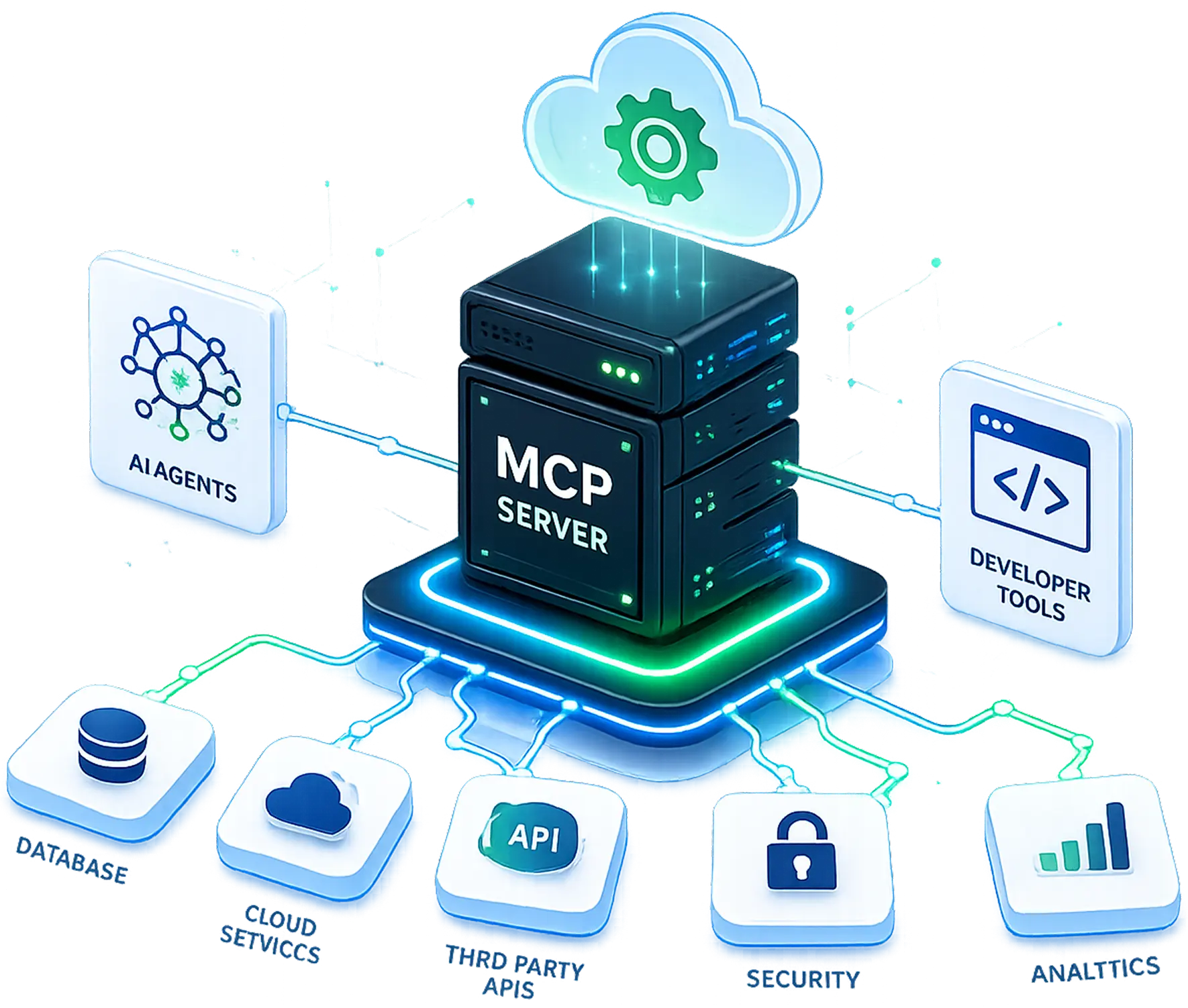
No rebuild required. We build a standardized MCP server that turns your existing APIs into tools AI agents can call—enabling them to read and act. Built once, ready for every future AI client.

Zero Frontend Rebuild

First Movers Win AI Workflows: Companies that build this now embed themselves directly inside their customers' AI habits before it becomes table stakes.

Proven Track Record

Production MCP Servers
Delivered on Time & at Scale

Real-world MCP integrations built over existing REST APIs, complex multi-server setups, and high-security architectures.

Real Estate Platform 2 Months • 640 Hrs

Naavik Real Estate Intelligence

Enabled builders, sales teams, and buyers to query and update live plot, pricing, and booking data directly through AI agents instead of navigating screens. Built over existing REST APIs reusing existing OAuth 2.0 auth—with zero changes to the core platform.

Node.js ModelContextProtocol/sdk OAuth 2.0
Data Aggregation 1 Month • 160 Hrs (Fixed)

PropertyScoop Location Intelligence

Unified six separate government and commercial lookups (EPA water quality, FCC RF, national noise models, storm risks, substation proximity, and satellite orientation) into one JSON-RPC address query with per-tool metered access.

JSON-RPC Claude Desktop Cursor / Windsurf
Travel Intelligence 2 Months • ~158 Hrs

Real-Time Transport Pricing Engine

Answers live transport pricing queries straight inside Claude, Cursor, and VS Code. One MCP server aggregates live data from six transport suppliers under a unified tool set, supporting both local and public deployment modes.

Multi-Supplier Sync VS Code / Cursor Dual Deployment
Enterprise Messaging ~1.5 Months

Multi-Server AI Orchestration Layer

Embedded developer model delivering full ownership of a net-new MCP communication channel. Engineered to match the enterprise platform's strict multi-server conventions and existing authentication model.

Multi-Server Spec Enterprise Auth Embedded Dev
Client Endorsements

What Our Partners Say

"Our platform already had complex business logic and APIs. TechAvidus invested time in understanding how everything worked before implementing the MCP layer. They delivered an AI-ready integration while preserving our existing architecture, validation rules, and security boundaries."
BT

Bhavesh T

Naavik
"TechAvidus demonstrated strong technical expertise in designing and delivering our MCP server. They translated a complex integration challenge into a practical, maintainable solution that aligned with our product vision."
TE

Toby Ehrenkranz

Founder, PropertyScoop
Why TechAvidus

Built for Agent Reasoning,
Not Just Protocol Compliance

The team that scopes your system in week one is the team you talk to in month six.

Long-Term Team Continuity

"The person who scopes your auth model in week one is still the one your team calls in month six."

90%

Employee Retention

105+

Team Members

ISO

9001:2015 Certified

Top

Rated Across Platforms
Engineering Discipline

Designing for How AI Agents Actually Reason

A schema an agent can technically call isn't the same as one it reliably chooses to call. Most MCP implementations stop at protocol compliance—a tool that responds correctly when invoked.

We design tool names, descriptions, and schemas around how Claude, ChatGPT, or Cursor reason about tool selection. A technically valid MCP server that an AI agent rarely selects isn't a working integration—it's a compliance exercise.

Tested Tool Selection

We focus on real-world tool execution accuracy rather than unverified promises.

Zero-Rewrite Track Record

Every engagement to date has shipped without a platform rewrite or new auth system. Delivery timelines run 1 to 2 months per build.

Naavik Real Estate Live tool-calling layer built directly over existing OAuth 2.0 auth.
PropertyScoop Six external data sources unified behind one unified MCP interface.
Multi-Industry Production Proven deployments across Real Estate, PropTech, Travel, and Enterprise Messaging.

Commercial Transparency

Transparent terms and complete ownership, designed for total enterprise peace of mind.

  • Fixed-Scope Build Clear deliverable scope and predictable costs before any work begins.
  • Strict NDA & 100% IP Ownership Your code, auth model, and logic stay confidential. You own all IP from day one.
  • Full Source Code Handover Complete source code is yours upon delivery—no proprietary vendor locks.
  • Optional Post-Delivery Retainer Maintenance and expansion support available when needed, never required.
Who We Serve

Tailored Integration for
Modern Software Platforms

Whether you build developer tooling or manage complex vertical data, we unlock your product's accessibility inside AI agent workflows.

AI-Native SaaS & DevTools

If your product already ships an AI-facing feature but the product itself becomes a dead end the moment a customer leaves your UI for Claude, ChatGPT, or Cursor—this closes that gap.

  • Extend product reach directly into developers' and users' active LLM workspaces.
  • Eliminate context-switching friction between your web UI and external AI clients.
Applied in Practice: Naavik Platform Model

Vertical SaaS & Data/Analytics Platforms

If your platform's real value is the data or capability it exposes—property risk data, messaging infrastructure, or operational systems—an MCP server turns that into something an AI agent can query and act on directly.

  • Turn complex data endpoints into clean, actionable AI tool schemas.
  • Enable direct read and write actions straight from customer agent prompts.
Applied in Practice: PropertyScoop Aggregation
Core Deliverables

End-to-End MCP Engineering
From Architecture to Production

Four foundational pillars engineered to extend your existing APIs into robust, agent-ready tools.

Pillar 01

Architecture Scoping & Tool Design

Deciding exactly what your product exposes to AI agents — designed so an agent actually picks the right tool, not just responds when called.

What's Included:

  • Full review of existing API surface and authentication model.
  • Tool schema design (inputs, outputs, and descriptions) optimized for LLM reasoning rather than a 1:1 mechanical API dump.
  • Read/write operation classification with explicit human confirmation safeguards.
Approach: MCP protocol / JSON-RPC 2.0 tool-calling patterns validated against existing API contracts.
Outcome: A fully documented tool set signed off before a line of server code is written.
Pillar 02

Authentication, Governance & Access Control

Ensuring the MCP layer inherits your platform's existing permission boundaries instead of introducing a weaker, parallel entry point.

What's Included:

  • Reuse of existing credentials (OAuth 2.0/2.1, API keys) with zero parallel auth systems.
  • Role- and plan-scoped tool visibility ensuring agents can't access data a human in that role couldn't see.
  • Complete audit logging on all AI-initiated tool calls and write actions.
Approach: Authenticates on behalf of the calling user and scopes exposed tools to user role/plan (Naavik pattern).
Outcome: Your existing security boundary seamlessly extended to AI agents.
Pillar 03

Multi-System & Multi-Host Integration

One unified AI layer that behaves consistently across all AI clients—even when pulling from multiple complex backends.

What's Included:

  • Unified response schema regardless of how many source systems feed it.
  • Cross-platform validation across Claude Desktop, ChatGPT, Cursor, Copilot Studio, and Windsurf.
  • Graceful degradation and fault tolerance if an upstream system is slow or unavailable.
Approach: Unifies multiple independent providers behind a single JSON-RPC interface (PropertyScoop pattern).
Outcome: One universal AI layer across every connected system—no one-off rebuilds required.
Pillar 04

Testing, Validation & Production Handoff

Validating real-world customer usage against production hosts—delivering a fully maintainable system beyond demo scripts.

What's Included:

  • Tool-call validation using MCP Inspector and live host clients.
  • Input validation and fail-safe error handling on every tool schema.
  • Complete source code, architecture docs, and a 2-week post-launch support window.
Approach: Tool-by-tool testing against the exact host environment your customers operate in.
Outcome: A server your internal team can read, extend, and own—zero black boxes.

Protocol Standards & Architecture Notes

Every build is engineered to the official Model Context Protocol (MCP) specification using JSON-RPC 2.0 as the message format, over stdio or streamable-HTTP transport. Authentication leverages your existing OAuth 2.0/2.1 or API-key infrastructure without introducing parallel credentials.

JSON-RPC 2.0 stdio / streamable-HTTP OAuth 2.0 / 2.1 Claude Desktop ChatGPT Cursor Copilot Studio
Host Compatibility Disclaimer

Built for compatibility across leading AI clients including Claude, ChatGPT, Cursor, and Copilot Studio. Compatible with, not built in partnership with, any third-party AI vendor.

Our Process

How We Work
Five Steps to Production Readiness

A predictable, sign-off-driven engagement engineered for zero disruption to your internal engineering team.

Step 01

Scope What Gets Exposed

You decide which product capabilities become AI-callable and which stay UI-only. We bring the technical read on your API surface; you make the call on scope. Nothing gets exposed without your explicit approval.

Explicit Client Sign-off
Step 02

Review & Approve Tool Design

Before a server exists, you see actual tool names, descriptions, and schemas. This answers "Will Claude pick the right tool?" on paper first—preventing build-phase scope renegotiations later.

Schema Sign-off
Step 03

Build Against Existing Architecture

Zero heavy lifting for your engineering team. The MCP layer is built against your existing APIs and auth. You get working tools to test in staging as they are built—no big-reveal surprises at the end.

Continuous Staging Test
Step 04

Approve Access Model Before Production

Confirm which user roles can reach which tools before anything goes live. Ensures buyer-facing AI agents are strictly locked out of admin and CRM data based on your explicit sign-off, not assumptions.

Security & Permission Review
Final Handoff
Step 05

Launch & Take Full Ownership

Receive full source code, architecture documentation, and a 2-week support window to catch edge cases under real usage. The server is yours to run, extend, or maintain—zero vendor lock-in.

100% Source Code & IP Transfer
Transparent Commercial Model

Pay for What You Build.
Zero Unpredictable Flat Rates.

Scope is engineered around your system's exact complexity, endpoints, and auth rules—predictable costs from day one.

Fixed-Scope Contract

What Drives Your Custom Quote

Billing Mode Scope-Based Build
Tool & System Count

Total connected APIs, internal services, and data providers aggregated into the MCP server.

Auth Layer Depth

OAuth 2.0/2.1 pass-through, API keys, and multi-tier role/plan permissions.

Read vs. Write Capability

State-changing tools that require user confirmation dialogs and transactional safeguards.

Staging & Telemetry

Integration with pre-existing sandbox environments and custom audit log tracking.

Pre-agreed scope on paper before engineering starts No unexpected scope inflations
Speed to Value

Delivery Speed

Fast-track implementation cycles engineered for rapid AI integration.

Single System Build 2 – 4 Weeks
Rapid
Multi-System Build 4 – 8 Weeks
Enterprise
Includes 2-Week Post-Launch Support

Clear Deliverable Boundaries

Complete transparency on exact scope inclusions and available add-ons.

Standard Deliverables
  • Working, host-validated server
  • Full source code & IP handover
  • System architecture & tool docs
  • 2-week post-launch support
Optional Add-Ons
  • Ongoing maintenance retainer (optional post-delivery)
  • AI Integration Discovery Workshop (if scope is undecided)
Ready to Elevate Your Product?

Connect Your Product to AI Workflows

Book a technical scoping call to review your existing APIs and receive a precise fixed-scope proposal.

Proven Track Record

Production-Grade
MCP Implementations

Real-world case studies demonstrating how we transform complex multi-system APIs into seamless, AI-callable infrastructure.

Real Estate / PropTech Flagship Deployment

Naavik Plotter — MCP Agentic Access Layer

Engineered a comprehensive MCP tool-calling layer spanning the platform's core plot management, instant booking engine, CRM, and analytics APIs—allowing AI agents to directly query and execute workflows without altering underlying business rules.

Timeline 2 Months
Engineering 640 Hours
Auth Model OAuth 2.0
Location Intelligence Fixed-Cost

PropertyScoop MCP Server

Unified six independent external data providers behind a single JSON-RPC interface, giving AI clients standard tool syntax regardless of which upstream provider is supplying the data.

6 Unified Data Sources 1 Month Delivery (160 Hrs)
Travel & Transportation Anonymized

Live Travel-Intelligence Platform

Built a standalone production MCP server exposing real-time transport pricing feeds from multiple global suppliers as AI-callable tools—engineered to run seamlessly across both local developer environments and public server deployments.

Local & Public Deployment Modes
2 Months (~158 Hrs)
SaaS / Conversational AI NDA Protected

Enterprise Messaging Platform

Delivered a production MCP server native to a multi-channel enterprise messaging platform. Built strictly adhering to the client's existing architectural patterns, coding conventions, and strict security posture.

Native System Conventions
~1.5 Months

Frequently Asked Questions

Everything you need to know about our MCP server builds and process.

The first week is architecture scoping: we map your existing API surface, confirm which capabilities become AI-callable tools, and document your authentication model. You see the actual tool names and schemas before we write server code — not after. That sign-off is what keeps the rest of the build on schedule.

MCP server builds are fixed-scope engagements — you know the deliverable and the cost before work starts. A single-system build typically runs $8,000–$18,000; a multi-system build runs $18,000–$40,000. A monthly retainer ($2,000–$5,000) is available afterward for maintenance and expansion, but it's optional, not a condition of the build.

The number of systems or tools you're connecting is the biggest driver, followed by authentication complexity and whether tools need write access rather than read-only. A build with an existing staging environment and clear observability requirements also scopes faster than one starting from scratch.

The engineers who scope your architecture in week one are the same ones building and handing off the server at the end — 90% of our engineers stay year over year, so we don't rotate teams mid-engagement. You're not re-explaining your API to a new person halfway through.

Onboarding starts with a technical discovery call covering your existing API surface, auth model, and which capabilities you want AI-agent-accessible. From there we move into tool design, which you review and approve before any server code is written — there's no separate discovery-workshop phase for this service.

They can — plenty of teams do. What we bring is that we've already solved the parts that take longest to get right the first time: designing tool schemas so an agent actually picks the right one, scoping role-based access without weakening your existing auth, and handling multi-host compatibility across Claude, ChatGPT, Cursor, and others. If your team has bandwidth and MCP experience, building in-house is a reasonable call — we're the option when speed matters more than the learning curve.

We commit to a defined scope and milestone schedule, not an outcomes guarantee. You'll know what's being delivered and by when before the engagement starts, and you'll see progress at each milestone rather than a single reveal at the end. What we don't do is promise a fixed date regardless of scope changes discovered mid-build.

No. The build itself is a fixed-scope engagement with a defined start and end. A maintenance retainer is available afterward if you want ongoing support, but it's opt-in — nothing locks you into it as a condition of the initial build.

A schema that technically wraps your API isn't the same as one an AI agent reliably chooses to use. Auto-generated MCP wrappers convert your existing endpoints mechanically, which is fast but often produces tool names and descriptions an agent struggles to select correctly or use safely for write actions. We design the tool layer around how an agent reasons about which tool to call and how your existing permissions should scope it — the free auto-gen route is a reasonable starting point for a prototype, not for something your customers depend on.

Those platforms move data between systems on a schedule or a trigger; MCP exposes your product to an AI agent that decides, in the moment, what to look up or act on based on a conversation. If your customers are asking Claude or ChatGPT to work with your product directly, an iPaaS platform doesn't solve that — it's built for a different problem. The two aren't competing; most of our MCP builds sit alongside an existing integration platform rather than replacing it.

Yes — through our AI Integration Services Discovery & AI Readiness Workshop, not a separate MCP-specific offer. It's a 1–2 week engagement that includes an MCP architecture recommendation as one possible outcome, alongside a broader look at whether MCP, direct API integration, or something else fits your situation. We'd rather tell you MCP isn't the right call than sell you architecture you don't need.
Claude ChatGPT Cursor

Ready to make your product reachable from
Claude, ChatGPT, and Cursor?

We'll scope it against your existing architecture before you commit to anything.

We'll show you exactly which part of your product connects first, what the build actually takes, and what stays out of scope.