Key Takeaways
- 1. Open-source MCP servers can accelerate development when an existing implementation meets your technical and security requirements.
- 2. Custom MCP servers offer greater control over business-specific workflows, integrations, and access rules.
- 3. Both approaches require security reviews, testing, documentation, and ongoing maintenance
- 4. A hybrid approach can combine reusable open-source components with custom business logic.
- 5. The best choice depends on functional fit, maintainability, risk, and long-term product goals.
Introduction
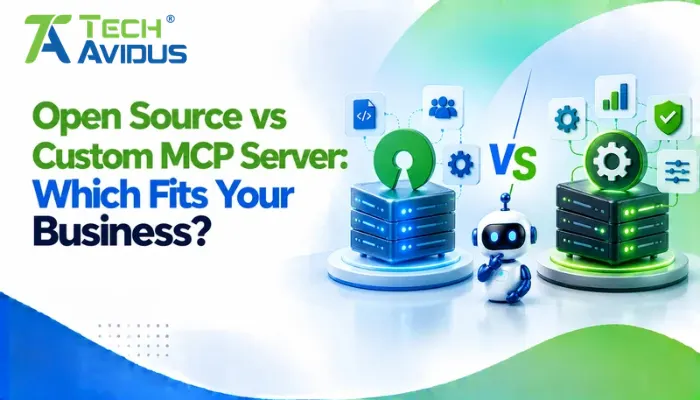
Choosing between an open-source and a custom MCP server depends on your business requirements, existing systems, security needs, and long-term maintenance capacity. An open-source solution may provide a useful starting point when an existing implementation meets your needs, while a custom server offers greater control over specialized workflows and integrations.
The Model Context Protocol (MCP) provides a standardized way for compatible AI applications to interact with external tools and contextual information. Before choosing an implementation approach, businesses should assess what they need to connect, how sensitive their data is, and who will maintain the integration after deployment.
What Is the Difference Between Open-Source and Custom MCP Servers?
An open-source MCP server uses publicly available source code that can be inspected and, subject to its license, adapted. A custom MCP server is developed or substantially tailored to meet a specific business’s requirements.
Open-source MCP server
An open-source implementation can help teams get started without building every component from scratch. It may already support common integrations, tools, or workflows, reducing duplicated engineering work when it fits the intended use case.
However, publicly available code is not automatically secure, actively maintained, or suitable for production. Teams still need to check its license, dependencies, release history, documentation, and compatibility with their target AI clients.
Custom MCP server
A custom server is designed around a defined set of business workflows, systems, and operational requirements. This can be useful when the product needs specialized permissions, proprietary business logic, or integration behavior that existing implementations do not support.
The trade-off is additional responsibility for architecture, development, testing, documentation, and maintenance. A custom solution should have a clear reason to exist rather than duplicating functionality that a reliable existing implementation already provides.
The official Model Context Protocol documentation is a useful starting point for understanding the protocol and evaluating implementations against the relevant specification.
When Should You Choose an Open-Source MCP Server?
An open-source server is often the better starting point when its capabilities match your requirements and your team can maintain it responsibly. It is especially useful for validating an idea before investing in a more specialized implementation.
Consider this approach when:
- Your use case is standard: You need a common integration and an existing server already supports the required functionality. Validate its behavior with your actual data sources and target AI clients before adopting it.
- You want to reuse existing code: Your developers can review the implementation, adapt permitted components, and maintain the resulting solution. Check the license and third-party dependencies before modifying or redistributing code.
- You are testing a new workflow: A suitable existing implementation may help you validate whether AI-enabled access solves a real business problem. Keep the initial deployment limited until security and reliability have been verified.
When Is a Custom MCP Server the Better Choice?
A custom implementation is appropriate when business requirements cannot be met safely or reliably with an existing server. It allows the team to design the interface around specific workflows, permissions, and system architecture.
Consider custom development when:
- Your workflows are specialized: You need to connect proprietary systems or expose business functions that available implementations do not support. Custom tools can be designed around your actual processes and validation rules.
- You need tighter control over access: Your application has specific authorization, audit, or tenant-isolation requirements. These controls still need careful engineering and testing; custom code alone does not guarantee better security.
- You need product-specific behavior: Your SaaS platform must expose selected capabilities consistently to supported AI clients. A purpose-built server can provide an interface tailored to your product’s data model and operational constraints.
How Do Security, Maintenance, and Integration Affect the Decision?
Security and maintainability should be evaluated for both approaches, not treated as automatic advantages of either one. An open-source server may have a useful track record but still require patches and configuration changes; a custom server may fit your needs closely but create a new maintenance obligation.
Evaluate the following areas:
- Security and permissions: Check authentication, authorization, input validation, secrets management, and access to sensitive data. Ensure the implementation follows the security requirements of the systems it connects to.
- Integration compatibility: Confirm that the server supports the required APIs, data formats, and target clients. Existing API documentation and a working test environment can help uncover incompatibilities early.
- Maintenance and ownership: Review who will handle security updates, dependency changes, bug fixes, and compatibility testing. Open-source code still needs an owner, while custom development requires a clear support plan.
- Licensing and governance: Review the license and any organizational restrictions before adopting or modifying an open-source project. For either approach, document dependencies, deployment settings, and release procedures.
Advantages and Limitations of Each Approach
Neither approach is universally better; the right option depends on how closely the implementation matches the requirements and what your team can support over time.
Open-source approach
- Advantages: Reusing an existing implementation can reduce duplicated work and give developers a starting point for experimentation. Public code can also make it easier to inspect how the integration works.
- Limitations: Functionality may not match your requirements, and maintenance activity can vary by project. You may need to adapt the code, replace dependencies, or build missing safeguards before production use.
Custom approach
- Advantages: The server can be shaped around your business logic, access policies, and integration requirements. This can provide a clearer fit for complex or product-specific workflows.
- Limitations: Your team takes on more responsibility for development and long-term upkeep. Without disciplined documentation and testing, the solution can become difficult to maintain as requirements evolve.

Practical Example: Building an AI Integration for a B2B Platform
Imagine a B2B software company wants an AI assistant to retrieve customer account information and prepare support-ticket drafts. The team finds an open-source server that handles basic data retrieval but does not support the company’s permission rules or ticket workflow.
Rather than replacing everything immediately, the team could assess whether the existing code can be safely extended. If the gaps are manageable, a hybrid approach may reuse the working components and add custom tools for business-specific actions.
If the existing implementation is incompatible with the platform’s architecture or security requirements, building a custom server may be more maintainable. In either case, the team should test authorization, invalid inputs, error handling, and tenant isolation before production deployment.
Best Practices for Choosing the Right Approach
Make the decision through a structured technical assessment rather than assuming that open source is always faster or custom development is always more secure.
- Define the business use case first: Identify which data or actions the AI application needs to access. A narrow, well-defined workflow makes it easier to compare existing implementations against actual requirements.
- Evaluate the available code: Review functionality, license terms, dependencies, documentation, and maintenance activity. Test the implementation with your target environment instead of relying only on its feature list.
- Compare integration options: When considering mcp vs api, determine whether you need an AI-facing interface or simply a conventional connection between systems. MCP can complement existing APIs rather than replace them.
- Plan for production requirements: Document authentication, permissions, monitoring, deployment, and maintenance responsibilities. A prototype that works locally may still need significant work before it is production-ready.
- Measure practical value: Assess whether the implementation solves the intended problem and can be operated reliably. The benefits of model context protocol are most relevant when standardized AI access improves a real workflow.
Recap: Open Source or Custom?
An open-source MCP server is a strong candidate when an existing implementation meets your functional, security, and licensing requirements. A custom MCP server is worth considering when business-specific workflows, integrations, or access controls cannot be supported effectively by available code.
A hybrid approach can also work when reusable components provide a sound foundation but additional capabilities are required. The best choice is the one that meets your requirements and can be maintained responsibly over time. If your business needs a tailored, secure, and scalable integration, explore our MCP Server Development service to find the right solution for your requirements.
Conclusion
Choosing between open-source and custom development starts with understanding your requirements, existing systems, and capacity for ongoing maintenance. Reuse existing code when it meets your needs; build custom functionality when there is a clear technical or business reason.
Need help selecting the right approach? Techavidus can help assess your requirements and plan a practical MCP implementation.
.jpg "Savan Surani")
Savan Surani
Savan Surani is an expert in MCP (Model Context Protocol) Server Development, specializing in building secure, scalable, and efficient solutions that connect AI models with external tools, APIs, and data sources. He focuses on developing custom MCP servers, streamlining AI integrations, and enabling seamless communication between AI applications and business systems. With a strong focus on automation, system interoperability, and reliable architecture, Savan helps businesses build intelligent, connected, and scalable AI-powered solutions.