Key Takeaways
- 1. Fixed-scope MCP projects work best when requirements, deliverables, and exclusions are clearly documented.
- 2. Project timelines depend on integration complexity, API readiness, security requirements, and testing needs.
- 3. Clear acceptance criteria help teams measure project completion and avoid misunderstandings.
- 4. A defined change-control process helps manage new requirements without disrupting project expectations.
- 5. A discovery phase helps identify technical risks and validate assumptions before finalizing the scope and delivery plan.
Introduction
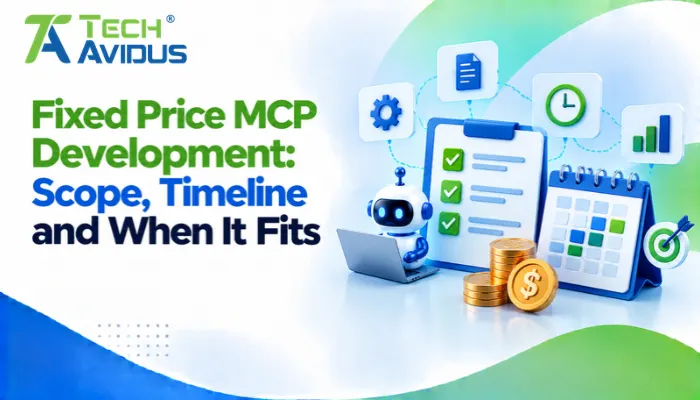
Fixed price MCP development is a project approach in which the deliverables, scope, milestones, and acceptance criteria are agreed upon before development begins. It can work well for businesses that need a clearly defined Model Context Protocol (MCP) server or integration and want greater predictability around project delivery.
However, a fixed-price model is only as reliable as the scope behind it. If requirements are uncertain, existing systems are poorly documented, or security needs keep changing, the project may require formal change requests or a different engagement model.
The key is to define what will be built, what is excluded, how success will be tested, and how changes will be handled before development starts.
What Does Fixed Price MCP Development Include?
A fixed-price MCP project defines a specific technical outcome for an agreed scope of work. Rather than charging for an open-ended development effort, the project is organized around documented deliverables and acceptance criteria.
Depending on the requirements, a scope may include:
- MCP server implementation: Developing a server that exposes selected tools, resources, or prompts to compatible AI clients. The scope should identify which capabilities are included and which remain outside the initial release.
- Integration with existing systems: Connecting the server to approved APIs, databases, or business applications. Responsibilities for API access, test environments, credentials, and third-party dependencies should be agreed upon in advance.
- Security and validation: Implementing appropriate authentication, authorization, input validation, and access restrictions. The project should specify which security controls and tests are included.
- Testing and handover: Verifying expected behavior, documenting setup, and providing agreed deployment or handover support. Production monitoring and ongoing maintenance should be defined separately if they are not included.
The goal is to make the deliverable measurable, not simply to describe it as “an MCP integration.”
.webp)
How Is the Project Scope and Timeline Defined?
The timeline for a fixed-scope MCP project depends on the number of capabilities, integration readiness, security requirements, and depth of testing. A small prototype connected to one well-documented API has different needs from a production integration involving several systems and sensitive business data.
What should the scope document cover?
A practical scope document should answer four questions before development begins:
- What will be delivered? List the MCP tools, resources, integrations, deployment environment, and documentation included in the project. Avoid vague outcomes such as “make the application AI-ready” without defining the expected functionality.
- How will completion be verified? Define acceptance criteria, supported client environments, expected responses, and error-handling behavior. These criteria give both parties a shared basis for reviewing the finished work.
- What dependencies exist? Identify API documentation, access credentials, sample data, infrastructure, and client-side requirements. Delays in third-party access can affect delivery even when the development work is clearly scoped.
- How will changes be managed? Establish a process for reviewing new features, changing requirements, and unexpected technical constraints. Any change that affects scope or delivery expectations should be documented and approved.
What affects the delivery timeline?
The most common factors are the readiness of existing APIs, complexity of business logic, authentication requirements, deployment setup, and testing coverage. Teams should assess these factors during discovery rather than committing to a schedule based only on the number of tools being developed.
The official Model Context Protocol server specification provides a useful technical reference for defining server capabilities and understanding how tools, resources, and prompts are exposed. Reviewing the requirements against the specification helps teams identify implementation work before finalizing scope.
When Does Fixed Price MCP Development Make Sense?
A fixed-price engagement is usually a good fit when the business objective is clear, technical dependencies are understood, and the deliverables can be tested against agreed criteria.
It may fit well when:
- Building a focused proof of concept: You want to expose a small set of existing application functions to a compatible AI client. A limited scope helps validate feasibility before committing to a wider rollout.
- Adding a defined integration to an existing product: The APIs and business rules are documented, access is available, and the team knows which workflows must be supported. These conditions make planning and acceptance testing more straightforward.
- Delivering a specific internal workflow: The business needs a defined outcome, such as retrieving approved records or generating a report through an AI assistant. Clear boundaries make it easier to distinguish the initial deliverable from future enhancements.
It may be less suitable when:
- Requirements are still evolving: If the team is unsure which AI workflows customers need, a discovery or iterative development phase may be more appropriate before committing to a fixed scope.
- Legacy systems are poorly understood: Undocumented APIs, inconsistent data, or unavailable test environments can introduce uncertainty that is difficult to estimate accurately.
- The product requires continuous experimentation: If tools, workflows, and integration requirements will change frequently, a flexible engagement model may handle those changes more effectively.
A Practical Example: Scoping an MCP Server Project
Imagine a B2B software company wants an AI assistant to retrieve account information and create support-ticket drafts from its existing platform.
The project team could begin by confirming API access, defining the supported operations, and documenting which customer records each user may access. The initial scope might cover read-only account lookup, draft creation, validation, and a defined set of acceptance tests.
During discovery, the team may also find that creating tickets requires additional permission checks or approval steps. Identifying these requirements early makes the scope more realistic and reduces the likelihood of unexpected changes during implementation.
This is also where MCP Server Development for Enterprise may require additional planning: multi-tenant access, audit requirements, deployment controls, and integration with enterprise identity systems can significantly affect the work involved.
.webp)
How Should Businesses Evaluate MCP Integration Requirements?
Businesses should evaluate technical readiness, scope uncertainty, security obligations, and long-term maintenance before choosing a project model. A useful planning process includes the following steps:
- Run a discovery assessment: Review existing APIs, system architecture, target AI clients, and the workflows the integration must support. Record assumptions and unresolved questions before committing to deliverables.
- Separate initial scope from future enhancements: Identify the minimum useful release and document optional features separately. This prevents a focused implementation from quietly expanding into a larger product initiative.
- Consider the complete implementation effort: When assessing mcp integration cost, consider development, testing, infrastructure, security, deployment, and maintenance requirements together. Avoid evaluating the project solely by the number of tools or endpoints.
- Compare MCP with alternatives: In a mcp vs api assessment, consider whether the goal is AI-client interoperability or simply a conventional connection between two systems. MCP may complement existing APIs, but it is not automatically necessary for every integration.
- Agree on handover and support: Define who will maintain the server, address compatibility updates, monitor failures, and manage future changes. These responsibilities should be clear even when ongoing support is outside the initial project scope.
Recap: Is a Fixed-Scope MCP Project Right for You?
Fixed-price MCP development works best when the deliverables, technical dependencies, and acceptance criteria can be defined before implementation. A focused scope, realistic timeline, and documented change process help establish shared expectations.
When requirements are uncertain or systems are poorly documented, discovery and technical validation should come first. Choose the engagement model that matches the project’s level of uncertainty, rather than forcing every MCP initiative into the same delivery structure.
Conclusion
A well-planned fixed-scope MCP project starts with clear deliverables, verified dependencies, and measurable acceptance criteria. Before development begins, validate the use case, assess integration risks, and define how changes will be managed.
Need help planning your MCP project? Techavidus can help assess your requirements and identify a practical implementation approach.
.jpg "Savan Surani")
Savan Surani
Savan Surani is an expert in MCP (Model Context Protocol) Server Development, specializing in building secure, scalable, and efficient solutions that connect AI models with external tools, APIs, and data sources. He focuses on developing custom MCP servers, streamlining AI integrations, and enabling seamless communication between AI applications and business systems. With a strong focus on automation, system interoperability, and reliable architecture, Savan helps businesses build intelligent, connected, and scalable AI-powered solutions.