Key Takeaways
- 1. A full-service MCP partner can support planning, architecture, development, testing, deployment, and maintenance.
- 2. The right implementation begins with business workflows and existing system requirements.
- 3. Security, access control, and integration testing should be built into the project from the start.
- 4. Clear deliverables, documentation, and support responsibilities help prepare an MCP solution for production.
- 5. The best partner explains technical trade-offs clearly and aligns development with measurable business goals.
Introduction
Choosing an MCP development agency is about more than getting an MCP server built. Businesses need a technical partner who can understand their workflows, connect existing systems, implement security controls, and prepare the integration for reliable use.
The Model Context Protocol (MCP) provides a standardized way for compatible AI applications to interact with tools and contextual information exposed by external systems. Implementing it successfully requires product planning, backend development, testing, deployment, and ongoing technical support.
A full-service development partner helps coordinate these activities so the solution addresses a real business need rather than becoming another disconnected technology project.
What Does an MCP Development Partner Actually Deliver?
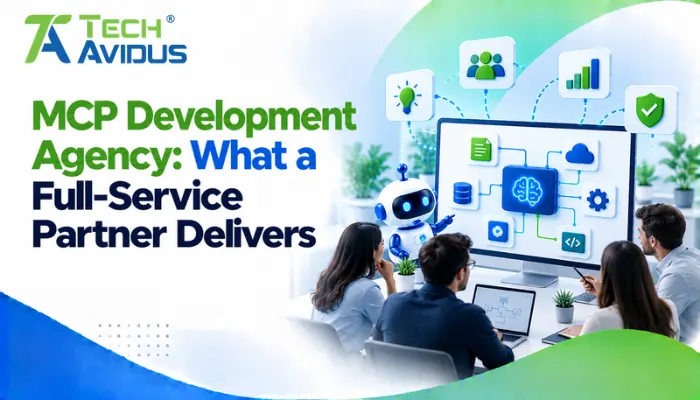
A full-service MCP development partner manages the technical work required to connect AI applications with selected business capabilities. The exact deliverables depend on the use case, existing architecture, and production requirements.
1. Discovery and technical planning
The process begins by identifying which business workflows would benefit from AI access. A partner should assess current APIs, data sources, user permissions, target AI clients, and integration constraints before recommending an implementation.
This stage should produce a defined scope, architecture recommendations, technical assumptions, and acceptance criteria. It also helps determine whether MCP is appropriate or whether a conventional API integration would meet the requirement more simply.
2. MCP server architecture and development
The development team builds the server that exposes approved capabilities to compatible AI clients. This can involve defining tools, resources, prompts, input schemas, error handling, and connections to existing backend services.
For example, a customer support platform might expose a tool to retrieve a permitted ticket record and another to prepare a draft response. The implementation should preserve existing business rules rather than allowing AI requests to bypass them.
3. Integration with existing systems
An MCP server often works alongside existing APIs, databases, CRMs, analytics platforms, or internal services. A development partner maps the required workflows and ensures that requests are validated before they reach those systems.
The team should also address API failures, incomplete data, rate limits, and dependency management. These details matter because a technically functional server can still create a poor user experience if it cannot handle ordinary operational problems.
4. Security and access management
Security must be part of the architecture, not a final checklist item. The implementation should apply appropriate authentication, authorization, input validation, tenant isolation, and audit logging based on the sensitivity of the connected systems.
The official Model Context Protocol security best practices provide a useful reference for identifying protocol-specific risks. A development partner should translate applicable guidance into practical controls for the actual deployment environment.
What Happens During Testing and Deployment?
Testing confirms that the server behaves as expected, respects permissions, and handles failures safely before it is released. Deployment then makes the integration available in the intended environment with suitable monitoring and operational controls.
A capable partner should cover several testing areas:
- Functional testing: Verify that each tool accepts valid inputs, returns expected outputs, and handles invalid requests appropriately. Confirm that resources and prompts behave as documented.
- Security testing: Check authorization boundaries, unauthorized access attempts, sensitive data exposure, and tenant isolation where applicable. High-impact actions should have appropriate safeguards.
- Compatibility testing: Test with the AI clients and environments the business intends to support. Compatibility should be verified rather than assumed simply because both systems use MCP.
- Deployment and monitoring: Configure the required environment, logging, error reporting, and operational procedures. Document how the team will investigate failures and roll out future updates.
The handover should include setup instructions, configuration details, known limitations, and maintenance responsibilities. This gives internal teams a practical foundation for operating the solution after launch.
How Do You Choose the Right MCP Development Partner?
The right partner combines relevant technical experience with clear communication, practical security knowledge, and a structured delivery process. Evaluate the quality of its approach, not just its ability to demonstrate a working prototype.
Look for these qualities:
- Relevant integration experience: Ask how the team approaches APIs, backend systems, AI applications, and protocol-based integrations. Request examples of similar technical challenges, while respecting client confidentiality.
- A transparent delivery process: The partner should explain discovery, milestones, testing, acceptance criteria, dependencies, and change management. Clear documentation helps prevent mismatched expectations.
- Security-first engineering: Ask how permissions, credentials, sensitive data, logging, and production access will be handled. The answers should be specific to your systems rather than generic assurances.
- Maintainability and support: Confirm who will handle updates, compatibility issues, incident investigation, and future enhancements. A production integration needs a maintenance plan, not just a successful initial release.
- Business-focused recommendations: A good partner explains why a particular approach fits the use case and identifies unnecessary complexity. The objective is to solve a business problem, not to add technology without a clear purpose.
Advantages and Limitations of Full-Service MCP Development
A full-service approach can coordinate multiple technical workstreams, but it still requires clear ownership and realistic expectations from both sides.
Advantages
- One coordinated delivery process: Planning, development, testing, and deployment can follow a shared scope and set of acceptance criteria. This reduces the risk of gaps between separate technical teams.
- Better alignment between architecture and business needs: A partner can evaluate workflows and integrations before selecting an implementation approach. This helps keep the project focused on useful capabilities rather than unnecessary features.
Limitations
- External expertise still requires internal involvement: Your team must provide domain knowledge, access to relevant systems, and timely decisions. Without these inputs, even a capable partner may struggle to validate requirements.
- Ongoing ownership remains important: Third-party systems, AI clients, and business requirements can change after launch. The business needs an agreed plan for maintenance, security updates, and future development.
A Practical Example: Connecting a CRM to an AI Assistant
Imagine a B2B company wants its sales team to ask an AI assistant for account summaries and prepare follow-up notes using information stored in its CRM.
A development partner could first map the sales workflow and identify the records each user is allowed to access. The team would then implement a small set of tools, connect them to existing CRM services, and test the results against real-world scenarios using appropriately protected test data.
Before launch, the partner would verify access restrictions, error handling, and the behavior of supported AI clients. The team could begin with read-only account summaries and add actions such as drafting follow-up notes only after the initial workflow has been validated.
This staged approach makes it easier to identify technical gaps early and gives the business a clear basis for deciding what to build next.

Best Practices for a Successful MCP Project
Businesses can improve delivery outcomes by defining the use case, validating technical assumptions, and agreeing on ownership before development starts.
- Start with one valuable workflow: Identify a task that customers or employees already perform and determine whether AI access would make it easier. A focused pilot is often more useful than exposing every product feature immediately.
- Evaluate the integration approach: During an mcp vs api assessment, consider whether the requirement calls for AI-client interoperability or a straightforward system-to-system connection. MCP can complement existing APIs rather than replace them.
- Clarify scope and delivery expectations: Document the features, integrations, exclusions, testing requirements, and handover deliverables. For projects using fixed price mcp development, ensure the acceptance criteria and process for handling changes are agreed upon in advance.
- Plan for long-term operations: Include monitoring, security reviews, compatibility checks, and maintenance in the project plan. When evaluating mcp integration cost, consider the effort required after launch as well as the initial implementation.
- Keep business and technical teams involved: Make sure stakeholders can validate workflows, review outputs, and approve important decisions. Their feedback helps ensure the implementation remains useful in everyday operations.
Recap: What Should a Full-Service MCP Partner Provide?
A full-service MCP development partner helps businesses plan, build, test, secure, deploy, and maintain integrations between compatible AI applications and business systems.
The engagement should begin with a defined business use case and a review of existing architecture. Successful delivery also requires appropriate access controls, clear acceptance criteria, useful documentation, and a plan for ongoing maintenance.
Choose a partner who can explain the technical decisions, identify risks early, and connect each deliverable to a practical business objective. For businesses looking to build secure, reliable integrations tailored to their AI workflows, explore our MCP Server Development service.
Conclusion
The right MCP development partner helps turn an AI integration idea into a well-defined, secure, and maintainable implementation. Start by identifying a meaningful workflow, reviewing your existing systems, and setting clear expectations for delivery and ongoing support.
Need expert guidance for your MCP project? Techavidus can help you evaluate your requirements and plan the next steps.
.jpg "Savan Surani")
Savan Surani
Savan Surani is an expert in MCP (Model Context Protocol) Server Development, specializing in building secure, scalable, and efficient solutions that connect AI models with external tools, APIs, and data sources. He focuses on developing custom MCP servers, streamlining AI integrations, and enabling seamless communication between AI applications and business systems. With a strong focus on automation, system interoperability, and reliable architecture, Savan helps businesses build intelligent, connected, and scalable AI-powered solutions.