Key Takeaways
- 1. MCP readiness depends on your systems, data quality, security, and business workflows.
- 2. An assessment identifies which applications and processes are suitable for AI integration.
- 3. Authentication, authorization, and data governance should be reviewed before exposing business capabilities.
- 4. A limited pilot can help validate technical feasibility and business value before wider implementation.
- 5. A clear roadmap helps prioritize integration work and prepare teams for ongoing support.
Introduction
Businesses exploring AI agents and connected applications need more than a compatible technology stack. They also need accessible data, reliable systems, appropriate security controls, and clearly defined workflows. An MCP readiness assessment helps determine whether a business is prepared to adopt the Model Context Protocol (MCP) and connect its systems with compatible AI applications.
For SaaS companies and growing businesses, this assessment identifies practical integration opportunities, technical gaps, and operational risks before development begins. It also helps teams decide where to start, what needs improvement, and how to approach implementation in manageable stages.
What Is an MCP Readiness Assessment?
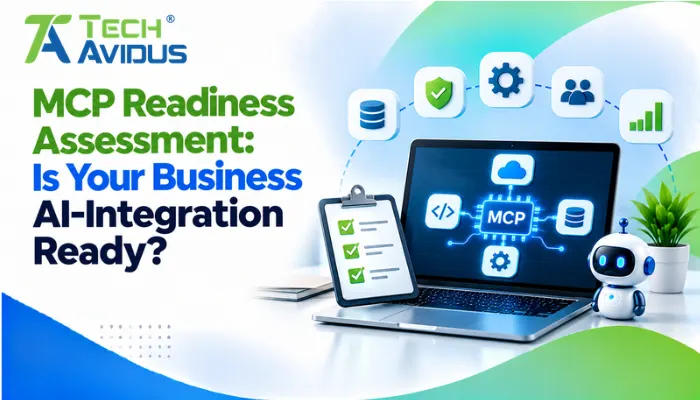
An MCP readiness assessment is a structured evaluation of a business's technical infrastructure, data, security, and workflows to determine whether it is prepared to integrate with AI applications through the Model Context Protocol.
MCP provides a standardized way for compatible AI applications to connect with external tools and contextual information. However, adopting it successfully requires more than setting up an MCP server.
A practical assessment examines:
- Existing APIs and application architecture.
- Data accessibility, quality, and structure.
- Authentication and permission controls.
- Potential AI-assisted business workflows.
- Technical ownership, maintenance, and monitoring requirements.
The outcome should be a clear view of what is ready, what needs improvement, and which integration opportunities should be prioritized.
Why Does Your Business Need an MCP Readiness Assessment?
An assessment helps businesses avoid starting development before understanding their actual integration requirements.
Without preparation, teams may expose unsuitable endpoints, overlook permission issues, or invest in workflows that do not solve meaningful customer problems.
A readiness review helps organizations:
- Identify suitable AI use cases: Find processes where AI assistants can retrieve information or perform approved actions. Prioritize workflows based on business value, feasibility, and risk.
- Evaluate existing infrastructure: Understand whether current APIs, databases, and applications can support the planned integration. Identify dependencies that may need changes.
- Reduce security risks: Review how sensitive information is accessed, processed, and protected. Establish appropriate boundaries before connecting AI applications to business systems.
- Create an implementation roadmap: Translate assessment findings into clear technical and operational priorities. This makes development planning more structured and measurable.
What Should an MCP Readiness Assessment Evaluate?
A useful assessment examines five connected areas: business objectives, technical infrastructure, data readiness, security, and operational capacity.
1. Business goals and AI use cases
Start by identifying what the business wants AI integration to accomplish. Possible use cases include customer-support assistance, internal knowledge search, sales operations, reporting, and task automation.
For MCP for business owners, the important question is not simply whether the technology can be implemented. It is whether connecting an AI application to a particular workflow will solve a real business problem.
2. Existing systems and API readiness
Review the applications that may need to connect with AI tools, including CRMs, ERP platforms, databases, internal dashboards, and SaaS products.
Check whether these systems provide documented APIs, stable endpoints, consistent response formats, and suitable authentication. Legacy applications may need an integration layer or backend improvements before they can support a reliable MCP implementation.
3. Data quality and accessibility
AI integrations depend on the quality and accessibility of the information they retrieve. Review whether business data is accurate, structured, current, and available to the right users.
Also identify sensitive information, duplicate records, inconsistent formats, and data sources that should not be exposed. Data governance should define what can be accessed, by whom, and under which conditions.
4. Security, privacy, and permissions
Security readiness means understanding how an AI application will authenticate, access data, and perform actions on behalf of users.
Review identity management, role-based access control, credential storage, audit logging, and approval requirements for sensitive operations. The NSA's security considerations for MCP-based AI automation highlight why organizations should evaluate security across the complete AI integration environment, not only the server itself.
5. Team capabilities and operational ownership
An MCP implementation needs people responsible for development, security, deployment, and ongoing support.
Determine whether internal teams can manage server hosting, integration testing, incident response, and updates. If external support is needed, define technical ownership and access responsibilities before development begins.
How Do You Assess Technical Readiness for MCP?
Technical readiness is the ability of existing systems to support secure, reliable communication with compatible AI applications.
A practical review should examine:
- API availability: Confirm that important business operations can be accessed through documented and maintainable interfaces. Identify missing endpoints and outdated integrations that may need attention.
- Integration architecture: Decide whether systems need a new MCP server, an existing integration layer, or separate servers for different business functions. Avoid exposing unrelated capabilities through one broad interface.
- MCP capability planning: Identify which tools, resources, and prompts would be useful for each workflow. Define the purpose, inputs, expected outputs, and permissions for every exposed capability.
- Deployment and scalability: Review hosting environments, network access, monitoring, logging, and expected usage. A local prototype and a remote production service may have different infrastructure requirements.
The official MCP architecture documentation explains the host-client-server model and the roles of tools, resources, prompts, and transport. It provides a useful technical foundation for this review.
What Are the Benefits and Limitations of an MCP Readiness Assessment?
An assessment helps businesses make informed implementation decisions, but it cannot remove every technical or operational risk.
Benefits
- Clearer project priorities: Teams can identify high-value use cases and focus development on workflows with practical benefits. This avoids starting with broad integrations that are difficult to validate.
- Early identification of gaps: Reviewing APIs, data, and security before development helps uncover missing capabilities and permission issues. Teams can address these problems before they affect production.
- Better implementation planning: An assessment provides a foundation for architecture decisions, pilot scope, testing requirements, and support responsibilities. It helps align technical work with business objectives.
Limitations
- Readiness can change: Applications, APIs, business requirements, and security policies evolve. Assessment findings should be reviewed again when significant changes occur.
- Some improvements require additional work: Legacy systems, inconsistent data, or weak access controls may need remediation before integration. A readiness report identifies these issues but does not automatically resolve them.
- Technical readiness does not guarantee adoption: Even a well-built integration may not be useful if employees or customers do not need the workflow. User feedback and pilot results remain important.
Practical Example: Assessing a SaaS Company's MCP Readiness
Consider a B2B SaaS company that wants customers to retrieve project information and create tasks through an AI assistant.
Before development, the team conducts a readiness review and discovers:
- Its project management API already supports task retrieval and creation, but some endpoints lack consistent documentation.
- Customer data is accessible, but permissions are not consistently enforced across all API operations.
- The company has no defined process for monitoring AI-triggered actions.
- Its product team has identified two workflows suitable for an initial pilot.
Based on these findings, the team documents the required API improvements, defines user-level permissions, and selects read-only project search as the first pilot.
This staged approach validates the integration before introducing actions such as task creation or project updates.

Best Practices for an Effective MCP Readiness Assessment
A readiness assessment should produce actionable recommendations, not just a technical checklist.
- Start with business priorities. Select workflows based on user needs, business value, and implementation feasibility. Avoid adopting MCP simply because it is a new technology.
- Assess one application at a time. Review APIs, data access, dependencies, and security requirements for each system. This makes technical gaps easier to identify and resolve.
- Define permission boundaries early. Separate read-only capabilities from operations that create, update, or delete information. Establish approval requirements for sensitive actions.
- Document integration requirements. Record expected workflows, system dependencies, data sources, authentication methods, and testing criteria. This gives developers a clear implementation reference.
- Run a limited pilot. Test one or two meaningful workflows with representative users and realistic data. Evaluate reliability, access controls, user experience, and task completion before expanding.
- Plan for governance and maintenance. Assign responsibility for monitoring, updates, incident handling, and security reviews. Include these requirements in the implementation roadmap.
For businesses exploring an MCP server for B2B companies, these practices are particularly useful when multiple customers, user roles, and business systems need controlled access.
Recap: Is Your Business Ready for MCP?
MCP readiness depends on the quality of your existing systems, data accessibility, security controls, and business use cases.
An assessment identifies integration opportunities, technical gaps, permission requirements, and operational responsibilities before development begins.
Starting with a limited pilot helps validate the approach before broader adoption. A practical roadmap then guides development, testing, deployment, and ongoing maintenance. If your business is ready to turn MCP opportunities into practical AI integrations, explore our MCP Server Development service to build a solution aligned with your technical requirements and business goals.
Conclusion
Adopting MCP successfully starts with understanding whether your business is technically and operationally prepared. Reviewing existing systems, data quality, security, and workflow requirements helps prevent avoidable integration challenges.
Techavidus helps businesses evaluate their integration requirements, identify practical AI opportunities, and plan secure MCP implementations aligned with their goals.
.jpg "Savan Surani")
Savan Surani
Savan Surani is an expert in MCP (Model Context Protocol) Server Development, specializing in building secure, scalable, and efficient solutions that connect AI models with external tools, APIs, and data sources. He focuses on developing custom MCP servers, streamlining AI integrations, and enabling seamless communication between AI applications and business systems. With a strong focus on automation, system interoperability, and reliable architecture, Savan helps businesses build intelligent, connected, and scalable AI-powered solutions.