Key Takeaways
- 1. Repetitive manual work can indicate opportunities for intelligent automation.
- 2. AI can help businesses improve customer support and operational efficiency.
- 3. Disconnected systems and data make AI adoption more challenging.
- 4. A structured implementation strategy helps businesses measure meaningful results.
- 5. AI solutions should align with business objectives, security requirements, and long-term growth.
Introduction
As businesses grow, managing daily operations, customer communication, data, and repetitive tasks becomes increasingly challenging. Traditional workflows that once worked efficiently may start slowing down productivity, increasing manual effort, and creating operational bottlenecks. This is where artificial intelligence (AI) can make a meaningful difference.
Recognizing the signs your business needs AI integration can help you identify opportunities to improve efficiency, make smarter decisions, and build scalable business processes. From automating repetitive activities to improving customer experiences, AI can support different departments when implemented with the right strategy.
However, adopting AI is not simply about following a technology trend. It is about understanding your business challenges and identifying where intelligent automation can deliver practical value.
Your Team Spends Too Much Time on Repetitive Tasks
When employees spend more time completing repetitive administrative activities than focusing on meaningful work, it may be time to consider automation.
Tasks such as data entry, invoice processing, appointment scheduling, report generation, and email categorization can consume valuable working hours. AI-powered automation can reduce repetitive effort and allow employees to concentrate on customer relationships, planning, and business development.
For example, an AI-powered document processing system can extract information from invoices, organize records, and send relevant information to an accounting workflow. Employees can then review exceptions instead of manually entering every detail.
Businesses can start by identifying high-volume, rule-based processes and gradually introducing automation where it makes operational sense.
Your Customer Support Team Struggles to Handle Growing Queries
Customer expectations continue to evolve, and people increasingly expect quick, relevant responses across different communication channels.
If your support team struggles with growing customer queries, delayed responses, or repetitive questions, intelligent customer support tools may help. AI chatbots and virtual assistants can answer common questions, guide customers through basic processes, and route complex requests to human agents.
For instance, an eCommerce business can use an AI assistant to respond to questions about order status, product availability, delivery information, and return policies.
The goal is not to replace human support but to make customer service more responsive while allowing employees to handle conversations that require personal attention.
Your Business Data Is Not Helping You Make Better Decisions
Businesses generate information through sales platforms, CRM systems, marketing campaigns, websites, and customer interactions. However, collecting data does not automatically create useful business insights.
AI-powered analytics can help identify patterns, recognize customer behavior, forecast demand, and support data-driven planning. Instead of depending entirely on manual reports, decision-makers can use intelligent systems to understand business performance more effectively.
For example, a retail company can analyze historical sales, seasonal demand, and inventory information to identify products that may require additional stock.
These AI Integration Examples demonstrate how businesses can turn existing information into practical insights rather than treating data as disconnected records.
Your Existing Software Systems Do Not Work Well Together
Disconnected business applications can create unnecessary manual work, duplicate information, and communication gaps between departments.
For example, your CRM may store customer information, your accounting software may manage invoices, and your marketing platform may track campaign performance. If these systems operate independently, employees may need to transfer information manually.
AI-enabled integrations can connect relevant business applications through APIs, automation workflows, and intelligent data processing.
Before implementing new tools, businesses should evaluate their existing software architecture, data quality, API availability, and integration requirements. This helps prevent unnecessary complexity and creates a stronger foundation for future automation.
Your Business Struggles to Scale Without Increasing Workload
Business growth often brings more orders, customers, employees, and operational responsibilities. If every increase in business activity requires additional manual effort, your current processes may not be scalable.
AI-powered workflow automation can help businesses manage increasing workloads by streamlining lead qualification, customer segmentation, inventory monitoring, and internal reporting.
This is particularly useful when exploring AI Integration For Small Business operations, where teams may have limited resources but still need efficient systems to support growth.
For example, a small service company can use an intelligent lead management workflow to categorize incoming inquiries, identify potential customers, and notify sales representatives about relevant opportunities.
Your Business Is Losing Opportunities Through Slow Decision-Making
Delayed decisions can affect sales performance, customer satisfaction, inventory planning, and marketing effectiveness.
When important business information is scattered across multiple platforms, managers may spend considerable time collecting reports before identifying what needs attention. Predictive analytics and intelligent reporting can help bring relevant information together.
Consider a marketing team that manually reviews campaign performance across several advertising platforms. An integrated analytics workflow can consolidate campaign information, identify unusual performance changes, and highlight areas that need investigation.
The Benefits of AI Integration in Business extend beyond saving time. They can include better visibility into operations, more consistent workflows, improved forecasting, and faster access to relevant information.
Your Competitors Are Improving Their Digital Capabilities
Technology adoption can influence how efficiently businesses operate and respond to changing customer expectations.
If competitors are offering faster customer support, personalized experiences, automated services, or smarter digital products, it may be worth evaluating whether your current technology approach is holding your business back.
However, adopting AI simply because competitors are doing so is not a sound strategy. Businesses should identify specific opportunities where automation or intelligent decision-making can improve their products, services, or internal processes.
A practical starting point is to review your customer journey, operational challenges, and existing software capabilities before selecting an appropriate solution.
Advantages and Limitations of Adopting AI
AI adoption can improve business operations, but its effectiveness depends on implementation quality, data readiness, and ongoing management.
Advantages
- Improved productivity: Automation reduces repetitive administrative work and gives employees more time for important responsibilities.
- Better customer experiences: Intelligent assistants can provide faster responses and support personalized customer interactions.
- Data-driven decisions: Predictive analytics can help identify trends and support informed business planning.
- Scalable operations: Connected workflows can help businesses manage growing workloads more consistently.
Limitations
- Data quality challenges: Inaccurate, incomplete, or outdated information can affect AI-generated results.
- Integration complexity: Older applications may require additional development or API modifications before connecting with AI systems.
- Privacy and security concerns: Businesses must establish appropriate data access, protection, and monitoring practices.
- Human oversight: AI outputs can be incorrect or incomplete, making human review important for sensitive business decisions.
The National Institute of Standards and Technology (NIST) provides an AI Risk Management Framework that helps organizations approach AI-related risks and trustworthy AI practices throughout the system lifecycle. This is a useful reference when planning responsible adoption.
Real-World Business Scenarios
The following illustrative scenarios show how organizations can identify practical opportunities for intelligent automation.
eCommerce business: A growing online store receives hundreds of customer inquiries about orders, returns, and product availability. An AI-powered support assistant can handle common questions while forwarding complicated issues to customer service representatives.
Professional services company: A consulting business receives inquiries through its website, email, and social media. An automated workflow can organize leads, identify inquiry categories, and notify the appropriate sales representative.
Manufacturing business: A manufacturer collects equipment performance and maintenance information from different systems. Predictive analytics can help identify unusual patterns that may require maintenance attention.
These scenarios demonstrate how businesses can connect AI capabilities with existing workflows instead of introducing technology without a clear purpose.
How to Build an Effective Implementation Strategy
A successful AI implementation should begin with business requirements rather than technology selection. A structured Ai Integration Roadmap helps organizations move from identifying challenges to deploying and improving practical solutions.
Consider these steps:
- Identify business priorities: Select repetitive, time-consuming, or data-intensive processes that could benefit from automation.
- Evaluate existing infrastructure: Review current applications, databases, APIs, security requirements, and data quality.
- Choose the right use case: Start with a manageable project that addresses a clearly defined business problem.
- Develop and integrate: Connect suitable AI models and tools with existing business applications and workflows.
- Test and monitor: Evaluate accuracy, performance, user experience, security, and operational improvements.
- Expand gradually: Use implementation feedback to improve the initial solution before introducing additional capabilities.
Businesses should also establish measurable performance indicators before implementation. Ai Integration ROI can be evaluated through changes in processing time, manual workload, customer response time, operational accuracy, and employee productivity.
The objective is to measure actual business improvements rather than relying on assumptions about what AI should deliver.
Best Practices for Successful Implementation
Businesses can improve their implementation outcomes by following a few practical recommendations.
- Start with a specific problem: Avoid implementing AI across every department simultaneously. Choose one workflow where improvement can be measured clearly.
- Prioritize data security: Establish access controls, data handling policies, and appropriate protection for sensitive business information.
- Keep employees involved: Train teams to understand AI-assisted workflows and identify situations that require human intervention.
- Monitor performance continuously: Review output quality, integration reliability, and business outcomes after deployment.
- Plan for future growth: Select solutions that can accommodate additional applications, users, and changing business requirements.
TechAvidus helps businesses explore custom software development, intelligent automation, and application integration approaches aligned with their operational requirements.
Quick Recap: When Should a Business Adopt AI?
A business should consider AI when repetitive tasks consume employee time, customer support becomes difficult to manage, or disconnected systems slow down operations.
AI can also help organizations improve data analysis, streamline workflows, support business growth, and make more informed decisions.
The right implementation starts with a clear business challenge, reliable data, suitable technology, and continuous performance monitoring.
Conclusion
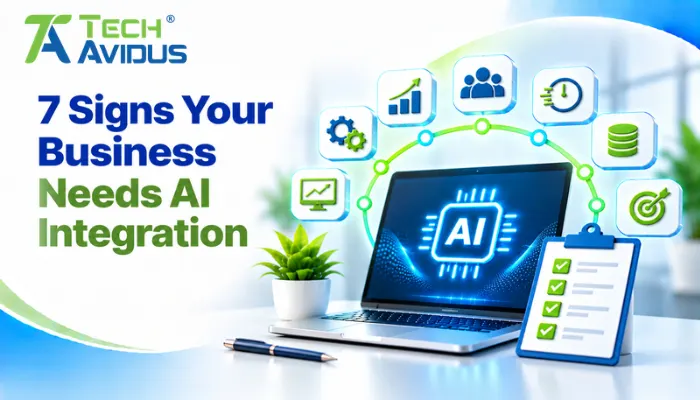
AI adoption is becoming an important consideration for businesses that want to improve operational efficiency, enhance customer experiences, and prepare for future growth. Recognizing these seven warning signs can help decision-makers understand where existing processes need improvement and where intelligent technology may deliver practical value.
The best approach is to start with a specific business challenge, evaluate available opportunities, and build a solution that supports long-term objectives.
TechAvidus helps businesses turn technology opportunities into practical solutions through custom development, automation, and AI Integration Service capabilities. Connect with our team for a free consultation to discuss your business requirements and explore the right implementation approach.
.jpg "Raju Parmar")
Raju Parmar
Raju Parmar is an AI integration specialist passionate about connecting intelligent technologies with real-world business solutions. He focuses on integrating AI-powered tools, APIs, machine learning models, and automation systems into existing business workflows. With a strong understanding of modern AI technologies, Raju helps businesses improve operational efficiency, streamline processes, and build smarter digital experiences through practical and scalable AI integration solutions.