Key Takeaways
- 1. AI can automate repetitive business activities and reduce manual workloads.
- 2. Businesses can use AI for customer support, marketing, finance, sales, and operations.
- 3. Connecting AI with existing software makes business workflows more intelligent.
- 4. Successful implementation requires proper planning, data security, and continuous monitoring.
- 5. Measuring business outcomes helps organizations understand the value of AI adoption.
Introduction
Businesses are moving beyond AI experimentation and finding practical ways to integrate artificial intelligence into everyday operations. From automating customer support to predicting sales trends, AI is helping organizations improve workflows, make informed decisions, and deliver better customer experiences.
In 2027, successful AI adoption will depend less on simply using AI tools and more on connecting them with existing business systems, databases, applications, and operational processes. Understanding practical AI Integration Examples can help businesses identify where automation, machine learning, and generative AI can create meaningful value.
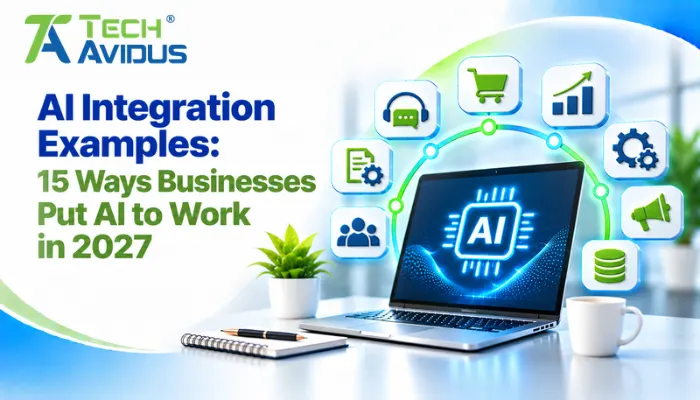
15 Practical Ways Businesses Are Using AI
Artificial intelligence can support almost every department when it is connected to the right business processes. Here are 15 practical applications that demonstrate how organizations can put AI to work.
1. Intelligent Customer Support
AI-powered customer support systems help businesses answer common questions, manage service requests, and provide assistance around the clock.
Companies can connect AI chatbots with CRM platforms, knowledge bases, and ticketing systems. This allows customers to receive relevant responses while support teams focus on more complex issues.
2. Automated Lead Qualification
AI can analyze incoming leads and identify prospects who are more likely to become customers.
By integrating AI with CRM software, businesses can evaluate customer interactions, website activity, industry information, and previous engagement. Sales teams can then prioritize promising opportunities.
3. Personalized Marketing Campaigns
AI helps marketing teams understand customer interests and create more relevant campaigns.
When connected with email marketing and customer data platforms, AI can recommend personalized content, segment audiences, and identify suitable campaign timing.
4. Predictive Sales Forecasting
Businesses can use machine learning to analyze historical sales, seasonal patterns, customer demand, and market trends.
Integrating predictive analytics with sales management software helps decision-makers prepare for demand changes and make more informed business plans.
5. Intelligent Document Processing
Organizations handle invoices, contracts, application forms, reports, and other documents every day.
AI-powered document processing can extract information, classify documents, identify important details, and transfer structured data into ERP or business management systems.
6. AI-Powered Inventory Management
AI can help businesses monitor inventory levels and anticipate product demand.
When connected with inventory management and supply chain platforms, predictive models can identify potential stock shortages, recommend replenishment, and reduce unnecessary inventory.
7. Automated Financial Operations
Finance departments can use AI to assist with invoice processing, expense categorization, transaction monitoring, and financial reporting.
Integrating AI with accounting software helps teams identify unusual transactions and reduce repetitive administrative work. Human approval remains important for sensitive financial decisions.
8. Intelligent Recruitment and HR Management
AI can support recruitment teams by organizing applications, extracting candidate information, and helping identify relevant experience.
Connected HR systems can also assist with employee onboarding, internal knowledge management, and routine employee queries. Hiring decisions should remain subject to human review and fair evaluation.
9. AI-Driven Quality Control
Manufacturing businesses can use computer vision to inspect products and identify visible defects during production.
By integrating cameras, machine learning models, and manufacturing systems, organizations can detect quality issues earlier and provide production teams with actionable information.
10. Personalized E-Commerce Recommendations
AI recommendation engines analyze browsing behavior, purchase history, product preferences, and customer interactions.
When integrated with e-commerce platforms, these systems can suggest relevant products, personalize shopping experiences, and help customers discover suitable items.
11. Predictive Equipment Maintenance
AI can analyze sensor readings, equipment performance, and maintenance history to identify potential machinery problems.
Connecting predictive maintenance systems with industrial IoT platforms allows maintenance teams to investigate warning signs before equipment failures disrupt operations.
12. AI-Powered Business Intelligence
Businesses generate information across sales, marketing, finance, customer support, and operations.
AI-powered analytics can connect these data sources, identify patterns, summarize reports, and help managers explore business performance through natural-language queries.
13. Intelligent Cybersecurity Monitoring
AI can support security teams by analyzing network activity, login patterns, system events, and unusual behavior.
When integrated with security information and event management platforms, AI can help prioritize alerts and identify suspicious activities for investigation.
14. Automated Software Development Workflows
Development teams can use AI to assist with code generation, documentation, testing, debugging, and code review.
Integrating AI coding assistants with development environments, version control systems, and CI/CD pipelines can improve developer workflows. However, generated code still requires testing, security reviews, and human approval.
15. Voice-Based Business Automation
Voice AI enables customers and employees to interact with business systems through spoken commands.
Organizations can connect speech recognition, language models, and text-to-speech technologies with appointment systems, customer databases, and internal applications to support voice-driven workflows.
How to Select the Right AI Opportunities
Not every business process needs artificial intelligence. Organizations should prioritize applications where AI addresses a clearly identified operational challenge.
Start by examining repetitive activities, information-heavy processes, customer experience gaps, and decisions that depend on large amounts of data.
For example, a growing e-commerce company might begin with customer support automation and product recommendations rather than introducing AI across every department simultaneously.
The right approach is to select a manageable use case, test its performance, and expand after understanding its operational impact.

Advantages and Limitations of Business AI Adoption
AI can create meaningful improvements, but organizations should understand both its capabilities and limitations before implementation.
Advantages
- Improved operational efficiency: AI automates repetitive activities and allows employees to focus on higher-value responsibilities. Properly designed workflows can also reduce unnecessary manual data entry.
- Better business insights: Machine learning can identify patterns across large datasets. These insights can support planning, forecasting, and operational decision-making.
- Enhanced customer experiences: Personalized recommendations and intelligent support systems can make customer interactions more relevant. Businesses can also provide assistance across multiple digital channels.
- Scalable workflows: AI-powered systems can support increasing volumes of requests and information. This helps organizations expand operations without relying entirely on manual processes.
Limitations
- Data quality challenges: Inaccurate, incomplete, or outdated information can affect AI-generated results. Businesses need reliable data management practices.
- Security and privacy risks: Connecting AI with business applications can introduce additional data access and compliance considerations. Access controls and security reviews are essential.
- Integration complexity: Older applications and disconnected databases may require additional development work. Compatibility should be evaluated before implementation.
- Human oversight requirements: AI systems can produce incorrect or misleading outputs. Important business decisions should include appropriate human review.
What Does Successful Implementation Look Like?
Consider a growing online retail company receiving hundreds of customer inquiries about order status, returns, delivery schedules, and product availability.
Initially, employees handle these requests manually by checking different systems and preparing individual responses.
The company introduces an AI-powered support assistant connected to its e-commerce platform, order database, and customer relationship management system.
The assistant retrieves relevant information, answers common questions, and directs complicated requests to human support representatives.
This implementation demonstrates how AI workflow automation can connect separate business applications and make an existing process more efficient without replacing the entire technology infrastructure.
Planning and Measuring an AI Initiative
A successful implementation needs a clear business objective, a suitable technology stack, and a realistic deployment plan.
An Ai Integration Roadmap helps businesses organize implementation into manageable stages, starting with business requirements and moving toward development, testing, deployment, and optimization.
An Ai Integration Checklist should cover data availability, system compatibility, API access, security requirements, user permissions, testing procedures, and performance monitoring.
Businesses also frequently ask, How Long Does Ai Integration Take? The timeline depends on the complexity of the application, data readiness, integration requirements, security reviews, and the number of systems involved. A focused pilot can be simpler than a company-wide implementation involving multiple legacy platforms.
Measuring Ai Integration ROI requires comparing implementation and operational efforts against measurable business improvements. Relevant indicators include processing time, support response time, error rates, employee productivity, conversion rates, and customer satisfaction.
Understanding the Benefits of Ai Integration in Business also means looking beyond automation. Improved information accessibility, better customer experiences, faster workflows, and more informed decisions can contribute to long-term operational value.
For organizations planning their implementation, the NIST AI Risk Management Framework provides useful guidance for identifying, assessing, and managing risks associated with AI systems. Its approach emphasizes trustworthy and responsible AI throughout the system lifecycle.
Best Practices for Implementing AI in Business
Businesses should approach AI implementation as a structured technology initiative rather than simply introducing another software tool.
- Start with a clear business problem: Identify processes that consume significant employee time or create operational bottlenecks. Select an application where AI can provide measurable improvements.
- Evaluate existing infrastructure: Review databases, APIs, cloud platforms, and business applications before development. This helps identify integration requirements and potential compatibility issues.
- Prioritize data security: Establish appropriate authentication, encryption, access permissions, and data governance policies. Sensitive information should only be shared with authorized systems.
- Choose suitable AI technologies: Select machine learning, generative AI, computer vision, or natural language processing according to the actual business requirement. Avoid selecting technology simply because it is popular.
- Test before deployment: Run pilot implementations using realistic business scenarios. Validate accuracy, performance, security, and user experience before expanding the solution.
- Monitor and improve continuously: Track system performance and collect feedback from employees and customers. Regular evaluation helps identify errors, changing requirements, and opportunities for improvement.
Quick Summary: How Businesses Can Benefit from AI
AI helps businesses automate repetitive tasks, analyze information, improve customer experiences, and make more informed decisions.
Common applications include intelligent customer support, predictive analytics, document processing, personalized marketing, cybersecurity monitoring, and automated software development.
Successful AI implementation requires clear business objectives, reliable data, secure system integration, appropriate human oversight, and continuous performance monitoring.
Conclusion
Artificial intelligence is becoming an important part of modern business operations. From customer support and sales forecasting to cybersecurity and intelligent automation, organizations have multiple opportunities to improve how they work.
The key is to identify the right business challenges, select appropriate technologies, and connect AI solutions with existing systems securely and effectively.
TechAvidus helps businesses turn AI opportunities into practical software solutions through custom development, intelligent automation, and seamless system integrations. If your organization is planning its next AI initiative, explore our AI Integration Service and request a free consultation to discuss your business requirements.
.jpg "Mayur Parmar")
Mayur Parmar
Mayur Parmar is an AI Integration expert specializing in connecting artificial intelligence technologies with business applications and digital workflows. He focuses on integrating AI models, APIs, automation tools, and intelligent systems to improve operational efficiency, streamline processes, and enhance user experiences. With a strong interest in practical AI solutions, Mayur helps businesses leverage AI capabilities to build smarter, more scalable, and efficient applications that support innovation and long-term business growth.