Key Takeaways
- 1. AI reduces repetitive work and helps employees focus on important responsibilities.
- 2. Intelligent automation improves operational efficiency and workflow consistency.
- 3. AI-powered insights support faster and more informed business decisions.
- 4. Personalized customer experiences can strengthen engagement and satisfaction.
- 5. A well-planned implementation helps businesses adopt AI securely and sustainably.
Introduction
Artificial intelligence is changing how businesses operate, compete, and serve their customers. From automating repetitive tasks to improving customer communication, AI is helping business owners make everyday operations faster, smarter, and more efficient.
The real value comes when AI works alongside existing business systems rather than operating as a separate tool. Companies can connect AI with their CRM, ERP, websites, customer support platforms, and internal applications to simplify workflows and improve business performance.
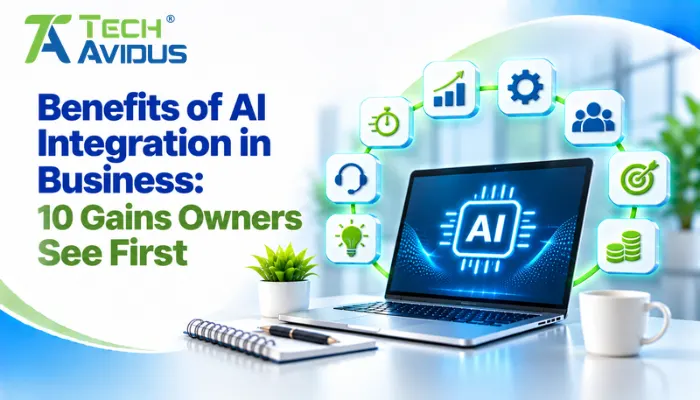
Understanding the benefits of AI integration in business starts with identifying where intelligent automation and data-driven decisions can make the biggest difference. Here are 10 practical gains business owners can experience when AI becomes part of their operations.
10 Practical Gains Businesses Can Experience
1. Better Productivity Across Teams
AI helps employees complete routine tasks more efficiently by reducing repetitive manual work. Activities such as document processing, email classification, appointment scheduling, and data entry can be partially or fully automated.
For example, a sales team can use AI to organize incoming leads, summarize customer conversations, and prepare follow-up recommendations. Employees can then spend more time building relationships and converting opportunities.
2. Faster and More Consistent Customer Support
AI-powered chatbots and virtual assistants can respond to common customer questions around the clock. They can help customers find information, track orders, understand services, and receive initial troubleshooting guidance.
When connected to a CRM or support platform, AI can also retrieve relevant customer information and direct complex requests to the appropriate employee.
3. Smarter Business Decisions
AI analyzes large datasets to identify patterns, trends, and opportunities that may be difficult to recognize through manual reporting. Business owners can use these insights to understand customer behavior, monitor performance, and plan future activities.
For example, predictive analytics can help retailers understand seasonal demand and prepare inventory accordingly. Human decision-makers should still review important recommendations before taking action.
4. More Personalized Customer Experiences
AI can help businesses understand individual preferences and deliver more relevant recommendations, messages, and offers. This makes customer interactions more useful instead of relying on the same communication for everyone.
An eCommerce company, for example, can analyze browsing activity and previous purchases to recommend relevant products and personalize email campaigns.
5. Improved Operational Efficiency
Disconnected software and manual approval processes often slow down business operations. AI integration can connect different applications and automate information movement between departments.
For instance, when a new customer submits an inquiry, an integrated workflow can categorize the request, update the CRM, notify the sales team, and prepare an initial response. This reduces unnecessary handoffs and improves workflow consistency.
6. Reduced Operational Errors
Manual data entry, repetitive calculations, and inconsistent record management can create avoidable mistakes. AI-assisted validation and document processing can identify missing information, unusual entries, and inconsistencies.
For example, an AI-enabled finance workflow can flag unusual invoice details for employee review. Final financial approvals should remain subject to appropriate human controls.
7. Stronger Sales and Marketing Performance
AI helps marketing and sales teams understand audience interests, analyze campaign performance, and prioritize potential customers. It can also assist with content planning, lead scoring, customer segmentation, and follow-up recommendations.
Businesses can use these insights to make their marketing activities more relevant and help sales representatives concentrate on promising opportunities.
8. Better Resource Planning
AI-powered forecasting can help organizations estimate demand, plan employee schedules, and allocate resources more effectively. This is particularly useful for businesses managing inventory, multiple projects, or changing customer requirements.
For example, a manufacturing company can analyze historical production information to identify possible bottlenecks and adjust its planning before delays become significant.
9. Improved Business Scalability
As a company grows, the volume of customer inquiries, transactions, documents, and internal activities also increases. AI can help manage this additional workload without requiring every process to grow at the same rate.
Businesses can gradually expand automated workflows, connect additional applications, and introduce more advanced AI capabilities as their requirements evolve.
10. Greater Opportunities for Innovation
AI gives businesses new ways to develop products, improve services, and explore opportunities. Generative AI, machine learning, predictive analytics, and intelligent assistants can support research, prototyping, and product development.
For example, a software company can introduce an AI-powered feature that helps customers analyze information or automate a previously manual task. This can create additional value beyond traditional software functionality.
How Businesses Can Approach Implementation
Successful adoption requires more than selecting an AI platform. Businesses need a clear implementation strategy that connects technology with measurable operational objectives.
The AI Integration Process should begin with identifying repetitive tasks, reviewing existing software, evaluating available business data, and selecting suitable use cases. Next, development teams can establish system connections, configure AI capabilities, test workflows, and prepare employees for adoption.
Before implementation, an organization should create an Ai Integration Checklist covering:
- Business objectives and expected outcomes. Define the specific problem AI should solve and establish measurable performance indicators.
- Existing software and data readiness. Review CRM, ERP, databases, APIs, and other applications that may need integration.
- Security and access controls. Determine how sensitive information will be protected and who can access AI-powered systems.
- Testing and human oversight. Validate outputs, identify possible errors, and establish approval procedures for important decisions.
- Monitoring and maintenance. Track performance, review feedback, and update integrations when business requirements change.
A practical Ai Integration Roadmap can divide implementation into manageable stages. Start with one high-value workflow, test its performance, collect employee feedback, and expand gradually to other departments once the initial implementation is reliable.
Business owners often ask, How Long Does Ai Integration Take? There is no universal timeline. A simple chatbot or single-workflow automation may be implemented relatively quickly, while enterprise-wide integration involving legacy software, complex databases, security requirements, and multiple departments can require a longer development and testing cycle.
To understand Ai Integration ROI, businesses should compare measurable improvements against implementation and ongoing operational efforts. Useful indicators include employee hours saved, processing time, customer response time, error frequency, conversion rates, and system maintenance requirements.
Advantages and Limitations to Consider
AI adoption offers meaningful opportunities, but businesses should understand its limitations before committing to large-scale implementation.
Advantages
- Improved efficiency: Automated workflows reduce repetitive activities and help teams manage larger workloads.
- Better insights: AI can identify patterns in business data and support more informed planning.
- Improved customer service: Intelligent assistants can provide faster responses and consistent support.
- Greater flexibility: Businesses can introduce additional AI capabilities as their requirements evolve.
Limitations
- Data quality requirements: Inaccurate or incomplete information can affect AI-generated results.
- Integration complexity: Older software and disconnected applications may require additional development.
- Security considerations: Businesses must protect customer information and establish appropriate access controls.
- Human oversight: AI can produce incorrect or misleading outputs, so important decisions require appropriate review.
The National Institute of Standards and Technology provides a useful reference through its AI Risk Management Framework, which helps organizations approach AI development and deployment with attention to trustworthiness and risk management.
Real-World Business Scenarios
Consider a growing eCommerce company receiving hundreds of customer inquiries about orders, returns, and product availability. Its support employees spend considerable time answering similar questions.
By connecting an AI assistant with its product database and order management system, the company can automate common responses and direct complicated requests to human representatives. Employees can focus on cases that require personal attention.
Another example is a manufacturing business that manages inventory through spreadsheets and disconnected applications. Integrating AI-powered demand forecasting with its inventory system can help identify changing demand patterns and support more informed purchasing decisions.
These examples illustrate how practical implementation can improve existing workflows without requiring businesses to replace every system they already use.
Expert Recommendations for Successful Adoption
A sustainable AI strategy should focus on business value, technical reliability, and employee readiness.
- Start with a clearly defined problem. Select a workflow where automation can make a meaningful difference rather than adopting AI simply because it is trending.
- Prioritize reliable data. Review data accuracy, consistency, accessibility, and permissions before connecting AI applications.
- Choose compatible technologies. Ensure that AI platforms can communicate with existing software through secure APIs and suitable integration methods.
- Keep employees involved. Explain how AI supports their work and provide training before introducing major workflow changes.
- Monitor performance continuously. Review system accuracy, user feedback, security, and business outcomes to identify areas for improvement.
IBM's research also highlights the importance of connecting AI with core business activities. Its June 2025 study of 2,900 executives identified improved decision-making and cost reduction through automation among the reported benefits of agentic AI systems.
What Should Business Owners Remember?
AI integration connects intelligent technology with everyday business operations to improve how work gets done.
The most practical gains include better productivity, faster customer support, improved decisions, personalized experiences, fewer manual errors, and more efficient resource management.
Businesses achieve sustainable results by starting with clear objectives, preparing their data, selecting compatible systems, maintaining human oversight, and measuring actual performance.
Conclusion
AI is becoming an important part of modern business operations, helping organizations improve productivity, deliver better customer experiences, and make informed decisions. However, meaningful results depend on choosing the right applications and connecting them properly with existing systems.
Business owners should begin by identifying operational challenges, evaluating their technology infrastructure, and selecting AI solutions that support long-term objectives.
TechAvidus helps businesses explore practical AI opportunities through custom development, intelligent automation, and system integration. With the right AI Integration Service, your business can move beyond experimentation and build connected, scalable solutions that support future growth.
Ready to explore AI opportunities for your business? Request a free consultation with TechAvidus and discuss an implementation approach aligned with your business goals.
.jpg "Raju Parmar")
Raju Parmar
Raju Parmar is an AI integration specialist passionate about connecting intelligent technologies with real-world business solutions. He focuses on integrating AI-powered tools, APIs, machine learning models, and automation systems into existing business workflows. With a strong understanding of modern AI technologies, Raju helps businesses improve operational efficiency, streamline processes, and build smarter digital experiences through practical and scalable AI integration solutions.