Key Takeaways
- 1. Start with business objectives and identify processes where AI can deliver practical improvements.
- 2. Prepare existing systems and business data before beginning implementation.
- 3. Introduce AI through structured development, integration, and testing phases.
- 4. Prioritize security, scalability, and human oversight throughout implementation.
- 5. Monitor performance continuously and improve solutions based on real business results.
Introduction
Growing businesses are increasingly adopting artificial intelligence to improve productivity, automate repetitive tasks, enhance customer experiences, and make better decisions. However, successful adoption requires more than simply introducing new AI tools. Businesses need a clear implementation strategy that connects technology with their actual operational goals.
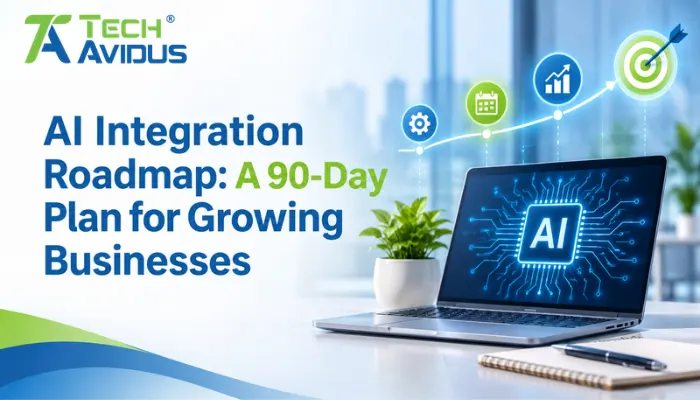
A structured 90-day AI implementation plan helps businesses move from identifying opportunities to deploying practical AI solutions. It provides a step-by-step approach to selecting technologies, preparing business data, integrating existing systems, testing workflows, and measuring results.
For TechAvidus, successful AI adoption starts with understanding business challenges and building solutions that can grow alongside the organization.
Understanding the Business Requirements Before Implementation
Successful AI adoption begins with identifying business problems rather than choosing tools. Before investing in development, businesses should understand which operations need improvement and what outcomes they expect.
Start by reviewing existing workflows, employee responsibilities, customer interactions, and software infrastructure.
Consider these potential opportunities:
- Customer support automation: Use AI chatbots to answer common questions, categorize customer requests, and assist support teams with faster responses.
- Sales and marketing automation: Apply predictive analytics and AI-powered tools to analyze customer behavior, organize leads, and support personalized campaigns.
- Business process automation: Automate repetitive administrative activities, document processing, and internal approval workflows.
- Data analysis and reporting: Use AI to identify patterns in business information and generate reports that support decision-making.
For example, an eCommerce company might prioritize automated product recommendations, while a service business may benefit more from intelligent lead qualification.
The objective is to select one or two high-value opportunities that can be implemented and evaluated within the initial 90 days.
A Practical Three-Phase Implementation Plan
A successful implementation should follow a structured sequence. The following plan divides the first 90 days into three phases, with each phase building on the previous one.
Days 1–30: Research, Planning, and Preparation
The first 30 days should focus on understanding requirements, evaluating existing systems, and defining the technical direction.
Identify business use cases
Document repetitive tasks, operational challenges, customer expectations, and areas where automation could improve efficiency. Rank opportunities according to business value, feasibility, and implementation complexity.
Evaluate existing infrastructure
Review current CRM platforms, ERP systems, databases, APIs, cloud infrastructure, and communication tools. Identify integration limitations and determine whether existing systems can support the planned solution.
Prepare business data
Check data accuracy, accessibility, consistency, and privacy requirements. AI solutions depend on reliable information, so incomplete or poorly organized data should be addressed before implementation.
Choose appropriate technologies
Compare AI models, automation platforms, cloud services, and development frameworks according to business requirements. Avoid selecting technology simply because it is popular.
For startups, Ai Integration For Startups should focus on manageable use cases, existing SaaS tools, and flexible architecture rather than building an unnecessarily complex system from the beginning.
Days 31–60: Development and System Integration
The second phase focuses on building the selected solution and connecting it with existing business applications.
Develop the initial solution
Build a minimum viable implementation around the highest-priority use case. This could include an AI-powered support assistant, document-processing workflow, recommendation engine, or intelligent reporting system.
Connect existing applications
Use APIs, webhooks, middleware, or custom integrations to exchange information between AI services and existing applications. Ensure that data flows correctly and that integration failures can be identified.
Implement security controls
Introduce authentication, access permissions, data encryption, and appropriate logging. Sensitive business information should only be accessible to authorized users and services.
Test functionality and accuracy
Evaluate response quality, processing speed, reliability, and performance using realistic business scenarios. Include unsuccessful inputs, unexpected requests, and integration failures in testing.
During this phase, Enterprise Ai Integration requires additional attention to legacy infrastructure, departmental access controls, data governance, and system interoperability.
Large organizations should also consider how the solution will support multiple departments and increasing workloads without compromising reliability.
Days 61–90: Deployment, Monitoring, and Optimization
The final phase focuses on controlled deployment and continuous improvement.
Launch a controlled pilot
Introduce the solution to a limited group of employees or customers. Collect feedback and observe how the application performs during actual business activities.
Monitor performance
Track relevant indicators such as task completion time, automation success rate, response accuracy, error frequency, and employee adoption. Compare results with the objectives established during the planning phase.
Improve workflows
Review feedback, correct integration issues, improve prompts or model configurations, and refine automation rules. Human review should remain available for decisions that require judgment or involve sensitive information.
Prepare for expansion
Document the architecture, integration dependencies, monitoring procedures, and maintenance responsibilities. Once the initial implementation performs reliably, identify the next suitable business process for expansion.

What Does the Implementation Process Involve?
The AI Integration Process connects artificial intelligence capabilities with business applications, data sources, and operational workflows.
It generally involves five interconnected activities:
- Data integration: Connect databases, CRM platforms, ERP applications, and other information sources while maintaining data quality and access controls.
- Model selection: Choose suitable AI models based on accuracy, functionality, latency, privacy, and business requirements.
- Application development: Build the interface, backend services, automation workflows, and API connections required for the solution.
- Testing and validation: Verify functionality, security, performance, and output quality before production deployment.
- Monitoring and maintenance: Track system performance, manage changes, address failures, and update integrations as requirements evolve.
These activities should be treated as an ongoing engineering lifecycle rather than a one-time development project.
How Much Time Should Businesses Allocate?
How Long Does Ai Integration Take depends on project complexity, data readiness, application compatibility, security requirements, and the number of systems involved.
A focused AI feature using existing APIs and organized data may be suitable for an initial 90-day rollout. However, a complex enterprise platform involving legacy applications, multiple departments, and extensive data migration may require a longer implementation period.
The 90-day approach is therefore a practical starting framework, not a guaranteed completion deadline.
Businesses should define realistic milestones and prioritize a working, measurable solution over rushing to deploy multiple AI features simultaneously.
Advantages and Limitations of Business AI Adoption
AI can improve business operations, but its effectiveness depends on implementation quality and organizational readiness.
Advantages
- Improved operational efficiency: Automating repetitive activities gives employees more time to focus on customer relationships, planning, and strategic responsibilities.
- Better decision support: AI-assisted analysis can help teams identify trends and understand business information more efficiently.
- Scalable workflows: Properly designed systems can support growing workloads without requiring every process to be handled manually.
- Enhanced customer experiences: Intelligent support and personalized interactions can help businesses respond more effectively to customer needs.
Limitations
- Data quality challenges: Inaccurate, incomplete, or disconnected information can reduce the usefulness of AI-generated results.
- Integration complexity: Older applications and incompatible systems may require additional development and testing.
- Security and privacy risks: Poor access controls or improper data handling can expose sensitive business information.
- Ongoing maintenance: AI applications require monitoring, updates, performance evaluation, and technical support.
Understanding these limitations early helps businesses make more informed implementation decisions.
Practical Business Scenarios
Consider how a structured implementation can work across different industries.
Scenario 1: eCommerce business
An online retailer wants to reduce the workload of its customer support team. It introduces an AI assistant connected to its product database and order management system.
The assistant handles common product questions and provides order-related information. Complex requests are forwarded to human support representatives.
Scenario 2: Growing software company
A software company wants to improve internal knowledge management. It develops an AI-powered assistant that retrieves information from approved company documents and technical resources.
Employees can find relevant information more efficiently while access permissions help protect confidential documentation.
Scenario 3: Enterprise organization
A large organization wants to improve reporting across multiple departments. It connects approved data sources to an AI-assisted analytics solution.
Department managers can explore operational information and generate reports while existing governance and access controls remain in place.
These are illustrative implementation scenarios, not claims of completed TechAvidus client projects. Each organization would require a solution designed around its actual infrastructure and business requirements.
Best Practices for a Successful Implementation
A well-planned Ai Integration Checklist helps businesses evaluate technical readiness and avoid preventable implementation problems.
Consider these recommendations:
- Start with measurable objectives: Define what the solution should improve and establish baseline performance indicators before development begins.
- Prioritize data protection: Apply access restrictions, encryption, secure API authentication, and data retention policies appropriate to the information being processed.
- Choose scalable architecture: Build modular applications that can accommodate additional integrations, users, and workloads as the organization grows.
- Keep humans involved: Provide review and approval mechanisms for sensitive decisions, important customer interactions, and uncertain AI outputs.
- Test before production: Validate performance, integration reliability, security, and unexpected scenarios in a controlled environment.
- Monitor continuously: Track application errors, model performance, user feedback, and changes in business requirements.
- Document technical decisions: Maintain records of integrations, dependencies, configurations, and operational responsibilities.
For additional guidance, the NIST AI Risk Management Framework provides a recognized approach to managing AI-related risks and promoting trustworthy AI systems. Its framework organizes risk management around four functions: Govern, Map, Measure, and Manage.
Businesses can also refer to Microsoft's Azure Well-Architected Framework for practical guidance on reliability, security, performance efficiency, and operational excellence.
Summary: Building a Sustainable AI Strategy
A successful business implementation starts with clear objectives, reliable data, and a well-defined technical architecture.
The first 30 days should focus on research and preparation. The next 30 days should prioritize development, system integration, and testing. The final 30 days should concentrate on deployment, monitoring, and optimization.
Businesses should begin with manageable use cases, measure actual performance, and expand only when the initial solution demonstrates value.
A structured implementation strategy helps growing organizations adopt AI responsibly while preparing their technology infrastructure for future requirements.
Conclusion
AI adoption is most successful when businesses follow a clear strategy, prioritize practical use cases, and build technology around real operational requirements. A 90-day implementation plan provides a structured starting point for moving from initial planning to deployment and continuous improvement.
Whether a business is introducing its first AI-powered application or modernizing existing enterprise systems, the right technical partner can make the journey more manageable.
TechAvidus helps businesses develop intelligent, scalable software solutions tailored to their operational goals. Explore our AI Integration Service to identify opportunities, connect existing systems, and build solutions that support long-term business growth.
Ready to bring AI into your business operations? Contact TechAvidus for a free consultation and discuss your implementation requirements.
.jpg "Mayur Parmar")
Mayur Parmar
Mayur Parmar is an AI Integration expert specializing in connecting artificial intelligence technologies with business applications and digital workflows. He focuses on integrating AI models, APIs, automation tools, and intelligent systems to improve operational efficiency, streamline processes, and enhance user experiences. With a strong interest in practical AI solutions, Mayur helps businesses leverage AI capabilities to build smarter, more scalable, and efficient applications that support innovation and long-term business growth.