Key Takeaways
- 1. AI can help small businesses automate repetitive tasks and improve operational efficiency.
- 2. Starting with one clearly defined business problem makes AI adoption easier to manage.
- 3. Existing CRM, accounting, marketing, and customer support systems can benefit from AI capabilities.
- 4. Data security, human supervision, and employee training are important for successful implementation.
- 5. Measuring business outcomes helps determine whether an AI investment is delivering value.
Introduction
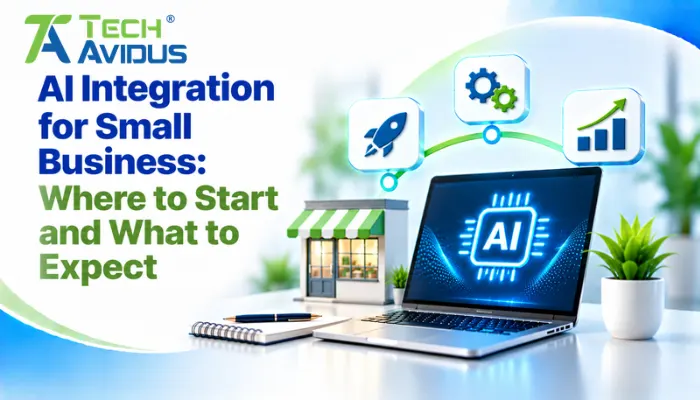
Artificial intelligence is no longer limited to large enterprises with dedicated technology teams. Today, small businesses can use AI to simplify everyday operations, improve customer communication, automate repetitive tasks, and make better business decisions.
AI Integration for Small Business is about connecting intelligent tools with existing business processes to solve practical problems. Instead of investing in complicated technology from day one, businesses can start with simple applications such as automated customer support, sales follow-ups, document processing, and data analysis.
The key is knowing where AI can make a meaningful difference, which tools are suitable, and how to introduce them without disrupting existing operations.
Where Should Small Businesses Start with AI?
Small businesses should begin by identifying time-consuming activities that follow predictable patterns. These processes are often the easiest opportunities for introducing AI without changing the entire business structure.
For example, a business receiving dozens of customer inquiries daily might introduce an AI-powered chatbot to answer common questions. A sales team could use AI to organize leads, summarize conversations, and prepare follow-up messages.
Before selecting any technology, review existing workflows and identify where delays, manual effort, or communication gaps occur.
Identify Repetitive Business Tasks
Start by reviewing everyday activities across different departments. Look for processes that consume employee time but do not require complex human judgment.
Common opportunities include:
- Customer inquiry management and frequently asked questions.
- Lead qualification and sales follow-up communication.
- Invoice processing and document classification.
- Appointment scheduling and email organization.
- Marketing content preparation and performance analysis.
Automating selected activities allows employees to concentrate on customer relationships, planning, and other important responsibilities.
Choose the Right AI Tools
Selecting suitable technology is just as important as identifying the business problem. Small businesses should consider tools that integrate with their existing software rather than introducing unnecessary platforms.
For example, ChatGPT can support content creation and information processing, Microsoft Copilot can assist with productivity workflows, and CRM platforms with built-in AI capabilities can help organize sales activities.
The right selection depends on business requirements, integration options, data sensitivity, and employee familiarity.
How Can AI Improve Everyday Business Operations?
AI can improve business operations by reducing manual work, supporting faster decisions, and making information easier to access. Its value depends on how well the technology fits existing workflows.
The Benefits of Ai Integration in Business become more visible when intelligent systems solve specific operational challenges rather than being introduced simply because AI is trending.
For example, an eCommerce company can use AI to categorize customer questions, identify common product concerns, and assist with personalized recommendations. A service-based business can automate appointment reminders and organize incoming inquiries.
These improvements can support productivity while allowing employees to maintain control over important business decisions.
Practical Applications Across Business Departments
Different departments can use AI in different ways depending on their responsibilities.
- Sales: AI can organize leads, summarize customer conversations, and suggest relevant follow-up actions. Sales representatives can spend more time building relationships instead of managing repetitive administrative work.
- Marketing: AI can help analyze campaign performance, generate content ideas, and identify audience interests. Marketing teams should still review messaging to maintain brand consistency and accuracy.
- Customer Support: AI-powered assistants can respond to common questions and route complicated requests to human representatives. This can improve response management without removing the need for personal customer support.
- Operations: AI can assist with document extraction, inventory analysis, and workflow automation. Employees should review important outputs before they affect business operations.
What Does a Practical Implementation Plan Look Like?
A structured implementation approach helps businesses move from experimentation to reliable everyday usage. The objective is to introduce AI gradually, validate its performance, and expand only when the results justify further investment.
An effective Ai Integration Roadmap can follow four stages:
Stage 1: Business Assessment
Review current processes, identify operational challenges, and select one suitable use case. Define what success should look like before choosing a tool.
Stage 2: Tool Selection and Integration
Evaluate available AI platforms based on functionality, compatibility, security, and scalability. Connect the selected solution with relevant business applications.
Stage 3: Testing and Employee Training
Run a controlled pilot with a limited group of users. Collect feedback, check output accuracy, and train employees to use the system responsibly.
Stage 4: Monitoring and Expansion
Measure performance against the original objectives. Improve the workflow based on actual results before extending AI capabilities to other departments.
This phased approach helps prevent unnecessary complexity and makes implementation easier to manage.
How Can Businesses Measure AI Performance?
AI performance should be evaluated through measurable business improvements rather than the number of tools introduced. Businesses need to understand whether the technology is reducing workload, improving service quality, or supporting better decisions.
Understanding Ai Integration ROI requires comparing implementation and ongoing operating expenses with measurable benefits. Useful indicators include:
- Time saved on repetitive administrative tasks.
- Changes in customer response and resolution times.
- Improvements in lead handling and follow-up consistency.
- Reduction in manual processing errors.
- Employee productivity and customer satisfaction.
For example, a company introducing automated customer inquiry classification can compare how long employees previously spent organizing requests with the time required after implementation.
Not every benefit will immediately translate into financial savings. Some improvements, such as better customer experiences and more consistent processes, may deliver value over a longer period.
What Are the Advantages and Limitations of AI Adoption?
AI offers practical opportunities for small businesses, but successful adoption requires realistic expectations and appropriate safeguards.
Advantages
- Improved productivity: Automation can reduce repetitive work and give employees more time for higher-value activities.
- Better customer experiences: AI assistants can help businesses provide faster initial responses and more consistent information.
- Smarter decision-making: AI can identify patterns in business information and support data-driven planning.
- Business scalability: Well-designed workflows can handle increasing workloads without requiring every task to be managed manually.
Limitations
- Data privacy concerns: Sharing sensitive customer or business information with AI platforms can introduce security risks.
- Output accuracy: AI-generated information may contain mistakes and should be checked before use.
- Integration challenges: Connecting new tools with older software may require technical adjustments and testing.
- Employee adoption: Teams may need training and time to become comfortable with new workflows.
The Australian Cyber Security Centre provides practical guidance on protecting small businesses when adopting AI, including vendor assessment, privacy protection, and human oversight. Its guidance on artificial intelligence for small business is a useful resource before deployment.
What Does AI Integration Look Like in Real Business Scenarios?
Practical Ai Integration Examples help business owners understand how intelligent technology can fit into their existing operations.
Consider these illustrative scenarios:
Example 1: A Small Retail Business
A retail business receives frequent questions about product availability, delivery, and returns. An AI-powered support assistant can answer approved frequently asked questions and direct complex requests to employees.
The business can also analyze recurring inquiries to identify customer concerns and improve its support process.
Example 2: A Professional Services Company
A consulting company manages client inquiries, meeting schedules, and follow-up emails manually. AI can help summarize meeting notes, organize incoming leads, and prepare draft communications.
Employees review the information before sending messages or making client-related decisions.
Example 3: An eCommerce Business
An online store handles product descriptions, customer feedback, and order-related questions. AI can assist with product content preparation, review categorization, and customer inquiry management.
The business retains human review for product accuracy, sensitive customer requests, and important decisions.
These scenarios demonstrate that useful AI adoption does not always require developing a completely new application. Existing software and carefully selected integrations can often provide a practical starting point.
Best Practices for Successful Implementation
Successful AI adoption requires a combination of business planning, technical evaluation, and employee involvement.
A simple Ai Integration Checklist can help business owners prepare before introducing new technology:
- Define the business problem and expected outcome before selecting an AI platform. Avoid choosing tools without a clear operational purpose.
- Review existing software and available integration options to prevent unnecessary duplication. Check whether current applications already provide suitable AI features.
- Evaluate vendor security, privacy policies, data ownership, and access controls. Understand how business information is stored and processed.
- Start with a small pilot and test the system using realistic business scenarios. Collect employee feedback and review unexpected outputs.
- Establish human approval procedures for important customer, financial, and operational decisions. AI should support employees rather than replace accountability.
- Monitor performance and regularly review the system. Update workflows when business requirements or technology capabilities change.
Businesses should also document acceptable AI usage and train employees to recognize inaccurate outputs, sensitive information risks, and potential security issues.
Recap: What Should Small Businesses Remember?
AI adoption should begin with a clearly identified business challenge, not with technology selection alone.
Small businesses can start by automating repetitive tasks, improving customer communication, and connecting AI capabilities with existing software.
A gradual implementation process helps organizations evaluate performance, manage risks, and build employee confidence.
Regular monitoring, data protection, and human supervision are essential for maintaining reliable AI-powered business operations.
Conclusion
AI adoption is an opportunity for small businesses to improve productivity, simplify operations, and create better customer experiences. However, successful implementation requires more than selecting an AI tool. It involves understanding business requirements, choosing suitable technologies, connecting existing systems, and continuously evaluating performance.
Starting with one practical use case can help businesses build confidence and understand where further automation makes sense.
TechAvidus helps businesses explore and implement practical AI solutions through custom development, intelligent automation, and software integration. Our AI Integration Service can help connect AI capabilities with your existing business applications and operational workflows.
Ready to explore AI opportunities for your business? Contact TechAvidus for a free consultation and discover a practical approach to your AI adoption journey.
.jpg "Dishant Panchal")
Dishant Panchal
Dishant Panchal is an AI Integration Expert specializing in connecting artificial intelligence solutions with business applications and digital workflows. He focuses on integrating AI models, APIs, and intelligent automation tools to streamline operations, improve efficiency, and enhance user experiences. With an interest in practical AI implementation, Dishant helps businesses bridge the gap between emerging AI technologies and real-world requirements, enabling smarter processes, seamless system connectivity, and scalable digital solutions.