Key Takeaways
- 1. Agencies offer access to multiple technical specialists and coordinated project management.
- 2. Freelancers can provide direct communication and flexibility for smaller, well-defined projects.
- 3. Data security, integration complexity, and maintenance requirements should influence your decision.
- 4. Long-term AI initiatives often benefit from collaborative teams and structured technical support.
- 5. The right development partner should align with your business goals, technical requirements, and future growth plans.
Introduction
Artificial intelligence is transforming how businesses operate, automate processes, serve customers, and make decisions. From AI-powered chatbots and predictive analytics to intelligent workflow automation, companies are increasingly investing in AI to improve efficiency and competitiveness. However, choosing the right development partner is just as important as selecting the right technology.
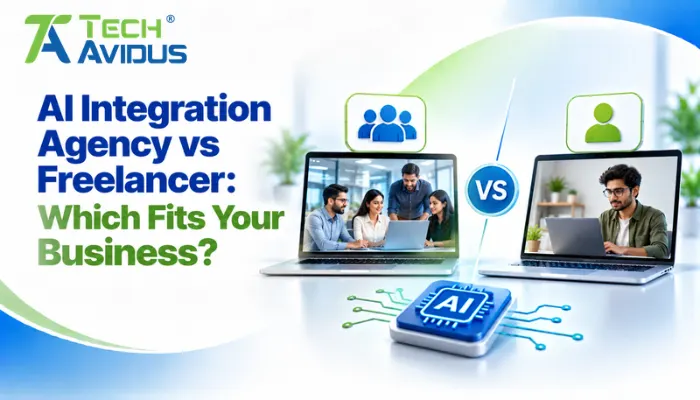
When comparing an agency with an independent professional, businesses need to consider technical expertise, project complexity, communication, security, scalability, and ongoing maintenance. Both options can deliver valuable results, but their suitability depends on your business objectives and available resources.
An independent professional may be suitable for a clearly defined project, while an experienced development agency can provide a broader team and structured support for complex implementations. Understanding these differences helps businesses make a more informed decision.
Understanding the Two Development Models
What Does an AI Development Agency Offer?
An AI development agency is a company that provides coordinated technical services through a team of professionals. Depending on the project, this team may include AI engineers, software developers, data scientists, solution architects, UI/UX designers, and quality assurance specialists.
Agencies typically follow an organized development process, starting with business requirement analysis and solution planning. They then move through architecture design, development, integration, testing, deployment, and maintenance.
For example, a company planning to introduce an AI-powered customer support platform may need chatbot development, CRM integration, customer data processing, API configuration, and performance monitoring. An agency can coordinate these different responsibilities within one development engagement.
What Does an Independent AI Developer Offer?
A freelancer is an independent professional who works directly with businesses on specific technical assignments. Freelancers may specialize in machine learning, natural language processing, chatbot development, AI automation, or integrating third-party AI platforms.
This model can work well when a business has a clearly defined requirement, an established technical environment, and an internal team capable of managing other project responsibilities.
For instance, a business may hire a freelancer to connect an existing application with an AI API or develop a proof of concept. However, projects involving several interconnected systems may require additional specialists.
Major Differences Businesses Should Consider
1. Technical Expertise and Team Availability
An agency can bring together professionals with different technical backgrounds. This is useful when an implementation requires backend development, AI model configuration, database management, cloud infrastructure, and application security.
A freelancer generally contributes expertise within their individual skill set. Some experienced professionals can handle multiple responsibilities, but businesses should verify their experience across every critical component.
2. Project Management and Communication
Agencies usually assign project managers or technical leads to coordinate activities, manage milestones, and communicate progress. This structure can help businesses manage complex implementations with multiple dependencies.
Freelancers generally communicate directly with clients, which can make decisions quicker. However, businesses may need to manage requirements, documentation, testing, and coordination themselves.
3. Scalability and Resource Flexibility
A growing AI project may require additional developers, testers, or cloud specialists as new requirements emerge. An agency can often allocate additional team members depending on availability and project scope.
A freelancer may have limited individual capacity. If the project expands significantly, the business may need to hire additional professionals or transition responsibilities to another development team.
4. Security, Quality Assurance, and Reliability
AI implementations can involve sensitive business information, customer records, proprietary data, and third-party integrations. Therefore, security practices, access controls, documentation, and testing should be established before development begins.
Businesses should evaluate the security responsibilities and quality assurance process of both agencies and freelancers. Neither engagement model automatically guarantees secure or reliable results.
5. Ongoing Maintenance and Technical Support
AI systems require continuous attention after deployment. API changes, model updates, changing business requirements, integration failures, and performance issues can affect system reliability.
An agency may provide a structured maintenance arrangement with access to different specialists. A freelancer can also provide ongoing support, but businesses should establish availability, response expectations, and backup arrangements in advance.
Advantages and Limitations of Each Option
Benefits of Hiring an Agency
- Broader technical capabilities: Businesses can access professionals across AI development, software engineering, integration, and testing. This reduces the need to coordinate several independent vendors.
- Organized project execution: Defined responsibilities, progress tracking, and documented workflows can make complex projects easier to manage. Businesses also gain a clearer structure for reviewing deliverables.
- Long-term development support: An agency can support future improvements, additional integrations, and system upgrades. This can be valuable when AI becomes part of everyday business operations.
Limitations of Hiring an Agency
- More coordination: Working with multiple team members may involve additional meetings, approvals, and communication steps. Businesses should establish clear reporting responsibilities.
- Engagement flexibility varies: Some agencies follow structured onboarding and delivery processes that may not suit very small or urgent assignments. Project requirements should be discussed before selecting a partner.
Benefits of Hiring a Freelancer
- Direct collaboration: Businesses can communicate directly with the person performing the technical work. This can simplify feedback and decision-making.
- Specialized expertise: A freelancer with relevant experience can provide focused assistance for a particular technical challenge. This is useful when the business already has an established development team.
- Flexible engagement: Freelancers may be suitable for short-term assignments, technical consultations, and limited implementation requirements. The scope can be defined around a specific deliverable.
Limitations of Hiring a Freelancer
- Individual capacity: One professional may not have the time or expertise to manage every aspect of a large AI implementation. Additional resources may be required as the project grows.
- Availability risks: Illness, competing commitments, or changes in professional availability can affect project continuity. Businesses should establish documentation and handover arrangements.
Real-World Business Scenarios
Scenario 1: A Startup Building an AI-Powered MVP
Imagine a startup developing an AI-powered application to validate a business idea. Its immediate requirements include connecting an AI model, creating a basic interface, and testing a limited set of features.
A skilled freelancer could be a practical choice if the requirements are narrow and the startup has someone internally managing the product. If the MVP requires several integrations, authentication, database architecture, and production deployment, an agency may offer more comprehensive support.
Scenario 2: An Established Company Automating Operations
Consider an established company that wants to automate customer support, connect AI capabilities with its CRM, and process internal business documents.
This implementation may require backend engineering, workflow automation, data security, API integration, testing, and ongoing monitoring. A coordinated development team can help manage these interconnected responsibilities.
Scenario 3: A Business Expanding an Existing AI Application
A business may already have an AI application but want to introduce additional features, improve response quality, or connect new enterprise systems.
A freelancer with the right specialization may handle a clearly isolated upgrade. However, when several components need modification, a development agency can provide broader technical resources and coordinated implementation.
These are illustrative business scenarios, not claims about completed client projects.
How to Choose the Right Development Partner
The best choice depends on the scope, technical complexity, internal capabilities, and long-term requirements of your project.
Before making a decision, consider the following recommendations:
- Define your business objectives: Identify the business problem you want AI to solve. Clear objectives make it easier to evaluate technical proposals and expected deliverables.
- Review relevant experience: Examine previous implementations, technical case studies, and experience with the tools your project requires. Ask how similar integration challenges were handled.
- Evaluate technical capabilities: Check expertise in machine learning, Python, APIs, cloud platforms, databases, data pipelines, and application development. Choose a partner whose capabilities match your actual requirements.
- Discuss security responsibilities: Clarify data access, confidentiality, authentication, documentation, and testing procedures. Establish who is responsible for protecting business information.
- Confirm post-deployment support: Discuss maintenance, monitoring, bug fixes, future enhancements, and ownership of source code. These details are essential for long-term project continuity.
For additional guidance, businesses can refer to the NIST AI Risk Management Framework, which provides guidance for managing AI risks and incorporating trustworthiness into AI design, development, deployment, and evaluation.
How Can Businesses Make AI Projects More Successful?
Successful AI implementation requires more than selecting a capable developer. Businesses should establish clear requirements, prepare reliable data, identify integration dependencies, and define measurable performance objectives.
In practice, teams should begin with a focused implementation plan and validate the solution using realistic business workflows. Before production deployment, test system compatibility, access permissions, output quality, error handling, and performance under expected workloads.
Businesses looking for a Dedicated Ai Developer should also evaluate whether one specialist can manage the complete technical scope or whether additional expertise is necessary.
Similarly, AI Development Services should be evaluated based on their ability to address the complete implementation lifecycle rather than simply delivering an AI feature. Architecture planning, integration testing, deployment, documentation, and maintenance all contribute to a dependable solution.
Quick Recap: Agency or Freelancer?
An AI development agency is generally suitable for complex projects requiring multiple technical specialists, structured project management, and ongoing support.
A freelancer is often suitable for focused technical assignments, prototypes, and projects with clearly defined deliverables.
Businesses should evaluate technical expertise, security practices, communication, scalability, and post-deployment responsibilities before making their decision. The most suitable partner is the one that can reliably meet the project's present requirements while supporting its future development.
Conclusion
Choosing the right development partner is an important step toward building reliable and scalable AI solutions. Freelancers can provide valuable expertise for focused assignments, while agencies can offer broader technical capabilities, coordinated project execution, and ongoing development support.
Before making a decision, assess your project's complexity, internal resources, security requirements, and long-term objectives. Avoid choosing a partner based only on initial convenience; consider their ability to support the complete development journey.
TechAvidus helps businesses explore, develop, integrate, and improve AI-powered solutions based on their technical and operational requirements. Whether you are planning a new implementation or modernizing an existing application, choosing the right AI Integration Service can help establish a stronger foundation for your digital transformation.
Contact TechAvidus for a free consultation and discuss an AI solution aligned with your business goals.
.jpg "Mayur Parmar")
Mayur Parmar
Mayur Parmar is an AI Integration expert specializing in connecting artificial intelligence technologies with business applications and digital workflows. He focuses on integrating AI models, APIs, automation tools, and intelligent systems to improve operational efficiency, streamline processes, and enhance user experiences. With a strong interest in practical AI solutions, Mayur helps businesses leverage AI capabilities to build smarter, more scalable, and efficient applications that support innovation and long-term business growth.