Key Takeaways
- 1. Ready-made AI tools are suitable for businesses that need quick implementation and standard functionality.
- 2. Custom solutions provide greater flexibility for unique workflows and complex business requirements.
- 3. Data security, scalability, integration needs, and maintenance should influence the decision.
- 4. A hybrid approach can combine ready-made platforms with custom development.
- 5. The best solution is the one that supports long-term business objectives and measurable operational improvements.
Introduction
Choosing between custom AI integration and off-the-shelf tools is an important decision for businesses planning to adopt artificial intelligence. The right approach depends on your business goals, existing technology, workflow complexity, data requirements, and long-term growth plans. While ready-made AI platforms offer convenience and faster implementation, a tailored solution can provide greater flexibility and control.
Understanding the differences between these approaches helps businesses select technology that solves real operational challenges rather than adding unnecessary complexity.
Understanding the Two Approaches
What Are Ready-Made AI Tools?
Off-the-shelf AI tools are prebuilt software applications designed to solve common business problems. They usually include ready-to-use features, standard integrations, and user-friendly interfaces.
Businesses can use these platforms for customer support automation, content generation, document processing, sales assistance, and data analysis without developing an AI system from scratch.
For example, a small business can introduce an AI chatbot using an existing platform to answer frequently asked customer questions. This approach is useful when requirements are straightforward and the available features meet operational expectations.
What Is Custom AI Development?
Custom AI development involves designing and implementing an AI solution around a company's specific workflows, systems, and objectives.
Instead of adapting business processes to an existing platform, organizations can develop functionality that matches their operational requirements. This may include connecting internal databases, integrating enterprise applications, building intelligent automation workflows, or implementing domain-specific machine learning models.
A business with complex inventory operations, for instance, might need an AI-powered forecasting system that considers its historical sales, supplier information, seasonal demand, and internal business rules.
Factors to Consider Before Making a Decision
1. Business Requirements and Workflow Complexity
The first step is identifying the actual problem you want AI to solve. If your business needs standard automation, an existing platform may be sufficient.
However, organizations with specialized approval processes, multiple departments, or industry-specific requirements may benefit from customized functionality. The solution should fit existing workflows without creating unnecessary operational changes.
2. Integration with Existing Systems
AI adoption becomes more valuable when it works seamlessly with existing business applications. Consider whether the solution can connect with your CRM, ERP, databases, customer portals, and internal software.
For example, a sales team may need AI to retrieve customer information from its CRM, summarize previous interactions, and recommend relevant follow-up actions. If standard connectors cannot support the required workflow, custom API development may be necessary.
3. Data Security and Compliance
Data protection should be evaluated before selecting any AI platform. Businesses must understand how providers process, store, access, and retain organizational information.
Custom development can offer more control over architecture and data access, but it does not automatically guarantee security. Both approaches require access controls, encryption, testing, monitoring, and appropriate governance.
The NIST AI Risk Management Framework provides guidance for managing AI risks throughout the design, development, deployment, and evaluation lifecycle.
4. Scalability and Future Requirements
A solution that works for a small team may not support a growing organization. Consider future users, increasing data volumes, additional integrations, and changing business processes.
Custom architecture can accommodate specialized growth requirements, while established platforms may offer convenient upgrades and managed infrastructure. Evaluate the provider's roadmap and technical limitations before committing.
5. Implementation and Maintenance
Ready-made platforms generally require less initial development because their core functionality already exists. However, configuration, integration, staff training, and ongoing subscription management still require attention.
Custom solutions involve requirements analysis, development, testing, deployment, and maintenance. Businesses should plan for software updates, model evaluation, infrastructure management, and technical support.
Advantages and Limitations of Both Approaches
Benefits of Ready-Made Solutions
- Faster implementation: Businesses can start using existing AI functionality without building an entire application. This is helpful when the objective is to automate a clearly defined task.
- Established functionality: Many platforms offer tested features, documentation, and integrations. This can reduce the technical effort required for standard business operations.
- Simpler initial adoption: Non-technical employees can often use ready-made applications through accessible interfaces. This makes experimentation easier across departments.
Limitations of Ready-Made Solutions
- Limited customization: Some platforms cannot accommodate complex business rules or specialized workflows. Organizations may need to change their processes to match the software.
- Third-party dependency: Businesses rely on the provider's availability, product updates, security practices, and service policies. Changes to features or terms can affect operations.
Benefits of Custom Development
- Workflow flexibility: Features can be designed around specific operational requirements. This is particularly useful for organizations with unique processes.
- Greater integration control: Developers can connect AI functionality with internal applications and business databases. This supports more connected workflows.
- Long-term adaptability: Organizations can extend features as requirements evolve. They can also select suitable models, infrastructure, and integration methods.
Limitations of Custom Development
- More planning and technical effort: Development requires clear requirements, experienced professionals, testing, and project management. Poor planning can lead to unnecessary complexity.
- Ongoing responsibility: The business must account for maintenance, security updates, monitoring, and performance improvements. Technical ownership should be established before deployment.
Practical Business Scenarios
Consider a growing eCommerce company that wants to automate customer support. Initially, a ready-made chatbot may handle common questions about shipping, returns, and order status.
As operations become more complex, the company may need AI to retrieve live order information, identify customer sentiment, connect with inventory software, and escalate sensitive requests. A customized integration could address these requirements more effectively.
Another example is a manufacturing business that wants to predict equipment maintenance requirements. A general AI assistant may help employees access documentation, but predictive maintenance requires relevant machine data, historical maintenance records, and specialized analytical workflows.
In practical implementation, teams should first test the smallest useful workflow. They can then identify where existing tools work well and where custom functionality is genuinely necessary.
How to Choose the Right Development Partner
Selecting the right technical partner is as important as selecting the technology. Businesses should evaluate experience with API integrations, cloud infrastructure, AI models, data engineering, and application security.
An experienced AI Development Services provider can assess existing systems, identify suitable technologies, and recommend an implementation strategy based on business requirements.
The decision around a Dedicated Ai Developer also depends on project complexity. A dedicated professional may be useful when a business needs consistent technical ownership, ongoing development, and close collaboration with its internal team.
When comparing an Ai Integration Agency vs Freelancer, consider project scope, technical expertise, accountability, communication, and post-launch support. A freelancer may suit a focused implementation, while an agency can provide access to multiple technical disciplines for broader projects.
For TechAvidus, the important principle is to select an implementation model that matches the business challenge rather than choosing technology simply because it is popular.
Can a Hybrid Approach Work Better?
Yes. A hybrid approach combines existing AI platforms with custom-developed components where additional functionality is required.
For example, a company might use an existing large language model through an API while developing custom authentication, database connections, business logic, and reporting features.
This approach avoids rebuilding capabilities that already work while allowing businesses to customize important workflows. It can also make it easier to test an AI initiative before expanding it across the organization.
Best Practices for a Successful AI Implementation
Businesses can improve AI implementation outcomes by following a structured approach.
1. Define measurable objectives: Identify the business problem, expected outcomes, and success criteria before selecting a platform. Clear objectives help prevent unnecessary development.
2. Evaluate existing infrastructure: Review current applications, databases, APIs, and security requirements. This helps identify compatibility issues early.
3. Start with a pilot project: Test AI functionality within a limited workflow before expanding deployment. A pilot helps reveal technical limitations and user adoption challenges.
4. Prioritize data governance: Establish policies for data access, privacy, retention, and monitoring. Review third-party providers and their responsibilities.
5. Plan for ongoing improvements: AI systems require regular evaluation as business data, user expectations, and technology change. Monitor accuracy, reliability, security, and operational performance.
Understanding the Difference in Practice
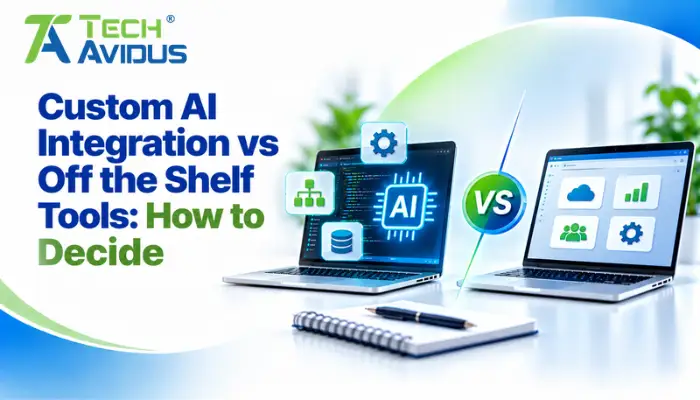
The decision around Custom AI Integration vs Off the Shelf should focus on business value rather than development preferences.
Ready-made solutions are often suitable for standard requirements, quick experimentation, and straightforward automation. Custom development is more appropriate when business processes demand specialized functionality, deeper integrations, or greater architectural control.
A hybrid approach can provide a practical middle ground when organizations need both convenience and flexibility.
Conclusion
Choosing between custom development and ready-made AI tools requires a clear understanding of your business requirements and future objectives. While existing platforms can simplify adoption, customized solutions provide greater flexibility for specialized workflows and complex integrations.
The right decision is not always about building everything from scratch or relying entirely on existing software. Businesses should evaluate their technical requirements, test practical use cases, and select an approach that delivers sustainable value.
TechAvidus helps businesses explore, develop, and integrate intelligent solutions aligned with their operational goals. Whether you need a tailored application, workflow automation, or a scalable AI Integration Service, the right technical strategy can help turn AI opportunities into practical business capabilities.
Ready to identify the right AI approach for your business? Contact TechAvidus for a free consultation.
.jpg "Dishant Panchal")
Dishant Panchal
Dishant Panchal is an AI Integration Expert specializing in connecting artificial intelligence solutions with business applications and digital workflows. He focuses on integrating AI models, APIs, and intelligent automation tools to streamline operations, improve efficiency, and enhance user experiences. With an interest in practical AI implementation, Dishant helps businesses bridge the gap between emerging AI technologies and real-world requirements, enabling smarter processes, seamless system connectivity, and scalable digital solutions.