Key Takeaways
- 1. Businesses benefit from specialized AI expertise when projects require continuous development and technical support.
- 2. AI professionals help build intelligent applications, automate workflows, and improve existing software.
- 3. Hiring decisions should consider project complexity, internal resources, and long-term development goals.
- 4. Dedicated technical collaboration can improve development consistency and product maintenance.
- 5. Businesses should evaluate technical experience, communication skills, and deployment knowledge before hiring.
Introduction
Artificial intelligence is changing how businesses operate, make decisions, and serve customers. From automating repetitive tasks to developing intelligent applications, AI is becoming an important part of modern business strategies. However, implementing AI successfully requires more than selecting a tool or experimenting with a chatbot.
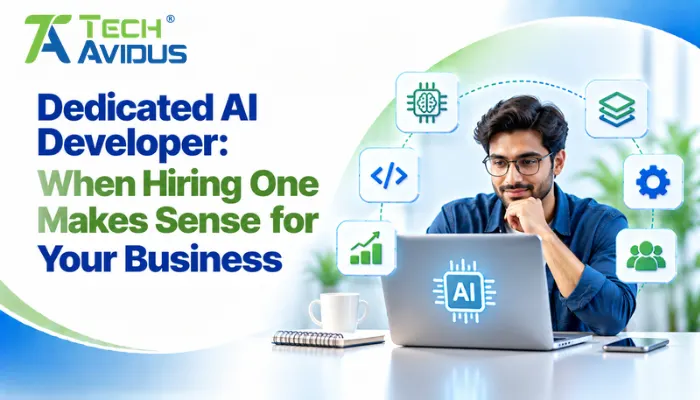
As business requirements become more complex, having a dedicated AI developer can help organizations turn ideas into practical, scalable solutions. Whether you are planning to build an AI-powered application, improve existing software, or automate internal operations, having the right technical expertise can make a significant difference.
But does every business need an in-house AI specialist? Not necessarily. The decision depends on your project requirements, technical capabilities, development roadmap, and long-term business objectives.
Why Is Specialized AI Expertise Becoming Important?
Specialized AI expertise helps businesses move beyond basic automation and develop solutions that address specific operational challenges.
Many organizations experiment with ready-made AI tools, but these tools may not fully support complex workflows, business-specific data, or existing software infrastructure.
For example, an eCommerce company might need an intelligent recommendation engine that analyzes customer preferences and purchasing behavior. Similarly, a healthcare software provider might require an AI-powered system to organize information and support administrative workflows.
These projects involve several technical activities, including data preparation, model selection, application development, API integration, testing, and deployment.
According to the Stanford HAI 2026 AI Index Report, organizational AI adoption continued to increase in 2025. This reflects the growing importance of developing practical AI capabilities across business functions.
When Does Your Business Need Additional Technical Expertise?
Hiring specialized talent makes sense when AI becomes an important part of your product development or business operations.
Here are some situations where bringing in an experienced professional can be valuable.
1. When You Are Building an AI-Powered Product
Developing an AI-powered product requires more than connecting an existing model to an application. Businesses must consider architecture, data processing, model performance, security, and user experience.
An experienced professional can help design intelligent features, develop backend functionality, connect machine learning models, and prepare applications for production environments.
This is particularly useful for startups developing SaaS platforms, intelligent dashboards, recommendation systems, and customer-facing applications.
2. When Your Business Needs Workflow Automation
Manual business processes can consume valuable employee time and create operational delays.
For example, businesses may want to automate customer support requests, document processing, lead qualification, invoice classification, or internal reporting.
An AI specialist can identify suitable automation opportunities and develop workflows using technologies such as Python, machine learning, large language models, and workflow automation platforms.
The objective should be to improve operational efficiency while keeping appropriate human oversight.
3. When Existing AI Projects Require Continuous Improvement
An AI application does not become successful simply because its initial version works.
Models may require performance improvements, integrations may need maintenance, and application requirements can change as the business grows.
Having consistent technical support makes it easier to investigate errors, improve model responses, monitor performance, and introduce new capabilities without repeatedly rebuilding the development process.
4. When Your Internal Team Lacks AI Experience
Your existing software development team may be highly experienced in web development, mobile applications, or backend engineering but may not have sufficient knowledge of machine learning or generative AI.
In such situations, bringing in an experienced AI professional can fill technical gaps and support knowledge sharing.
They can also collaborate with existing developers, designers, product managers, and business stakeholders to keep implementation aligned with organizational goals.
What Responsibilities Should an AI Professional Handle?
An AI development professional should contribute throughout the software development lifecycle, rather than focusing only on model development.
Their responsibilities may include:
Understanding business requirements: Identifying operational challenges and translating business objectives into technical specifications.
Designing application architecture: Selecting suitable frameworks, models, databases, and infrastructure for the intended solution.
Developing intelligent features: Building machine learning capabilities, generative AI functionality, recommendation systems, and natural language processing solutions.
Managing data workflows: Preparing, processing, validating, and organizing datasets to support reliable model performance.
Handling integrations: Connecting AI capabilities with existing applications, APIs, CRM platforms, ERP systems, and third-party services.
Testing and deployment: Evaluating application performance, identifying errors, managing deployment, and preparing the solution for real-world usage.
Ongoing maintenance: Monitoring application behavior, addressing technical issues, and improving functionality as business requirements evolve.
Should You Hire Internally or Work With an External Specialist?
The right hiring approach depends on the complexity of your project and the amount of ongoing technical work involved.
An internal employee may be suitable when AI development is a continuous business requirement and the organization wants direct control over its technical roadmap.
An external specialist or dedicated development arrangement may be more practical when a business needs additional expertise without building an entire internal department.
Working with an experienced technology partner can also provide access to professionals with different technical backgrounds.
For businesses that need support across planning, development, implementation, and maintenance, professional AI Development Services can help establish a structured development process based on specific project requirements.
The important consideration is to select an arrangement that supports communication, technical ownership, security, and long-term product goals.
Advantages and Limitations to Consider
Bringing specialized technical expertise into your business can offer several advantages, but organizations should also understand the responsibilities involved.
Advantages
Better technical focus: A dedicated professional can concentrate on AI-related development activities instead of dividing attention across unrelated software tasks.
Consistent development: Ongoing involvement helps maintain architectural consistency and makes future improvements easier to manage.
Faster problem-solving: Experienced developers can identify technical challenges and investigate issues involving models, datasets, APIs, and application performance.
Improved scalability: Proper architecture and development practices help applications accommodate changing business requirements.
Limitations
Requirement clarity: Without clearly defined objectives, even experienced developers may spend time building features that do not solve the actual business problem.
Data availability: AI solutions depend on suitable data. Incomplete, inconsistent, or poorly organized datasets can affect development quality.
Ongoing management: AI applications require monitoring, testing, security reviews, and regular improvements.
Technical coordination: Successful implementation requires collaboration between developers, management, and other stakeholders.

Real-World Business Scenarios
Consider how different organizations might benefit from specialized AI development expertise.
Scenario 1: An eCommerce Business
An online retailer wants to introduce personalized product recommendations. Its existing platform stores customer interactions and purchasing information but lacks intelligent recommendation functionality.
An experienced developer can create a recommendation workflow, connect it with the product database, and evaluate how effectively it presents relevant products to customers.
Scenario 2: A SaaS Startup
A startup is developing a SaaS platform with an AI-powered document analysis feature. Its existing development team can build the application interface but needs additional expertise in language models, document processing, and backend integrations.
Bringing in an AI specialist can help the team develop and test the required functionality while maintaining the existing product architecture.
Scenario 3: An Enterprise Organization
A large organization wants to reduce repetitive administrative work through intelligent document processing.
The development process may involve connecting internal databases, implementing document classification, configuring access permissions, and introducing monitoring mechanisms.
In each situation, the actual benefits depend on implementation quality, business requirements, data readiness, and user adoption.
Best Practices for Making the Right Hiring Decision
Before bringing additional technical expertise into your organization, consider the following recommendations.
Define your business objectives: Identify the specific problem you want AI to solve. Establish measurable goals rather than adopting technology simply because it is trending.
Evaluate practical experience: Review previous projects involving machine learning, generative AI, API development, application deployment, and production environments.
Check technical compatibility: Ensure the professional understands the frameworks, programming languages, cloud infrastructure, and software architecture relevant to your project.
Prioritize security: Discuss data privacy, access management, model risks, and security testing before implementation begins.
The NIST AI Risk Management Framework is a useful reference for organizations. It outlines four core functions: Govern, Map, Measure, and Manage, helping teams consider AI risks throughout the system lifecycle.
Start with a clear roadmap: Divide larger projects into manageable development stages. Begin with a well-defined use case, validate the results, and expand functionality based on business requirements.
Establish communication processes: Define responsibilities, documentation practices, development milestones, and review procedures to keep everyone aligned.
Quick Recap: Making the Right Decision
Hiring specialized AI talent makes sense when your business needs continuous development, advanced automation, intelligent product features, or improvements to existing AI applications.
Organizations with limited internal expertise can consider external development partnerships to access the required technical capabilities.
The best hiring decision depends on project complexity, data readiness, security requirements, internal resources, and long-term business objectives.
Conclusion
Hiring the right technical expertise is an important decision for businesses planning to adopt artificial intelligence. It becomes particularly valuable when projects require specialized knowledge, continuous development, complex integrations, and long-term technical support.
Before making a hiring decision, evaluate your business requirements, identify existing skill gaps, and establish a clear development roadmap. Choosing the right professional or technology partner can help transform AI ideas into practical business applications.
At TechAvidus, we help businesses develop intelligent software solutions that align with their operational requirements and future goals. Whether you are starting a new AI project or improving an existing application, our expertise in AI Integration Service can support your development journey.
Connect with TechAvidus for a free consultation and discuss the right technical approach for your next project.
.jpg "Raju Parmar")
Raju Parmar
Raju Parmar is an AI integration specialist passionate about connecting intelligent technologies with real-world business solutions. He focuses on integrating AI-powered tools, APIs, machine learning models, and automation systems into existing business workflows. With a strong understanding of modern AI technologies, Raju helps businesses improve operational efficiency, streamline processes, and build smarter digital experiences through practical and scalable AI integration solutions.