Key Takeaways
- 1. Start with repetitive business activities where AI can provide measurable improvements.
- 2. Select AI tools based on business requirements, data security, and compatibility.
- 3. Introduce AI through small pilot projects before expanding across departments.
- 4. Monitor productivity, accuracy, customer experience, and operational performance.
- 5. Maintain human oversight to support responsible and reliable AI adoption.
Introduction
Artificial intelligence is changing how businesses manage daily operations, communicate with customers, and make decisions. However, adopting AI successfully requires more than experimenting with popular tools. Businesses need a clear strategy that connects AI capabilities with real operational needs.
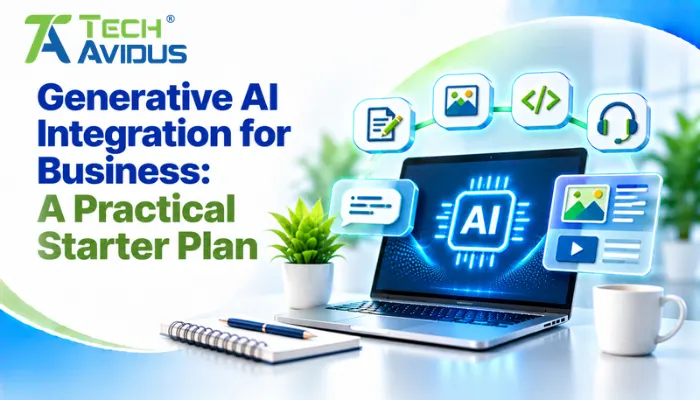
Generative AI Integration for Business helps organizations introduce intelligent solutions into existing workflows, from customer support and content creation to document processing and internal knowledge management. The key is to start with manageable opportunities, understand the available data, and measure results before expanding.
For growing companies, a practical starting plan can make AI adoption more structured, productive, and sustainable.

Understand Where Generative AI Fits Into Your Business
Generative AI can help businesses create content, summarize information, answer questions, analyze documents, and support customer interactions. Its value depends on how effectively these capabilities address existing business challenges.
Before selecting a tool, identify activities that consume significant employee time or involve repetitive manual work.
For example, a sales team might spend hours preparing follow-up emails, while customer support employees repeatedly answer similar questions. AI-powered workflows can assist with these activities while allowing employees to focus on more complex responsibilities.
Start by identifying three areas:
- Repetitive tasks: Find processes involving frequent data entry, document preparation, and routine communication. These are often suitable starting points for automation.
- Information management: Identify challenges involving searching, organizing, and summarizing business documents. AI assistants can help employees access relevant information more efficiently.
- Customer engagement: Review common customer questions and support requests. AI-powered assistants can provide initial responses and route complex queries to employees.
Build a Practical Starting Roadmap
A successful AI adoption plan should move from identifying business needs to testing, measuring, and improving solutions.
Step 1: Identify Business Challenges
Start with a specific operational problem instead of adopting AI simply because it is popular.
For instance, if employees spend too much time preparing reports, explore whether AI can summarize business data and generate initial report drafts.
Step 2: Select the Right AI Capabilities
Different business challenges require different AI technologies.
Consider large language models (LLMs), retrieval-augmented generation (RAG), AI chatbots, document processing, and workflow automation depending on the intended application.
The selected technology should integrate with existing systems rather than create unnecessary operational complexity.
Step 3: Prepare Your Business Data
AI solutions need appropriate information to generate useful outputs. Review data quality, access permissions, document formats, and privacy requirements before implementation.
Businesses should also establish clear rules about which information employees can share with external AI platforms.
Step 4: Launch a Small Pilot Project
Choose one department or workflow and test the solution with a limited group of employees.
Collect feedback about response accuracy, usability, processing time, and potential errors. Improve the workflow before introducing it to other departments.
Step 5: Measure and Expand
Once the pilot demonstrates practical value, identify opportunities to extend the solution.
Document the implementation process, assign responsibilities, train employees, and establish ongoing performance monitoring.
How Can Businesses Measure the Value of AI Adoption?
Measuring AI Integration ROI requires businesses to compare the improvements generated by an AI solution against the resources required to implement and maintain it.
Instead of focusing only on automation, evaluate measurable business outcomes.
Useful indicators include:
- Employee productivity and time saved on repetitive activities.
- Customer response times and support resolution rates.
- Document processing accuracy and error frequency.
- Lead response efficiency and sales team productivity.
- Employee adoption and satisfaction with AI-powered workflows.
For example, a business introducing an AI customer support assistant can compare average response times and the number of requests resolved without manual intervention before and after implementation.
The measurement process should also consider maintenance, integration effort, employee training, and human review requirements. This provides a more realistic understanding of business value.
Practical Applications Across Different Business Operations
AI can support multiple departments when it is connected to clearly defined business processes. The best applications are those that solve existing problems without introducing unnecessary complexity.
Here are some practical AI Integration Examples across different business functions.
- Customer support: An AI chatbot can answer frequently asked questions, guide customers through basic processes, and forward complicated requests to support employees.
- Sales and marketing: AI can help draft personalized emails, summarize customer interactions, organize leads, and generate initial campaign ideas.
- Human resources: AI-powered tools can assist with job description preparation, employee documentation, and internal policy searches.
- Finance and administration: AI can summarize invoices, extract information from documents, and assist with routine reporting, subject to appropriate verification.
- Operations: AI assistants can help employees search internal documentation, prepare process summaries, and retrieve relevant business information.
These applications demonstrate how intelligent automation can support existing teams rather than replace the judgment and experience of employees.
What Are the Main Advantages and Limitations?
The Benefits of AI Integration in Business extend beyond reducing repetitive work. Properly implemented solutions can improve information accessibility, support faster workflows, and help teams make better use of available resources.
Advantages
- Improved productivity: Employees can use AI to prepare drafts, summarize documents, and complete repetitive activities. This creates more time for strategic and customer-focused responsibilities.
- Better customer experiences: AI assistants can provide faster initial responses and help customers find relevant information. Human employees remain available for sensitive or complicated situations.
- More efficient operations: Connecting AI with business applications can reduce unnecessary manual steps. It also helps teams manage information across different workflows.
- Better access to information: AI-powered knowledge assistants can retrieve relevant information from approved internal documents. This supports employees who need quick access to organizational knowledge.
Limitations
- Incorrect outputs: Generative AI can produce inaccurate or misleading information. Important business decisions and customer-facing responses require appropriate verification.
- Data privacy concerns: Sensitive company information must be protected through access controls, secure integrations, and suitable data-handling policies.
- Integration challenges: Connecting AI tools with older business applications can require additional development and testing.
- Employee adoption: Employees may need training and time to become comfortable using AI-powered systems.
The National Institute of Standards and Technology provides useful guidance through its Generative AI Risk Management Profile, which discusses risks and responsible practices throughout the AI lifecycle.
Is AI Adoption Practical for Small Businesses?
AI Integration For Small Business does not require transforming every department at once. Smaller organizations can begin with one affordable, manageable use case and expand as their operational needs grow.
For example, a small eCommerce company could introduce an AI assistant to help answer common product questions, prepare product descriptions, and organize customer feedback.
A professional services company could use AI to summarize meeting notes, prepare initial proposals, and organize internal knowledge.
The important consideration is choosing tools that match the company's workflow, available technical resources, and security requirements. Small businesses should prioritize simplicity, measurable value, and ease of maintenance.
Signs Your Business May Need AI Support
Signs Your Business Needs Ai Integration often appear in everyday operations before management considers adopting new technology.
Look for these common indicators:
- Too much repetitive work: Employees regularly spend time preparing similar documents, answering repeated questions, or transferring information between applications.
- Slow customer responses: Customer inquiries remain unanswered because support teams cannot manage incoming requests efficiently.
- Disconnected business information: Employees struggle to find accurate information across multiple platforms, files, and databases.
- Growing operational complexity: Business activities increase, but existing processes become harder to manage with manual coordination.
- Limited reporting efficiency: Teams spend considerable time collecting and organizing information before they can make decisions.
Recognizing these challenges helps businesses identify where intelligent solutions could provide practical support.
Real-World Implementation Scenario
Consider a growing eCommerce company managing hundreds of customer inquiries every week.
Its support employees regularly answer questions about order status, product specifications, delivery procedures, and return policies. This creates repetitive workloads and can delay responses to more complicated customer concerns.
A practical AI implementation could follow this workflow:
- Connect an AI assistant to approved product documentation and customer support information.
- Integrate it with the company's website and existing support platform.
- Configure it to answer common questions using verified information.
- Forward sensitive or complicated requests to human support employees.
- Monitor answer accuracy, customer feedback, and response efficiency.
During implementation, the team should test common questions, unusual requests, incorrect information, and situations requiring human intervention.
This scenario illustrates how businesses can introduce AI into an existing workflow without replacing their entire technology infrastructure.
Best Practices for Successful Implementation
A structured approach helps businesses avoid unnecessary complexity and build solutions that remain useful as operations grow.
- Define measurable objectives: Establish what the solution should improve before development begins. Use clear indicators such as response time, processing accuracy, and employee productivity.
- Prioritize data security: Establish access permissions, encryption requirements, and data retention policies. Review third-party AI providers before connecting business information.
- Keep humans involved: Assign employees to review important AI-generated outputs. Human oversight is especially important for financial, legal, customer-facing, and sensitive business decisions.
- Choose scalable technology: Select AI models and integration methods that can support future business requirements. Avoid creating unnecessary dependencies on a single platform.
- Train employees: Explain how the system works, where it can help, and when manual verification is necessary. Employee confidence plays an important role in adoption.
- Review performance regularly: Monitor output quality, system reliability, user feedback, and operational improvements. Update prompts, knowledge sources, and workflows when requirements change.
For additional guidance, businesses can refer to the NIST AI Risk Management Framework when developing responsible AI policies and oversight processes.
Relevant Technology and Development Support
Implementing AI successfully often requires connecting multiple technologies into one reliable business workflow.
Depending on the use case, businesses may need large language models, APIs, cloud infrastructure, vector databases, RAG architecture, authentication systems, and existing CRM or ERP integrations.
For example, a company building an internal knowledge assistant may combine an LLM with a vector database and RAG pipeline to retrieve information from approved company documents.
TechAvidus helps businesses explore custom AI applications, software integrations, workflow automation, and scalable development approaches based on their operational requirements.
Recap: A Practical Approach to AI Adoption
Successful AI adoption begins with identifying business challenges and selecting suitable applications.
Businesses should start with a focused pilot project, prepare reliable data, and integrate AI with existing workflows.
Performance should be evaluated through productivity, accuracy, customer experience, security, and measurable operational improvements.
Continuous monitoring and employee involvement help organizations build reliable and scalable AI solutions.
Conclusion
Generative AI can create meaningful opportunities for businesses when implemented with a clear purpose and practical roadmap. The best starting point is not adopting every available AI tool but identifying operational challenges where intelligent technology can make a measurable difference.
Start small, evaluate results, involve employees, and gradually expand successful applications across your organization.
TechAvidus helps businesses plan, develop, and implement customized AI solutions that align with their operational goals. Explore our AI Integration Service to discover how the right technology can support your business transformation.
Ready to explore AI opportunities for your business? Request a free consultation with TechAvidus.
.jpg "Mayur Parmar")
Mayur Parmar
Mayur Parmar is an AI Integration expert specializing in connecting artificial intelligence technologies with business applications and digital workflows. He focuses on integrating AI models, APIs, automation tools, and intelligent systems to improve operational efficiency, streamline processes, and enhance user experiences. With a strong interest in practical AI solutions, Mayur helps businesses leverage AI capabilities to build smarter, more scalable, and efficient applications that support innovation and long-term business growth.