Key Takeaways
- 1. AI-generated applications should be reviewed for functional, architectural, performance, and security issues before production use.
- 2. Hidden bugs often appear at integration points, authentication flows, database operations, edge cases, and error-handling paths.
- 3. A structured code audit helps identify problems that ordinary testing may not reveal.
- 4. Refactoring and security validation should happen alongside bug fixing rather than as an afterthought.
- 5. Human engineering review remains important when AI-assisted development is used for business-critical software.
AI-generated software can help teams move from an idea to a working application quickly, but fast generation does not automatically mean production-ready code. Hidden logic errors, weak validation, insecure dependencies, inconsistent architecture, and incomplete error handling can remain unnoticed until users encounter them.
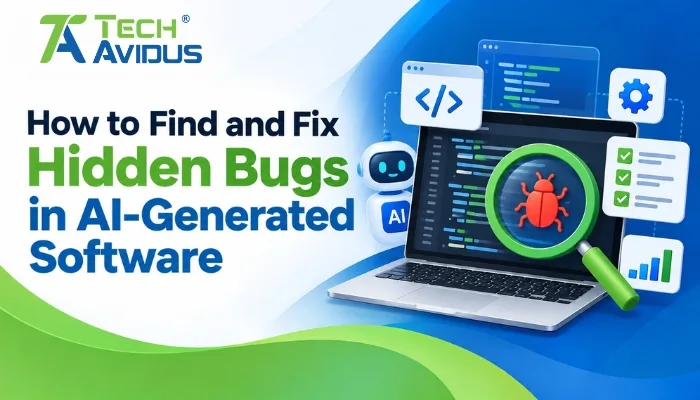
For startups and growing businesses, Fix Hidden Bugs in AI-Generated Software requires more than correcting visible errors. It involves understanding how the application works, identifying root causes, testing risky areas, improving code quality, and validating security before making further changes.
Why Do AI-Generated Applications Develop Hidden Bugs?
AI coding tools can generate functional-looking code without fully understanding the application's business requirements, long-term architecture, or production environment. A feature may work during a simple demonstration while failing under unusual inputs or real-world conditions.
Common hidden problems include:
- Logic errors: A workflow may produce the wrong result only under specific conditions or user actions.
- Weak validation: Inputs may not be properly checked before reaching databases, APIs, or application logic.
- Authentication gaps: Different user roles may accidentally receive access to functions or information they should not see.
- Dependency problems: Generated code may rely on outdated, unnecessary, or poorly configured packages.
- Integration failures: APIs, payment services, databases, authentication providers, and third-party platforms may behave differently than expected.
- Poor error handling: The application may fail silently, expose technical information, or leave transactions in an inconsistent state.
The key issue is that successful execution is not proof of software quality. A feature can appear correct while still containing defects that surface only when the application's conditions change.

How to Find Hidden Bugs in AI-Generated Software
Finding hidden defects requires a structured investigation rather than simply asking an AI tool to generate more code.
1. Reproduce the Problem
Start by documenting exactly what happens, what should happen, and under which conditions the problem appears.
In practice, engineers should reproduce the issue using realistic inputs and examine logs, API responses, database activity, browser behavior, and application state. This creates a reliable starting point before modifying the code.
2. Review the Application Architecture
AI-generated applications can accumulate duplicated logic, tightly coupled components, unnecessary dependencies, and inconsistent patterns.
Review the frontend, backend, database layer, APIs, authentication system, environment configuration, and third-party integrations. The objective is to understand how information moves through the application and where failures can propagate.
3. Ask What Does a Code Audit Check?
A practical code audit checks more than syntax. It can examine architecture, code quality, dependencies, authentication and authorization, input validation, error handling, database queries, API communication, configuration, testing coverage, and maintainability.
The exact scope depends on the application's technology and business risk, but the audit should prioritize areas where a defect could affect users, data, security, or availability.
4. Debug AI-Generated Code Systematically
When you Debug AI-Generated Code, avoid making isolated changes simply because an AI assistant suggests them.
First identify the failing behavior, trace the execution path, locate the root cause, apply a controlled fix, and run regression tests. This prevents one correction from creating another problem elsewhere in the application.
5. Refactor AI-Generated Code Where Necessary
Some bugs are symptoms of deeper structural problems. In those situations, teams may need to Refactor AI-Generated Code instead of repeatedly patching individual functions.
Refactoring can involve removing duplicated logic, separating responsibilities, improving naming and structure, simplifying complex functions, strengthening error handling, and creating clearer boundaries between application components.
Security Should Be Part of the Bug-Fixing Process
Security problems can remain hidden even when an application appears to work correctly.
A production review should examine authentication, authorization, secrets management, input validation, dependency risks, API permissions, database access, logging, and sensitive-data handling. For AI-enabled applications, the review may also need to consider prompt injection, insecure output handling, sensitive information disclosure, and other AI-specific risks.
OWASP's current GenAI security guidance identifies major risks for applications powered by large language models, making it a useful reference when evaluating AI-enabled software.
NIST's Secure Software Development Framework also recommends integrating security practices throughout the software development lifecycle rather than treating security as a final-stage activity.
How Do You Secure a Vibe-Coded Application?
To Secure a Vibe-Coded Application, start with an application inventory and risk assessment. Review exposed endpoints, authentication flows, database permissions, environment variables, dependencies, user roles, and external integrations.
Security testing should then be combined with functional testing. A secure application must not only resist obvious attacks; it should also behave correctly when users submit unexpected data or interact with features in unusual sequences.
What Is the Vibe Coding Rescue Process?
A practical vibe coding rescue process usually begins with discovery rather than immediate rewriting.
First, the engineering team reviews the existing codebase and identifies critical application flows. Next, it reproduces known issues, maps technical dependencies, evaluates security and architecture, prioritizes defects, and establishes a controlled remediation plan.
The final stage involves implementing fixes, refactoring unstable areas, running regression tests, and documenting the resulting codebase. This approach is particularly useful when a startup has a working prototype but lacks confidence in its production readiness.
Who Fixes Broken AI-Generated Code for Startups?
Who fixes broken AI-generated code for startups depends on the application's complexity, but experienced software engineers with knowledge of architecture, debugging, security, testing, and deployment are generally better positioned to handle complex remediation work.
For a small prototype, an experienced developer may be enough. For a business-critical application, startups may benefit from a broader engineering review covering code quality, infrastructure, security, integrations, and production readiness.
TechAvidus can assess AI-assisted applications, identify unstable areas, improve code quality, and help establish a more maintainable software foundation through relevant [TechAvidus — AI Development Services].
How Much Can It Take to Fix AI-Generated Code?
The cost to fix AI-generated code depends on factors such as application size, code quality, technical debt, number of defects, architecture, integrations, security requirements, documentation, and how much of the existing code can be retained.
A useful assessment should therefore happen before committing to a remediation strategy. Instead of assuming that every AI-generated application needs to be rebuilt, an engineering review can determine which components should be fixed, refactored, replaced, or retained.
Advantages and Limitations of AI-Assisted Software Development
Advantages
AI-assisted development can accelerate prototyping, help developers explore implementation options, generate repetitive code, and support faster experimentation.
For startups, this can shorten the path from an idea to a testable product and make early-stage development more accessible.
Limitations
Generated code can contain hidden assumptions, inconsistent patterns, weak security controls, unnecessary dependencies, and technical debt.
AI tools also do not automatically understand every business rule, compliance requirement, infrastructure constraint, or long-term maintenance consideration. Human review remains essential for software that handles important data or business processes.

A Practical Example: From AI Prototype to Stable Application
Consider a startup that uses an AI coding tool to create a customer-management application. The prototype successfully creates users, stores records, and displays dashboards.
After launch testing, several problems appear. Some users can access information outside their intended account scope. Certain API requests fail when fields are missing, while another workflow creates duplicate records after repeated submissions.
Instead of fixing each symptom independently, an engineering team can map the affected workflows, inspect authorization rules, trace database operations, reproduce the failures, and review the relevant application architecture.
The team can then prioritize security-sensitive issues, correct the underlying logic, refactor duplicated code, add regression tests, and validate the application again before deployment.
This approach turns bug fixing into a controlled engineering process rather than a series of reactive patches.
Best Practices for Preventing Hidden Bugs
- Create tests around critical workflows.
Focus on authentication, payments, data creation, permissions, API integrations, and other business-critical functions. Include edge cases instead of testing only successful scenarios. - Review generated dependencies.
Check whether packages are necessary, maintained, correctly configured, and appropriate for the application's environment. - Separate fixes from feature expansion.
Adding new functionality while the foundation is unstable can make debugging harder. Stabilize critical components before increasing complexity. - Use version control and small changes.
Keep changes traceable so that a problematic modification can be identified and reversed without disrupting the entire project. - Perform security reviews early.
Authentication, authorization, secrets, data access, and API security should be reviewed before production rather than after an incident. - Document important decisions.
Documentation helps future developers understand why a component exists, how it interacts with other services, and what assumptions it depends on.
For startups that need a broader technical review, a relevant option can be [TechAvidus — AI Application Development Services].
Recap: What Should You Do With Buggy AI-Generated Software?
AI-generated software should be evaluated as software—not assumed to be reliable simply because it was produced by an AI tool.
Hidden bugs are best addressed through reproducible testing, code review, architecture analysis, security assessment, targeted debugging, refactoring, and regression testing.
A working prototype can often be improved without completely rebuilding it, provided the underlying architecture is understood and remediation is prioritized according to technical and business risk.
Conclusion
AI-assisted development can be extremely useful for creating prototypes and accelerating software development, but Vibe Codding Rescue Services can help address hidden bugs, unstable code, security concerns, and technical debt when AI-generated applications require expert engineering support.
If your application contains unexplained bugs, inconsistent behavior, security concerns, or growing technical debt, start with an assessment instead of immediately rebuilding everything. Identify the highest-risk areas, understand the root causes, stabilize critical workflows, and introduce tests that prevent the same problems from returning.
TechAvidus can help businesses evaluate AI-assisted applications, improve unstable codebases, strengthen production readiness, and build a more maintainable foundation. Request a free consultation with TechAvidus to discuss your application and determine the right next step.

Bhavesh Ladva
Bhavesh Ladva specializes in MCP (Model Context Protocol) Server Development, helping businesses connect AI applications with external tools, APIs, databases, and business systems. His work focuses on building custom MCP servers that enable smoother tool execution, structured data access, and reliable AI integrations. By simplifying connections between AI models and existing workflows, Bhavesh helps teams reduce manual steps, improve process efficiency, and develop more practical AI-powered solutions. He prioritizes secure integrations, maintainable architecture, and scalable implementations aligned with real business requirements.