

Key Takeaways
- 1. A technical code audit examines security, architecture, code quality, dependencies, performance, and maintainability.
- 2. AI-generated code should be reviewed by experienced developers because automated generation does not guarantee secure or maintainable implementation.
- 3. Signs your AI app needs a code audit often include recurring bugs, unclear architecture, duplicated code, unstable integrations, and difficulty adding features.
- 4. A structured audit can help teams stabilize AI-generated codebase issues before scaling the product.
- 5. Startups can combine audit findings with an app readiness checklist for startups to determine what needs attention before launch.
AI coding tools can help startups move from an idea to a working application quickly, but working code is not automatically production-ready code. A technical code audit examines how an application is built, how securely it handles data, how reliably its components work together, and how difficult it will be to maintain as the product grows.
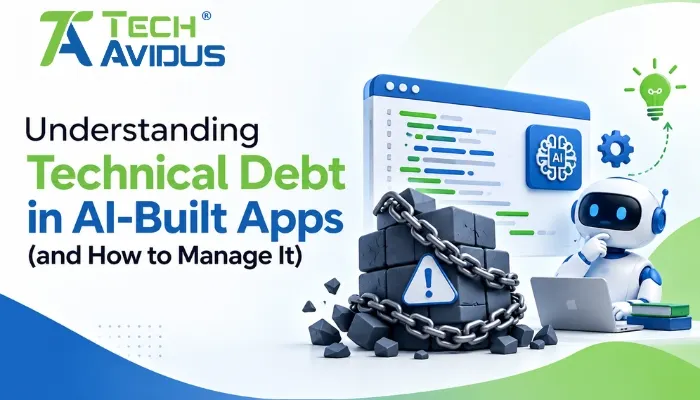
For teams building with AI-assisted development, an audit can reveal hidden security weaknesses, duplicated logic, fragile integrations, dependency risks, and technical debt from AI coding before those issues become expensive development problems.
What Does a Technical Code Audit Actually Check?
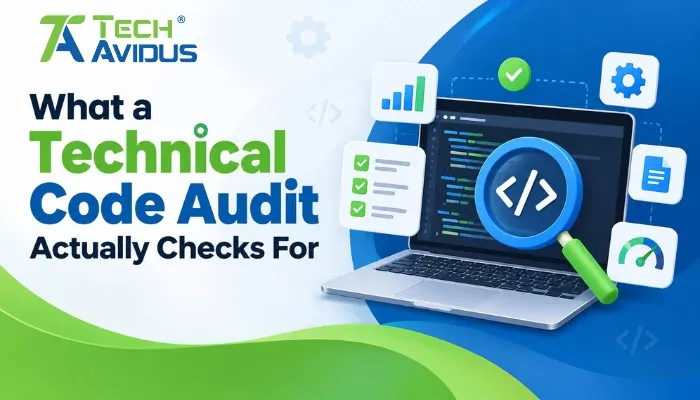
A technical code audit is a structured examination of an application's source code, architecture, dependencies, configuration, and development practices to identify technical risks and improvement opportunities.
The goal is not simply to find lines of bad code. A useful audit looks at how individual components interact and whether the entire application can remain secure, reliable, maintainable, and scalable.

1. Code Quality and Maintainability
The first area an auditor examines is the quality of the source code itself.
AI-generated applications can contain repeated functions, unnecessarily complicated logic, inconsistent naming, unused components, weak error handling, or code that works for one scenario but breaks under another.
An auditor typically checks:
- Code organization and readability
- Duplicate or unnecessary logic
- Error handling
- Naming and coding consistency
- Separation of responsibilities
- Reusable components
- Dead or unreachable code
The objective is to determine whether another developer can understand and safely modify the code without spending excessive time reverse-engineering it.
2. Application Architecture
Architecture determines how well the application can evolve.
A code audit examines the relationship between the frontend, backend, database, APIs, authentication systems, third-party services, and deployment environment. It can reveal tightly coupled components or architectural decisions that may create problems when the application grows.
For AI-built applications, this is particularly important because rapid prompting can produce functional features without establishing a consistent long-term architecture.
3. Security and Data Protection
One of the most important questions during an audit is: is my AI-generated app secure?
The answer cannot be determined simply by looking at whether the application works. Security requires examining authentication, authorization, input validation, API endpoints, database access, secrets, file handling, error messages, and sensitive data flows.
OWASP's Secure Code Review guidance emphasizes manual examination of application logic and data flow because automated tools may not identify every context-specific security weakness.
An audit may therefore review:
- Authentication and session management
- Role-based authorization
- Input and output validation
- API security
- Database queries
- Environment variables and secrets
- Sensitive information exposure
- Logging and error handling
The current OWASP Top 10 is also a useful reference point for reviewing major web application security risks.
4. Dependencies and Third-Party Components
Modern applications rarely operate independently. They depend on frameworks, libraries, APIs, payment services, authentication providers, cloud platforms, and other third-party components.
An audit checks whether these dependencies are properly maintained, appropriately configured, and still suitable for the application.
NIST's Secure Software Development Framework recommends reviewing third-party software components and checking for known vulnerabilities and maintenance risks.
This can uncover outdated packages, unnecessary dependencies, incompatible versions, or components that create avoidable security and maintenance risks.
5. Performance and Scalability
An application can perform well with a small number of users and still have architectural problems that appear under greater load.
A technical review can examine database queries, API response patterns, frontend rendering, caching, asynchronous processing, resource consumption, and inefficient operations.
The purpose is not to promise a specific performance improvement. Instead, the audit identifies potential bottlenecks and areas where the application may need optimization before its workload increases.
What Are the Signs Your AI App Needs a Code Audit?
Some of the clearest warning signs include recurring bugs, unexplained application behavior, duplicated code, fragile integrations, slow feature development, and difficulty understanding the existing codebase.
Other warning signals include:
- Every new feature creates another unexpected bug.
- Different parts of the application follow different coding patterns.
- Developers are afraid to modify existing functionality.
- Authentication or permissions behave inconsistently.
- API integrations fail without clear error handling.
- Nobody can clearly explain the application's architecture.
- The application depends heavily on generated code that has not received structured human review.
These symptoms do not automatically mean an application is unsafe or unusable. They indicate that a deeper technical assessment may be worthwhile.
How Does an Audit Identify Technical Debt from AI Coding?
AI-assisted development can accelerate implementation, but speed can also introduce inconsistencies when generated code is accepted without sufficient review.
Technical debt from AI coding can appear as duplicated implementations, unnecessary dependencies, inconsistent patterns, temporary workarounds, poorly documented logic, or features that function independently but do not fit the wider architecture.
An auditor looks beyond individual defects and identifies patterns. For example, five separate API handlers using five different approaches to validation may indicate a broader architectural issue rather than five unrelated coding problems.
Can a Technical Audit Help Stabilize an AI-Generated Codebase?
Yes. An audit can provide a prioritized roadmap for stabilizing an application instead of forcing a team to rewrite everything.
To stabilize AI-generated codebase issues effectively, developers can classify findings into categories such as critical security problems, functional defects, architectural weaknesses, maintainability concerns, and lower-priority cleanup.
NIST recommends combining code review and code analysis with a process for recording, triaging, and addressing discovered issues.
This approach helps teams fix the most consequential problems first while preserving code that already works appropriately.
Pros and Limitations of a Technical Code Audit
Advantages
Better risk visibility: An audit gives teams a clearer understanding of security, architecture, code quality, and dependency risks.
Improved maintainability: Identifying duplicated and unnecessarily complex code can make future development easier.
Smarter development planning: Findings can help product teams prioritize remediation instead of fixing issues randomly.
Better launch preparation: Audit results can support a structured assessment of whether the application is technically prepared for its intended users.
Limitations
An audit is not a guarantee of security: A review can identify many risks, but no single assessment proves that an application contains no vulnerabilities.
Some findings require business context: A technically imperfect implementation may be acceptable for a particular use case, while a small weakness could be significant in another environment.
Remediation requires development effort: Finding a problem is only the first step. The underlying issue still needs to be fixed, tested, and monitored.
Real-World Scenario: Reviewing an AI-Built Startup Application
Imagine a startup has used AI coding tools to build an MVP containing user registration, dashboards, subscription functionality, and several third-party APIs.
The application works during demonstrations, but developers encounter increasingly unpredictable bugs when adding features.
During an audit, the team discovers duplicated authentication logic, inconsistent API error handling, outdated dependencies, excessive database requests, and configuration values that need better protection.
Instead of immediately rebuilding the application, the team can prioritize the findings, address the highest-risk issues, establish consistent patterns, and then continue feature development on a more stable foundation.
For teams preparing for launch, this process can complement an app readiness checklist for startups covering functionality, security, deployment, monitoring, documentation, and operational ownership.
How to Choose the Right Developer for AI-Generated Code Fixes
When selecting a developer to repair AI-assisted software, look beyond general programming experience. The developer should be comfortable understanding an existing codebase, diagnosing root causes, reviewing security controls, working with the application's technology stack, and explaining technical findings clearly.
How to choose a developer to fix AI-generated code depends on the application's actual problems and technology rather than simply choosing someone who works with AI tools.
Look for evidence of experience with:
- Code audits and refactoring
- Application security
- API and database architecture
- Debugging unfamiliar codebases
- Testing and deployment
- Cloud infrastructure where relevant
- AI-assisted development workflows
Ask the developer to explain how they would inspect the existing application before proposing a rewrite. A thoughtful remediation plan should distinguish between code that needs replacement and code that can safely be improved.
For complex applications, a small technical assessment or audit can also help establish whether the developer understands the existing architecture before major changes are made.
Best Practices for a Technical Code Audit
Start with the application's architecture rather than immediately reviewing individual files. Understanding data flows and system boundaries provides context for evaluating individual implementation decisions.
Review automated findings manually. Static analysis, dependency scanners, linters, and testing tools can identify useful signals, but human review remains important for business logic and context-specific risks. NIST specifically recognizes code review and code analysis as complementary practices.
Prioritize findings by risk and business impact. Not every issue needs immediate remediation, so separate critical problems from improvements that can be addressed during normal development.
Document the reason behind each recommendation. A useful audit should explain what was found, why it matters, where it occurs, and what remediation approach should be considered.
Retest after remediation. Fixing code can introduce new behavior, so changes should be validated through appropriate automated and manual testing.
For startups, avoid treating the audit as a one-time event. Repeating focused reviews as the product evolves can help prevent technical debt from accumulating again.
Technical Code Audit Recap
A technical code audit evaluates more than whether an application currently works.
It examines code quality, architecture, security, dependencies, performance, maintainability, integrations, and development risks.
AI-generated applications can benefit from additional human review because generated code may require architectural, security, and maintainability validation before production use.
The most useful audit produces a prioritized remediation roadmap that developers can act on rather than simply a long list of technical problems.
Conclusion
AI-assisted development can accelerate application creation, but production readiness requires more than generated functionality. A technical code audit helps reveal what is happening underneath the interface—from security controls and dependencies to architecture, maintainability, and technical debt.
For startups and businesses with an AI-built application, the practical next step is to evaluate the existing codebase before making large development decisions. TechAvidus can help assess the application, identify priority issues, and create a practical remediation roadmap.
Explore Vibe Codding Rescue Services to take the next step, and request a free consultation to discuss your application.

Bhavesh Ladva
Bhavesh Ladva is an AI Developer and rapid product development expert with over 10 years of experience in AI, machine learning, deep learning, and NLP. He specializes in turning ideas into functional, scalable products using modern AI-powered development tools such as Lovable, Bolt, Claude, and other emerging AI platforms. His experience spans AI integrations, APIs, automation, cloud platforms, and intelligent workflows, enabling him to take products from concept to production efficiently.