Key Takeaways
- 1. AI-generated code should be refactored incrementally rather than rewritten blindly.
- 2. Tests and version control provide important safety nets during code changes.
- 3. Architecture, dependencies, security, performance, and error handling should be reviewed together.
- 4. Human review remains important because generated code can appear correct while missing application-specific requirements.
- 5. A structured refactoring process can turn an experimental codebase into a more maintainable application.
Introduction
AI coding tools can help startups build features quickly, generate prototypes, and turn ideas into working applications. The challenge often begins after the first version works. Generated code may contain duplicated logic, inconsistent patterns, weak error handling, unnecessary dependencies, or architecture that becomes difficult to maintain.
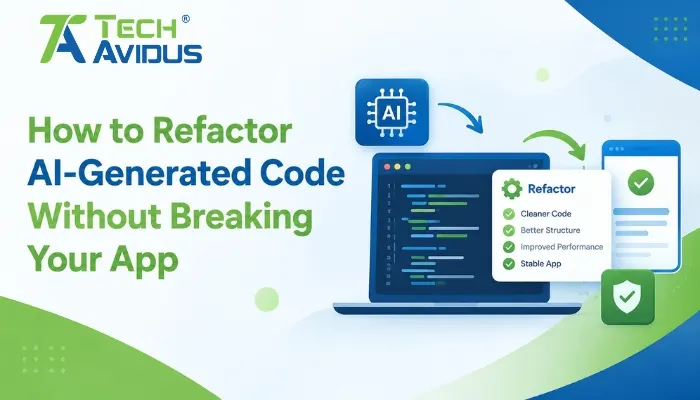
The goal is not to replace every AI-generated component. The safer approach is to understand what the application already does, identify risky areas, and make controlled improvements. In other words, Refactor AI-Generated Code by preserving expected behavior while improving its structure, reliability, security, and maintainability.
A careful refactoring process should therefore combine code inspection, testing, dependency analysis, incremental changes, and human engineering judgment.
Why Does AI-Generated Code Need Refactoring?
AI-generated code often optimizes for producing a functional answer to a prompt rather than understanding the complete long-term architecture of an application.
A developer may receive code that works for one feature but duplicates logic already present elsewhere. Another generated component may introduce a library that conflicts with the project's existing dependency strategy. Over time, these small decisions can create technical debt.
Common warning signs include:
- Duplicated functionality: Similar functions or components perform nearly the same task, making future changes harder to control.
- Inconsistent architecture: Different parts of the application follow different patterns for state management, API calls, validation, or database access.
- Weak error handling: Generated code may handle the expected success path but provide limited protection for failures, invalid inputs, or unexpected responses.
- Unused dependencies: AI tools can introduce packages or utilities that are unnecessary for the application's actual requirements.
- Hard-to-understand logic: Code can technically work while being difficult for another developer to maintain.
Refactoring addresses these problems without changing the application's intended behavior unnecessarily.
How to Refactor AI-Generated Code Safely
The safest approach is to treat refactoring as a controlled engineering process rather than a large rewrite.
1. Understand the Existing Application First
Before changing code, identify the application's architecture, major features, external integrations, database structure, authentication flow, and deployment environment.
Create a basic map of critical dependencies and application flows. This gives developers a reference point for determining whether a change affects only one component or has wider consequences.
For startups, an app readiness checklist for startups can be useful before substantial refactoring. It can cover build stability, testing, authentication, environment configuration, dependencies, monitoring, deployment, and documentation.
2. Establish a Baseline
Before modifying a component, confirm what currently works.
Run the existing application, execute available tests, inspect important user journeys, and document known bugs. Where automated tests are limited, create focused tests around critical functionality before making significant changes.
This baseline provides something concrete to compare against after every refactoring step.
3. Review the Architecture and Dependencies
The next step is to identify structural problems rather than immediately editing individual lines.
Look for duplicated services, oversized components, tightly coupled modules, unnecessary dependencies, repeated database queries, unclear interfaces, and inconsistent coding patterns.
This is also where a code audit can provide value. A structured review can reveal issues that are not immediately visible from the feature currently being fixed.
4. Understand What a Code Audit Checks
A thorough review generally examines application architecture, code quality, dependencies, security controls, data flows, error handling, performance-sensitive areas, configuration, and maintainability.
If you're asking what does a code audit check, the practical answer is that it examines how the application is built and whether its implementation introduces technical, security, operational, or maintenance risks.
For security-focused review, the OWASP Code Review guidance covers areas including authentication, authorization, input validation, logging, data handling, and common application vulnerabilities.
5. Refactor in Small, Testable Changes
Avoid changing the entire application at once.
Start with one module, service, component, or workflow. Improve its structure, run the relevant tests, inspect the result, and commit the change before moving to the next area.
Small commits also make it easier to identify exactly which change introduced a regression.
6. Debug AI-Generated Code Before Replacing It
Not every problematic component requires a rewrite.
To Debug AI-Generated Code, first reproduce the issue consistently. Then inspect the relevant execution path, inputs, dependencies, logs, and expected behavior.
For example, if an AI-generated payment workflow occasionally fails, replacing the entire payment module may introduce unnecessary risk. A better approach could be tracing the request flow, validating API responses, improving error handling, and adding tests for failed transactions.
What Should You Test After Refactoring?
Testing should cover more than whether the application starts successfully.
Functional tests should confirm that the original behavior still works. Integration tests can verify communication between services, databases, APIs, and third-party systems. Security checks should examine authentication, authorization, input handling, secrets, and sensitive data flows.
Regression testing is particularly important because refactoring changes existing code that other features may depend on.
NIST's Secure Software Development Framework recommends determining when code review and code analysis should be used and incorporating discovered issues and remediation into the development workflow.
For larger applications, static analysis, automated tests, dependency scanning, and human review can work together rather than being treated as separate activities.
How Do You Choose a Developer for AI-Generated Code Problems?
When evaluating how to choose a developer to fix AI-generated code, look beyond whether the developer knows the programming language.
The right engineer should be able to understand an existing codebase, reproduce bugs, assess architecture, work with version control, write or improve tests, analyze dependencies, and explain why a particular change is necessary.
Ask potential developers about their approach to:
- Existing applications rather than greenfield development.
- Regression prevention and testing.
- Security and dependency review.
- Technical debt and architecture.
- Incremental refactoring.
- Documentation and handover.
A strong developer should be comfortable saying that some code should be preserved, some should be refactored, and some may need to be replaced based on evidence.
The Vibe Coding Rescue Process: From Prototype to Maintainable App
The vibe coding rescue process should begin with diagnosis rather than immediate rebuilding.
A practical workflow can look like this:
- Application discovery: Understand the product, technology stack, architecture, integrations, and deployment environment.
- Issue reproduction: Reproduce reported bugs and identify affected workflows.
- Code assessment: Examine structure, dependencies, security, performance, and maintainability.
- Prioritization: Separate critical production risks from lower-priority cleanup.
- Controlled refactoring: Improve the highest-impact areas in small changes.
- Validation: Run automated and manual tests after each meaningful change.
- Production preparation: Verify configuration, deployment, monitoring, rollback, and documentation.
This approach is particularly useful when an application was created rapidly through AI-assisted or "vibe coding" workflows and has reached the point where additional features are becoming difficult to add safely.

How Much Can It Cost to Fix AI-Generated Code?
The cost to fix AI-generated code depends heavily on the condition and scope of the application rather than simply the amount of generated code.
Factors include codebase size, architecture, programming language, number of integrations, severity of bugs, test coverage, documentation quality, security requirements, deployment complexity, and whether the application needs targeted fixes or deeper restructuring.
A small application with clear architecture may require focused corrections. A larger application with tightly coupled components and little testing may require discovery, stabilization, refactoring, and regression testing before new development can safely continue.
For that reason, a technical assessment is usually more useful than estimating effort from the number of files or lines of code alone.
Who Can Fix Broken AI-Generated Code for Startups?
The question of who fixes broken AI-generated code for startups usually comes down to the type of problem involved.
A general developer may be suitable for isolated bugs, while an experienced software engineer or specialized development team can be more appropriate when problems involve architecture, security, integrations, deployment, or accumulated technical debt.
Startups should prioritize someone who can both diagnose the existing system and make controlled improvements. The objective is not simply to make one error disappear; it is to reduce the likelihood of the same class of problem returning.
Advantages and Limitations of AI-Assisted Refactoring
Advantages
Faster code discovery: AI tools can help developers locate repeated patterns, explain unfamiliar functions, and suggest possible restructuring approaches.
Useful modernization assistance: AI can assist with repetitive transformations, documentation, test generation, and straightforward code cleanup.
Developer productivity: When guided by experienced engineers, AI can accelerate certain maintenance tasks without removing human oversight.
Limitations
Context can be incomplete: AI may not understand undocumented business rules or dependencies outside the code it can see.
Suggested changes can introduce regressions: A seemingly cleaner implementation can unintentionally change application behavior.
Security is not guaranteed: Generated code should not automatically be treated as secure simply because it compiles or passes basic tests.
Large rewrites increase risk: Replacing functioning systems without understanding their dependencies can create more problems than it solves.
A Real-World Startup Scenario
Imagine a startup launches an MVP using AI-assisted development. The authentication flow works, the dashboard loads, and the application connects to a database.
As new features are added, developers discover duplicated API logic, inconsistent validation, slow queries, and occasional production errors.
Instead of rebuilding the application, the team first maps the architecture and identifies critical workflows. It then adds regression tests around authentication and database operations, reviews dependencies, isolates repeated services, improves error handling, and refactors one module at a time.
This approach allows the team to improve the foundation while continuing to protect existing functionality.
Best Practices for Safe AI Code Refactoring
Use version control aggressively. Keep focused commits so changes can be reviewed, compared, and reverted when necessary.
Preserve working behavior first. Refactoring should begin with a clear understanding of what the application currently does.
Test before and after changes. A reliable baseline makes regressions easier to identify.
Review dependencies. Remove unnecessary packages and verify that remaining dependencies are appropriate for the application.
Prioritize security. Examine authentication, authorization, input validation, secrets, data handling, and external integrations.
Document important decisions. Record architectural changes and unusual business rules so future developers do not have to rediscover them.
Combine automation with human review. AI tools, static analysis, and automated tests are useful, but application-specific judgment remains essential.
Recap: What Is the Safest Way to Improve AI-Generated Code?
Safe AI code refactoring means improving the internal structure of an application while preserving its expected behavior.
The process should begin with application discovery and a baseline, followed by code and dependency assessment, targeted changes, testing, security review, and production validation.
The most reliable strategy is incremental: understand the code, change one area at a time, test the result, and maintain a clear rollback path.
For applications that have become difficult to maintain after rapid AI-assisted development, a structured engineering review can help determine whether targeted fixes, refactoring, or broader architectural work is appropriate.
Conclusion
AI-assisted development can dramatically accelerate the early stages of building an application, but speed during development does not automatically produce maintainable production software.
The safest path is to understand the existing application, establish a baseline, identify technical and security risks, refactor incrementally, and validate every meaningful change.
TechAvidus can help startups with Vibe Coding Rescue Service by assessing AI-assisted applications, identifying problematic areas, improving code quality, and moving projects toward a more stable production foundation.
If your AI-built application is becoming difficult to maintain or you are unsure whether to fix, refactor, or rebuild it, request a free consultation with TechAvidus to discuss the application and determine a practical next step.

Bhavesh Ladva
Bhavesh Ladva specializes in MCP (Model Context Protocol) Server Development, helping businesses connect AI applications with external tools, APIs, databases, and business systems. His work focuses on building custom MCP servers that enable smoother tool execution, structured data access, and reliable AI integrations. By simplifying connections between AI models and existing workflows, Bhavesh helps teams reduce manual steps, improve process efficiency, and develop more practical AI-powered solutions. He prioritizes secure integrations, maintainable architecture, and scalable implementations aligned with real business requirements.