Key Takeaways
- 1. AI-generated applications should undergo security and code-quality reviews before production deployment.
- 2. Authentication, authorization, APIs, secrets, dependencies, data handling, and configuration deserve particular attention.
- 3. A structured audit helps separate genuine security risks from ordinary technical debt.
- 4. Fixes should be prioritized according to application exposure, business impact, and exploitability.
- 5. Security testing should continue after launch as the application, dependencies, and infrastructure evolve.
Introduction
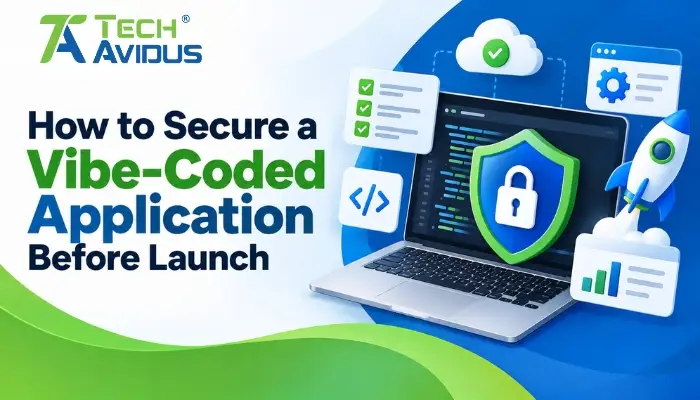
AI-assisted development and vibe coding can help startups turn an idea into a working application quickly. But getting an application to run is not the same as getting it ready for production. AI-generated code can contain weak authentication, exposed secrets, insecure APIs, poor access controls, vulnerable dependencies, or validation gaps that are easy to overlook during rapid development.
Before launch, startups should treat security as an engineering review rather than a final checkbox. Secure a Vibe-Coded Application by examining its architecture, source code, dependencies, authentication, APIs, data handling, deployment configuration, and error-handling behavior.
The goal is not to assume that AI-generated code is unsafe. The goal is to verify what the application actually does, identify meaningful risks, and fix weaknesses before real users and production data are exposed.
Why Does a Vibe-Coded Application Need a Security Review?
A security review is important because AI coding tools can generate functional code without necessarily understanding the complete security context of the application.
A developer may prompt an AI tool to create authentication, connect a database, build an API, or integrate a payment service. The resulting feature may work correctly in normal testing while still failing under malicious or unexpected input.
For example, an application may appear to restrict an admin page through the frontend while the backend API does not independently verify the user's authorization. Similarly, a database connection may work while credentials are accidentally exposed through configuration files or source code.
OWASP's 2025 Top 10 identifies areas such as broken access control, security misconfiguration, software supply-chain failures, cryptographic failures, injection, insecure design, authentication failures, and software or data integrity failures among the most critical web application security risks.
This makes the OWASP Top 10 a useful starting point for organizing a pre-launch review, although it should not be treated as a complete security checklist.

What Should You Check Before Launch?
A practical pre-launch review should examine the application from multiple angles rather than relying on a single automated scanner.
1. Authentication and Authorization
Check how users log in, how sessions or tokens are managed, and how permissions are enforced.
Every sensitive backend operation should verify authorization independently. Do not assume that hiding a button or page in the frontend prevents unauthorized access.
2. API Security
Review every important API endpoint for authentication, authorization, input validation, rate limiting, error handling, and excessive data exposure.
An API that works correctly for legitimate requests may still reveal sensitive information or accept unauthorized operations if its security controls are incomplete.
3. Secrets and Sensitive Information
Search the codebase and configuration for API keys, database credentials, tokens, private keys, and other secrets.
Secrets should be managed through appropriate environment or secret-management mechanisms rather than being embedded directly into source files or client-side code.
4. Dependencies and Third-Party Components
AI-assisted projects can quickly accumulate packages and libraries. Review dependencies for outdated versions, known vulnerabilities, unnecessary packages, and questionable configuration.
Software supply-chain security matters because vulnerabilities can enter an application through components that developers did not write themselves.
5. Input Validation and Injection Risks
Every untrusted input should be treated carefully, especially data entering databases, commands, templates, file operations, or external services.
Validate inputs according to their intended format and use secure APIs or parameterized mechanisms wherever appropriate.
What Does a Code Audit Check?
The question what does a code audit check becomes especially important when an application has been created quickly with AI assistance.
A useful code audit examines more than syntax or whether the application builds successfully. It can review architecture, authentication, authorization, API behavior, secret management, input validation, database queries, dependency usage, error handling, logging, configuration, and maintainability.
For an AI-assisted codebase, reviewers should also look for duplicated logic, unnecessary complexity, placeholder implementations, inconsistent security controls, unused functionality, and code that appears functional but has not been properly tested.
In practice, the audit should produce actionable findings rather than simply labeling the entire application as “secure” or “insecure.”
How Should AI-Generated Security Problems Be Fixed?
Finding a vulnerability is only the first stage. The next step is understanding why it exists and correcting the underlying implementation.
Teams may need to Debug AI-Generated Code when an application behaves unpredictably, fails security checks, produces unsafe responses, or contains incomplete implementations.
Debugging should begin with reproducible evidence. Identify the affected feature, reproduce the behavior, trace the relevant request or execution path, and determine whether the issue originates in frontend logic, backend logic, database access, configuration, or an external dependency.
After identifying the root cause, developers may need to Refactor AI-Generated Code rather than applying a small patch. Refactoring can simplify complicated logic, centralize security checks, remove duplicated functionality, improve validation, and make future maintenance easier.
The objective should be a reliable implementation—not simply making a security scanner stop reporting an issue.
Who Fixes Broken AI-Generated Code for Startups?
The answer to who fixes broken AI-generated code for startups depends on the complexity and risk profile of the application.
A suitable developer or engineering team should understand both the technology stack and the security implications of production software. For applications involving authentication, payments, personal information, business-critical workflows, or complex integrations, general coding ability alone may not be enough.
When evaluating a technical partner, look for experience with application security, API development, databases, cloud deployment, testing, code reviews, and AI-assisted development.
The right team should be able to explain why a problem exists, demonstrate how it can be reproduced, recommend a practical remediation, and verify the fix afterward.
How to Choose a Developer to Fix AI-Generated Code
When deciding how to choose a developer to fix AI-generated code, focus on engineering evidence rather than promises.
Ask prospective developers how they would approach your existing codebase before asking them to immediately rewrite it. A strong technical partner should first understand the architecture, identify high-risk areas, review dependencies and integrations, and establish priorities.
It is also useful to ask for examples of similar application-rescue, refactoring, security-review, or production-readiness work. Clear documentation and transparent communication are important because rescue projects often involve undocumented assumptions and technical debt.
A good developer should be comfortable explaining trade-offs instead of recommending a complete rebuild without first investigating the existing system.
What Is the Vibe Coding Rescue Process?
A practical vibe coding rescue process normally starts with discovery and assessment before remediation.
The first stage is to understand the application's architecture, technology stack, deployment environment, integrations, and known problems. The next stage is a structured code and security review that identifies vulnerabilities, technical debt, reliability issues, and architectural weaknesses.
Findings can then be prioritized according to severity and business impact. Through Vibe Codding Rescue Services, critical security issues should generally receive attention before cosmetic refactoring or lower-impact improvements, helping startups focus on the risks that matter most for a stable production launch.
The remediation stage involves debugging, refactoring, testing, and validating the affected functionality. Finally, the application should go through another verification cycle before production release.
This approach helps prevent teams from repeatedly fixing symptoms while leaving the underlying architectural problem untouched.

What About the Cost to Fix AI-Generated Code?
The cost to fix AI-generated code cannot be determined responsibly from the fact that AI was used to create the application.
The actual effort depends on factors such as codebase size, technology stack, architecture, application complexity, number of integrations, security findings, test coverage, technical debt, and the amount of undocumented or fragile code.
A small application with isolated issues may require targeted remediation, while a larger system with architectural problems may require broader refactoring and testing.
Instead of estimating from the development method alone, startups should first assess the existing codebase and create a prioritized remediation plan.
Advantages and Limitations of Pre-Launch Security Reviews
Advantages
Lower production risk: Finding security weaknesses before launch gives the team an opportunity to address them before real users interact with the system.
Better maintainability: Reviewing AI-generated code can expose duplicated logic, unnecessary dependencies, inconsistent patterns, and fragile implementations.
Clearer launch decisions: A documented security review gives founders and technical teams a clearer understanding of known risks and remaining work.
Limitations
A review cannot guarantee complete security: New vulnerabilities can appear as the application changes, dependencies are updated, or the threat environment evolves.
Remediation may reveal deeper problems: Fixing one issue can sometimes expose architectural weaknesses that require additional engineering work.
Security is an ongoing process: A one-time pre-launch audit should be complemented by secure development practices, monitoring, dependency management, and periodic testing.
Real-World Example: A Startup Preparing an AI-Built SaaS App
Imagine a startup has built a SaaS MVP using AI-assisted development. The core features work, users can register, data can be stored, and the team is ready to launch.
During a pre-launch assessment, the engineering team discovers that frontend restrictions are being used for certain administrative functions, while corresponding backend authorization checks are incomplete. They also find exposed configuration values and several dependencies requiring review.
Rather than rebuilding the entire application, the team maps the findings to specific components, prioritizes the most important risks, strengthens backend authorization, moves sensitive configuration into appropriate secret management, updates dependencies where necessary, and adds tests for previously unverified scenarios.
The final result is not simply an application that “passed a scan.” It is an application whose important security assumptions have been examined and tested.
Best Practices for AI-Assisted Application Security
Start security reviews before production deployment rather than after the first incident.
Keep development, testing, and production configuration appropriately separated. Sensitive credentials should never be casually copied into source code or frontend bundles.
Use automated dependency and security checks as supporting tools, but combine them with human code review. Automated tools can identify many patterns, but they do not fully understand business authorization rules or application-specific security requirements.
Document important security decisions. Future developers should be able to understand how authentication, authorization, data access, secrets, and external integrations are intended to work.
Finally, retest after remediation. A fix should not be considered complete until the original problem has been reproduced, corrected, and verified.
Recap: What Makes an AI-Built Application Ready for Launch?
An AI-built application is closer to production readiness when its authentication, authorization, APIs, dependencies, secrets, data handling, configuration, and critical workflows have been systematically reviewed and tested.
Security testing should focus on realistic application behavior, not only automated scan results.
AI-generated code should be treated like any other production code: it needs review, testing, maintenance, and responsible security controls.
A structured assessment can help startups identify what needs to be fixed now, what can be improved later, and whether the application is ready for its intended production environment.
Conclusion
Launching quickly with AI-assisted development can be valuable for startups, but speed should not replace engineering discipline. A working MVP is only one milestone; production readiness requires security validation, testing, maintainable code, and a clear understanding of application risks.
Before launch, review the codebase systematically, prioritize meaningful vulnerabilities, remediate root causes, and verify the fixes through testing. If the application has become difficult to understand or maintain, an experienced engineering team can help assess the existing implementation and create a practical path toward a stable production foundation.
Ready to assess your AI-built application before launch? Request a free consultation with TechAvidus to discuss your application's security, code quality, and production-readiness requirements.

Bhavesh Ladva
Bhavesh Ladva specializes in MCP (Model Context Protocol) Server Development, helping businesses connect AI applications with external tools, APIs, databases, and business systems. His work focuses on building custom MCP servers that enable smoother tool execution, structured data access, and reliable AI integrations. By simplifying connections between AI models and existing workflows, Bhavesh helps teams reduce manual steps, improve process efficiency, and develop more practical AI-powered solutions. He prioritizes secure integrations, maintainable architecture, and scalable implementations aligned with real business requirements.