

Key Takeaways
- 1. AI-generated code can accelerate development while still creating maintainability and security gaps.
- 2. Technical debt commonly appears through duplicated logic, weak architecture, outdated dependencies, and insufficient testing.
- 3. A structured code audit can reveal problems before they affect production reliability or future development.
- 4. Security should be reviewed separately from functionality because working code is not automatically secure code.
- 5. Refactoring, documentation, automated testing, and human code review help keep AI-built applications maintainable.
AI coding tools can turn an idea into a working application remarkably quickly, but speed can also introduce hidden maintenance problems. Technical debt from AI coding often appears when generated code works initially but lacks consistent architecture, documentation, testing, security controls, or long-term maintainability.
For teams building AI-assisted applications, the goal is not to avoid AI-generated code. It is to make sure that generated code is reviewed, tested, documented, and improved before technical shortcuts become expensive engineering problems.
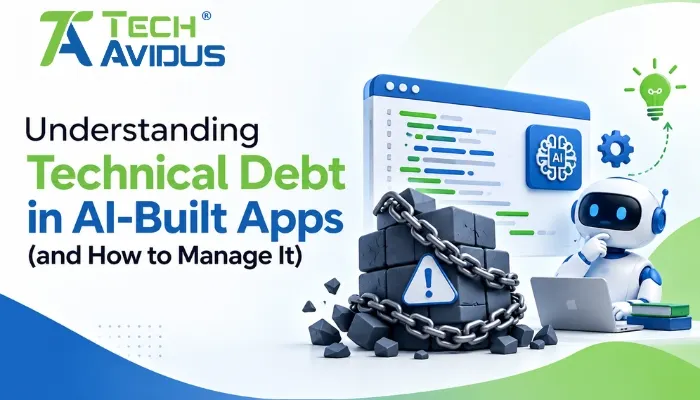
What Is Technical Debt in AI-Built Apps?
Technical debt is the future engineering effort created when development decisions prioritize immediate progress over long-term quality.
In AI-built applications, debt can develop when developers accept generated code without fully understanding how different components interact. An AI assistant may produce a functional API endpoint, database query, authentication flow, or user interface, but the surrounding architecture may become inconsistent as more features are added.
This can lead to duplicated functions, tightly coupled components, inconsistent error handling, unnecessary dependencies, and difficult-to-maintain code.
AI-generated code should therefore be treated as development input that requires engineering review rather than as finished production code.
How Does Technical Debt From AI Coding Develop?
The most common cause is rapid feature generation without an architecture and review process.
For example, imagine a team building a SaaS application with an AI coding assistant. The first few prompts produce authentication, dashboards, database operations, and API integrations quickly. Each feature works independently, but several prompts may create different approaches to authentication, validation, database access, and error handling.
Over time, the application becomes harder to understand.
Duplicated and Inconsistent Code
AI tools can generate similar functionality in slightly different ways across multiple prompts. Developers may end up with several versions of the same helper, validation rule, or API interaction.
This increases maintenance effort because fixing one implementation does not necessarily fix the others.
Weak Architecture
AI-generated features can be individually functional while lacking a coherent application architecture. Business logic may appear inside controllers, UI components, API routes, or database functions instead of being organized into appropriate layers.
The result is an application that becomes increasingly difficult to extend.
Dependency and Configuration Problems
Generated applications may include packages that are unnecessary, outdated, or poorly understood by the development team. Configuration can also become scattered across environment files, deployment scripts, and application code.
OWASP specifically recommends verifying AI-suggested packages and auditing dependencies because AI coding tools can suggest nonexistent or vulnerable packages.
Insufficient Testing
A generated application can appear stable because its primary user flow works. However, edge cases, authorization failures, malformed inputs, concurrency problems, and unexpected API responses may remain untested.
Passing tests alone is not proof that AI-generated code is secure or maintainable. OWASP recommends independent human review of AI-generated tests and attention to deleted tests, weakened assertions, and inadequate test coverage.
Is My AI-Generated App Secure?
There is no reliable way to answer is my AI-generated app secure simply by confirming that the application works or that an AI assistant reviewed the code.
Security needs a separate verification process covering authentication, authorization, input validation, secrets, dependencies, APIs, database access, logging, and deployment configuration.
NIST's Secure Software Development Framework guidance for generative AI recommends incorporating AI-specific security considerations into software development practices, including careful handling and validation of inputs and outputs.
For AI-enabled applications, teams can also use resources such as the OWASP Artificial Intelligence Security Verification Standard, which provides testable security requirements for AI-enabled systems across their lifecycle.
What Are the Signs Your AI App Needs a Code Audit?
Several warning signs indicate that an application would benefit from an independent technical review.
1. Developers Are Afraid to Change Existing Code
If a small feature regularly breaks unrelated functionality, the application may have excessive coupling or duplicated logic.
2. Nobody Can Explain Important Parts of the Code
Generated code that the current team cannot confidently explain creates long-term ownership risk. Every production component should have an identifiable purpose and owner.
3. Fixes Keep Creating New Problems
Repeated patching without addressing the underlying architecture is a classic indicator that technical debt is accumulating.
4. Tests Are Limited to Happy Paths
If tests mainly confirm that everything works under normal conditions, important failure scenarios may remain undiscovered.
5. Security Decisions Were Left to AI Prompts
Asking an AI tool to "make the application secure" is not a substitute for security requirements, code review, dependency analysis, and security testing.
Vibe Coding Rescue: When an AI-Built App Needs Structure
A Vibe Coding Rescue process can help when an application was built rapidly with AI tools but has become difficult to maintain.
The first step is usually discovery rather than immediate rewriting. Developers should map the application architecture, identify critical dependencies, review authentication and authorization, inspect database interactions, and understand deployment workflows.
The next stage is prioritization. Not every imperfect function needs immediate refactoring. Security vulnerabilities, production-breaking defects, architectural bottlenecks, and high-risk dependencies should receive attention before cosmetic cleanup.
A practical rescue workflow can include:
- Codebase assessment: Identify duplicated logic, architectural inconsistencies, risky dependencies, and unclear ownership.
- Security review: Examine authentication, authorization, secrets, input validation, API exposure, and data handling.
- Testing improvements: Add meaningful unit, integration, and end-to-end coverage around critical functionality.
- Refactoring: Consolidate duplicated functionality and establish clearer application boundaries.
- Documentation: Record architecture decisions, setup procedures, dependencies, and important business rules.
- Ongoing governance: Establish review standards for future AI-generated changes.

Advantages and Limitations of AI-Assisted Development
AI-assisted development can significantly accelerate prototyping, repetitive implementation, debugging, documentation, and experimentation.
It can also help smaller teams explore ideas without writing every component manually from the beginning.
However, speed does not remove engineering responsibility. AI-generated code may contain incorrect assumptions, unnecessary complexity, insecure implementation patterns, or dependencies that require verification.
The practical approach is to combine AI-assisted development with human architecture decisions, code review, automated testing, security controls, and continuous refactoring.
A Real-World Scenario: From Fast MVP to Maintainable Product
Consider a startup that uses AI coding tools to create an MVP with authentication, subscription management, an administrative dashboard, and third-party API integrations.
The MVP initially performs well. As customers increase, the team notices slower feature development and recurring bugs.
A code audit discovers duplicated database queries, inconsistent authorization checks, insufficient automated testing, and several components containing business logic that should have been centralized.
Instead of rebuilding everything, the team prioritizes the highest-risk areas, introduces shared services, strengthens authorization, improves test coverage, removes unnecessary dependencies, and documents the architecture.
The important lesson is that technical debt does not always require a complete rewrite. Targeted remediation can often make an existing AI-built application easier to maintain while preserving valuable working functionality.
Best Practices for Managing AI-Built Application Debt
Review AI-Generated Code Before Merging
Every significant AI-generated change should have a human owner who understands and approves the implementation.
Establish Coding Standards
Define conventions for architecture, naming, error handling, authentication, testing, dependencies, and documentation before the codebase becomes difficult to standardize.
Audit Dependencies Regularly
Verify packages, versions, vulnerabilities, licenses, and whether each dependency is actually required.
Test Beyond the Happy Path
Include invalid inputs, authorization failures, boundary conditions, API failures, database errors, and other realistic scenarios.
Refactor Continuously
Do not wait until the application becomes unmaintainable. Small, regular improvements can prevent accumulated shortcuts from becoming major engineering obstacles.
Keep Security Separate From Functionality
An application can perform exactly as expected while still exposing sensitive information or allowing unauthorized actions. Security verification needs dedicated attention.
Recap: Managing AI-Built Application Debt
AI-assisted development is most effective when speed is combined with engineering discipline.
Technical debt develops when generated code accumulates without architectural consistency, testing, documentation, security review, and refactoring.
A code audit can identify the highest-risk areas, while targeted refactoring can improve maintainability without automatically requiring a complete rewrite.
Human ownership remains essential because developers are responsible for understanding, reviewing, and approving the code that reaches production. OWASP similarly emphasizes human accountability for AI-generated code and recommends that AI output should not bypass human review.
Conclusion
AI can dramatically accelerate application development, but generated code still needs engineering ownership.
If your application has moved quickly from prototype to production and the codebase is becoming harder to understand, the right response is to assess the debt, prioritize the risks, and improve the architecture systematically.
TechAvidus can help evaluate AI-built applications, identify maintainability and security concerns, and create a practical remediation roadmap. AI Development Services can be used as the relevant internal service link for this topic.
Ready to understand what is happening inside your AI-built application? Schedule a free consultation with TechAvidus and turn accumulated technical debt into a manageable engineering plan.

Bhavesh Ladva
Bhavesh Ladva is an AI Developer and rapid product development expert with over 10 years of experience in AI, machine learning, deep learning, and NLP. He specializes in turning ideas into functional, scalable products using modern AI-powered development tools such as Lovable, Bolt, Claude, and other emerging AI platforms. His experience spans AI integrations, APIs, automation, cloud platforms, and intelligent workflows, enabling him to take products from concept to production efficiently.