Key Takeaways
- 1. Custom MCP projects begin with discovery, requirements definition, and technical architecture.
- 2. Deliverables can include server capabilities, backend integrations, security controls, tests, and documentation.
- 3. Timelines depend on integration complexity, API readiness, security requirements, and deployment needs.
- 4. Testing should cover functional behavior, permissions, errors, and compatibility with intended AI clients.
- 5. A clear maintenance and handover plan helps support the solution after launch.
Introduction
Custom MCP server development helps businesses connect AI applications with their own software, data, and workflows through the Model Context Protocol (MCP). Rather than relying entirely on a ready-made implementation, businesses can build a server around specific integration requirements, security policies, and product capabilities.
The process involves more than writing server code. Teams need to define use cases, review existing APIs, design tools and resources, implement access controls, test behavior, and prepare the solution for deployment.
A structured development process makes the deliverables clearer and helps businesses understand what is required to move from an initial idea to a maintainable integration.
What Does Custom MCP Server Development Include?
Custom MCP development involves building a server that exposes selected application capabilities to compatible AI clients. The server acts as an interface to approved tools, resources, and prompts while existing systems continue to manage their business logic and data.
The official Model Context Protocol documentation explains the protocol’s architecture and capabilities and is a useful reference during technical planning.
A typical project may include:
- Requirements discovery: Identify the business workflows, data sources, target AI clients, and actions the integration must support. Document exclusions and dependencies to avoid unclear expectations.
- Server architecture and implementation: Define the tools, resources, prompts, input schemas, and error-handling behavior. Connect these capabilities to existing backend services without bypassing established business rules.
- Security and testing: Implement appropriate authentication, authorization, input validation, and access restrictions. Test normal operations, invalid requests, and attempts to access unauthorized information.
- Deployment and documentation: Prepare the agreed environment, configuration, setup instructions, and operational guidance. Clarify whether production monitoring and ongoing support are part of the initial scope.
What Are the Main Stages of the Development Process?
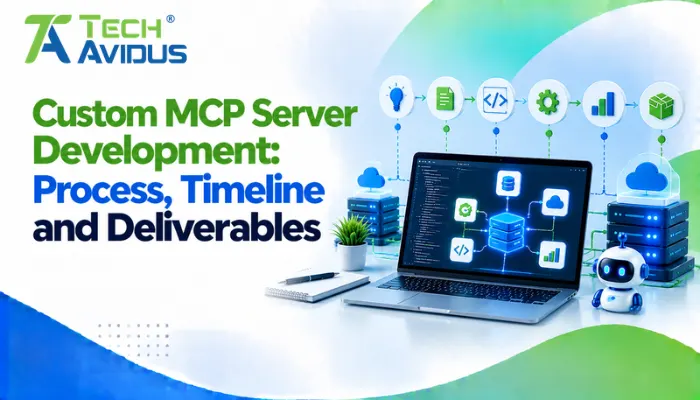
A custom MCP project typically moves through discovery, architecture, implementation, validation, and deployment. The exact sequence can vary, but each stage should produce clear outputs that the team can review before proceeding.
1. Discovery and requirements
The team identifies the problem the integration should solve and the users who will interact with it. It also reviews API documentation, data permissions, business rules, and any limitations in the current system.
Deliverables: A requirements document, prioritized use cases, integration inventory, and initial acceptance criteria.
2. Architecture and capability design
The team determines how the server will connect to existing systems and what capabilities it should expose. Decisions may cover authentication, data flow, tool definitions, deployment architecture, logging, and error handling.
When defining MCP tools, resources, and prompts, each capability should have a clear purpose. Tools perform defined actions, resources provide contextual information, and prompts offer reusable instructions for supported workflows.
Deliverables: Architecture documentation, capability definitions, interface schemas, and a security plan.
3. Development and integration
Developers implement the server and connect its capabilities to the relevant APIs or backend services. They should reuse established business logic wherever practical, rather than creating parallel rules that could produce inconsistent results.
For example, a CRM integration could provide an account lookup tool that uses the CRM’s existing permission checks. A separate tool could prepare a draft customer note, while leaving final approval to an authorized employee.
Deliverables: Working server components, configured integrations, source code, and developer documentation.
4. Testing and validation
The team verifies that each capability works as expected and behaves safely when inputs or dependencies fail. Tests should cover permissions, validation, error handling, data boundaries, and compatibility with the AI clients the business intends to support.
Deliverables: Test cases, test results, resolved defects, and a record of any known limitations.
5. Deployment and handover
The final stage prepares the server for its intended environment and transfers operational knowledge to the responsible team. Deployment requirements may include environment configuration, secret management, monitoring, logging, and rollback procedures.
Deliverables: Deployment instructions, configuration guidance, handover documentation, and agreed support arrangements.
What Affects the Development Timeline?
The delivery timeline depends on the scope and readiness of the systems being connected. A limited integration with documented APIs is generally easier to plan than one involving several services, complex permissions, or poorly understood legacy systems.
Key factors include:
- Integration complexity: Each additional system can introduce different authentication methods, data structures, and failure conditions. Dependencies should be identified during discovery.
- Security requirements: Sensitive data, role-based permissions, tenant isolation, and audit needs can require additional design and testing. These controls should be built into the plan from the beginning.
- Client compatibility: The team must verify that the target AI clients support the required protocol capabilities and interaction patterns. Compatibility should be demonstrated through testing rather than assumed.
- Deployment and operations: Infrastructure approvals, environment access, monitoring, and internal security reviews can influence release readiness. Delays may arise even when the server code is complete.
A realistic timeline should be agreed upon after the team has reviewed these factors and documented the assumptions behind its estimate.
Custom Development vs Existing MCP Solutions
Custom development is most useful when existing implementations cannot meet a business’s integration, security, or workflow requirements. A ready-made or open-source solution may be a better starting point when it already supports the required capabilities and can be maintained safely.
In an open source vs custom MCP server evaluation, review functional fit, licensing, code quality, security, extensibility, and long-term ownership. Reusing an existing implementation may reduce duplicated work, while custom development provides greater control over specialized behavior.
Similarly, when considering MCP vs API, remember that MCP can provide an AI-facing interface while conventional APIs continue to support application-to-application communication. The two approaches can work together; the decision should reflect the actual use case.
Advantages and Limitations of Custom MCP Development
A tailored implementation can align closely with business workflows, but it also creates engineering and maintenance responsibilities.
Advantages
- Purpose-built functionality: The server can expose exactly the tools and data access patterns the business needs. This is useful when generic implementations cannot accommodate specialized workflows.
- Greater architectural control: Teams can design integrations around their existing systems, permission models, and operational requirements. This can make the implementation easier to align with internal standards.
Limitations
- More engineering responsibility: The team must design, implement, test, document, and maintain the solution. Custom development is not automatically simpler or more secure than adapting an existing implementation.
- Ongoing maintenance: Dependencies, AI clients, APIs, and business requirements may change after launch. A maintenance plan is needed to keep the integration reliable and compatible.
Practical Example: Connecting an Internal Knowledge Platform
Imagine a business wants employees to ask an AI assistant questions about internal documentation and retrieve information from approved knowledge sources.
The development team could begin by identifying the permitted document repositories and defining a read-only search tool. It would then implement the MCP server, connect it to the existing search service, and enforce the same access permissions that employees already have.
Testing would cover relevant search results, unauthorized document access, unavailable services, and incomplete queries. After validation, the team could deploy the integration to a limited group, gather feedback, and expand access when operational requirements are met.
This staged process helps confirm that the integration is useful and secure before making it available more widely.

Best Practices for a Successful Implementation
A successful project combines clear requirements, controlled access, practical testing, and documented ownership.
- Start with a specific use case: Choose a workflow with a clear business objective and define what a successful result looks like. Avoid exposing unnecessary capabilities in the first release.
- Reuse existing business logic: Connect to established services and apply their validation and permission rules where appropriate. This helps avoid inconsistent behavior between the AI interface and the core application.
- Build security into the design: Apply least-privilege access, validate inputs, protect credentials, and test authorization boundaries. Follow the current protocol guidance and the organization’s security requirements.
- Automate testing where practical: Include functional tests, regression tests, and checks for invalid inputs and failure scenarios. Repeat relevant tests when changing dependencies or server capabilities.
- Plan for long-term ownership: Document configuration, deployment, monitoring, known limitations, and maintenance responsibilities. Make sure the team knows who will address defects and compatibility issues after release.
Recap: What Does a Custom MCP Project Deliver?
Custom MCP development turns defined business requirements into a tested interface that lets compatible AI applications interact with approved software capabilities.
A typical project includes requirements discovery, architecture design, server implementation, backend integration, security validation, testing, deployment, and documentation. The scope and timeline depend on system complexity, access requirements, and operational readiness.
The most effective approach is to start with a clear use case, validate it through testing, and plan for maintenance before production deployment. If your business needs a tailored solution to connect AI applications with existing systems, explore our MCP Server Development service for a custom implementation aligned with your technical and business requirements.
Conclusion
A successful MCP implementation starts with a clear business objective and a realistic understanding of existing systems. By defining deliverables, validating security, and testing the integration in stages, businesses can build a solution that is easier to operate and maintain.
Planning an MCP integration? Techavidus can help assess your requirements and identify a suitable implementation approach.
.jpg "Savan Surani")
Savan Surani
Savan Surani is an expert in MCP (Model Context Protocol) Server Development, specializing in building secure, scalable, and efficient solutions that connect AI models with external tools, APIs, and data sources. He focuses on developing custom MCP servers, streamlining AI integrations, and enabling seamless communication between AI applications and business systems. With a strong focus on automation, system interoperability, and reliable architecture, Savan helps businesses build intelligent, connected, and scalable AI-powered solutions.