Key Takeaways
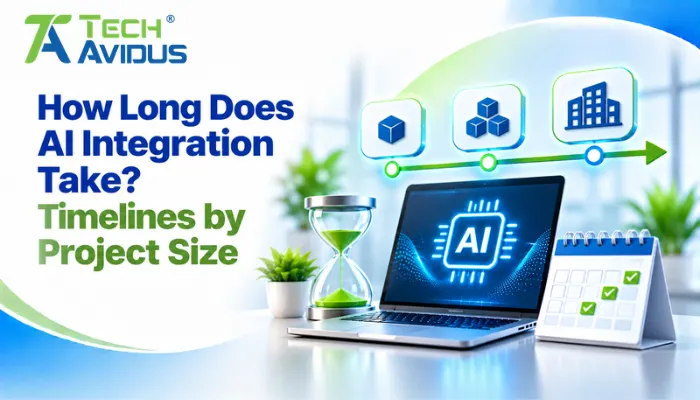
- 1. Small AI projects can often be completed within 2–6 weeks.
- 2. Medium-sized implementations generally require 2–4 months.
- 3. Large enterprise projects may take 6–12 months or longer.
- 4. Data readiness, system compatibility, and security requirements directly affect delivery time.
- 5. Proper planning, testing, and continuous optimization help prevent implementation delays.
Introduction
Artificial intelligence is becoming an important part of modern business operations, helping companies automate workflows, improve customer experiences, and make better decisions. However, one common question businesses ask before starting is: How much time does implementing AI actually require?
The answer depends on project complexity, data availability, existing infrastructure, integration requirements, and testing needs. A simple AI chatbot may take a few weeks, while a complex enterprise solution involving multiple systems can require several months.
Understanding the development timeline helps businesses plan resources, establish realistic expectations, and avoid unnecessary delays. This guide explores typical implementation timelines based on project size and the factors that influence successful delivery.
Understanding AI Implementation Timelines by Project Size
The time required to integrate AI depends primarily on what the solution needs to accomplish and how deeply it must connect with existing business systems.
1. Small Projects
Small AI implementations usually involve limited functionality and straightforward requirements. These projects are suitable for businesses that want to introduce automation without changing their entire technology infrastructure.
For example, a company might introduce an AI chatbot to answer common customer questions, automate email classification, or generate basic business reports.
Typical activities include requirement gathering, selecting an AI model, connecting the required data sources, basic development, and functional testing.
2. Medium-Sized Projects
Medium-sized projects involve more complex workflows, multiple integrations, and customized business requirements. They often require connecting AI capabilities with CRM platforms, ERP systems, internal databases, or customer-facing applications.
For instance, an eCommerce business may implement an AI-powered recommendation engine that analyzes customer behavior, product information, and purchase history.
Development involves data preparation, API integration, model configuration, workflow automation, user testing, and deployment.
3. Large Projects
Large implementations typically involve multiple departments, interconnected systems, and advanced AI capabilities. They require detailed planning, architecture design, security reviews, and extensive testing.
A practical example is an organization implementing AI-powered document processing across finance, customer support, and operations departments.
The solution may need role-based access, multiple data pipelines, integration with legacy applications, and performance monitoring.
4. Enterprise Projects
Enterprise-level implementations are more demanding because they involve complex infrastructure, large datasets, strict security requirements, and organization-wide workflows.
A financial institution, for example, may integrate AI for fraud detection, risk assessment, customer analytics, and automated document verification.
These projects require coordination between technical teams, business stakeholders, compliance specialists, and infrastructure departments.
What Factors Influence the Development Timeline?
The project size provides an initial estimate, but several technical and operational factors can change the actual delivery schedule.
Data Availability and Quality: AI systems depend on reliable, relevant data. Missing information, inconsistent formats, duplicate records, and poor data quality can increase preparation time.
Existing Infrastructure: Integrating AI into modern applications with accessible APIs is generally easier than connecting it with outdated legacy systems or disconnected databases.
Model Selection and Customization: Using an existing AI model may shorten development time, while specialized model training, fine-tuning, and evaluation require additional work.
Security and Compliance: Authentication, data privacy, access controls, and regulatory requirements must be considered before deployment. These activities can add significant time to projects involving sensitive information.
Testing and Optimization: AI applications need functional testing, accuracy evaluation, performance monitoring, and user feedback. A technically working solution is not necessarily production-ready.
What Does the Implementation Journey Look Like?
A structured AI Integration Process helps development teams manage technical dependencies and deliver solutions in manageable stages.
The following stages represent a practical workflow. Some activities can happen simultaneously, depending on project complexity.
1. Requirement Analysis and Planning
The first stage involves understanding business objectives, identifying automation opportunities, and defining measurable project outcomes.
Development teams evaluate existing systems, technical limitations, data sources, and integration requirements before preparing the project roadmap.
2. Data Preparation and Architecture Design
The next stage focuses on identifying relevant datasets, checking data quality, selecting suitable AI technologies, and designing the integration architecture.
For example, a business implementing an AI assistant may need to organize product documentation, customer records, and internal knowledge sources before connecting a language model.
3. Development and System Integration
During development, engineers configure AI models, build application components, establish API connections, and connect the solution with existing business platforms.
The development duration depends on the number of integrations, customization requirements, and complexity of the intended workflows.
4. Testing and Validation
Testing ensures that the AI solution performs as expected under different conditions. Teams evaluate output quality, integration reliability, security, accuracy, and application performance.
User acceptance testing also helps identify workflow issues before the system becomes available to actual users.
5. Deployment and Continuous Monitoring
After validation, the solution is deployed into the production environment. Teams monitor performance, resolve unexpected issues, and optimize the system using real-world feedback.
AI integration is not necessarily a one-time activity. Continuous evaluation is important because business requirements, data, and model capabilities can change.
Choosing the Right Development Approach
The development approach can influence project speed, flexibility, and long-term maintenance requirements.
For businesses evaluating AI Integration Agency vs Freelancer, the right choice depends on the scope of work, required expertise, and available internal resources. A freelancer may be suitable for a focused implementation with limited dependencies. An agency can provide coordinated support across architecture, development, integration, testing, and maintenance for projects involving multiple technical areas.
Similarly, Custom AI Integration vs Off The Shelf solutions involves different planning considerations. Ready-made AI platforms can accelerate implementation when existing features meet business requirements. Custom development is more suitable when businesses need specialized workflows, proprietary data connections, or deeper control over application behavior.
For growing companies, AI Integration for Startups often begins with a focused MVP or a single automation use case. This approach allows startups to validate business value before expanding functionality.
On the other hand, Enterprise AI Integration requires additional attention to governance, scalability, system compatibility, security, and cross-department coordination.
Advantages and Limitations of AI Integration
AI implementation offers several business benefits, but organizations should also understand its practical limitations.
Advantages
- Improved operational efficiency: Automating repetitive tasks allows employees to focus on more valuable activities while reducing manual workload.
- Better decision-making: AI can analyze large datasets and identify patterns that support faster, more informed business decisions.
- Enhanced customer experience: Intelligent chatbots, personalized recommendations, and automated support can improve customer interactions.
- Scalable business operations: Well-designed AI solutions can support increasing workloads without requiring every process to grow at the same rate.
Limitations
- Data dependency: Poor-quality or incomplete data can reduce the reliability of AI-generated results.
- Integration complexity: Connecting AI with existing applications may require additional development and infrastructure changes.
- Ongoing maintenance: AI applications need monitoring, updates, testing, and performance optimization after deployment.
Real-World Implementation Scenarios
Consider three practical business situations that demonstrate how project requirements affect timelines.
Scenario 1: Customer Support Automation
A small business wants an AI chatbot that answers frequently asked questions using existing website content. Since the functionality is limited and the data sources are straightforward, the project may take approximately 3–5 weeks.
Scenario 2: Intelligent eCommerce Platform
An online retailer wants personalized product recommendations connected to its existing product catalog, customer database, and order management system. Data preparation and multiple integrations could extend the project to approximately 2–4 months.
Scenario 3: Enterprise Workflow Automation
A large organization wants AI-powered document processing across multiple departments, with secure access controls and connections to legacy applications. This implementation may require 6–12 months or longer, depending on infrastructure and governance requirements.
Note: These are illustrative planning scenarios, not documented TechAvidus client case studies or guaranteed delivery commitments.
Best Practices for Completing Projects on Time
Businesses can reduce avoidable delays by following a few practical recommendations.
Start with a Clearly Defined Use Case: Avoid introducing too many AI features in the first release. Focus on a specific business problem and define what successful implementation should achieve.
Evaluate Data Before Development: Check data accessibility, quality, ownership, and security requirements early to identify potential blockers.
Choose Appropriate Technologies: Select AI models, APIs, cloud infrastructure, and integration tools according to actual business requirements rather than following trends.
Build in Phases: Deliver an initial working version, gather feedback, and expand functionality through planned development cycles.
Include Security and Testing Early: Integrate access controls, data protection, performance evaluation, and quality checks throughout development instead of leaving them until deployment.
Plan for Post-Launch Support: Establish monitoring, maintenance, and improvement processes to keep the application reliable as requirements evolve.
Summary: What Is a Realistic Project Timeline?
AI implementation timelines vary according to functionality, integration complexity, data readiness, and security requirements.
- Small projects generally require 2–6 weeks.
- Medium-sized projects typically take 2–4 months.
- Large projects can require 4–6 months.
- Enterprise implementations may take 6–12 months or longer.
The most reliable estimates come from evaluating business requirements, technical dependencies, and production-readiness expectations before development begins.
Conclusion
AI integration timelines depend on more than development speed. Project complexity, data readiness, infrastructure, security requirements, and testing all influence how quickly a solution can move from planning to production.
Small projects may take only a few weeks, while enterprise implementations can require several months of coordinated development and validation. Businesses should focus on realistic planning, clearly defined requirements, and scalable architecture rather than rushing deployment.
TechAvidus helps businesses plan, develop, and implement intelligent solutions aligned with their operational goals. Whether you are exploring your first AI-powered application or modernizing existing business systems, the right AI Integration Service can help establish a practical roadmap for successful implementation.
Ready to understand the timeline for your AI project? Contact TechAvidus for a free consultation and discuss your requirements with our development team.
.jpg "Dishant Panchal")
Dishant Panchal
Dishant Panchal is an AI Integration Expert specializing in connecting artificial intelligence solutions with business applications and digital workflows. He focuses on integrating AI models, APIs, and intelligent automation tools to streamline operations, improve efficiency, and enhance user experiences. With an interest in practical AI implementation, Dishant helps businesses bridge the gap between emerging AI technologies and real-world requirements, enabling smarter processes, seamless system connectivity, and scalable digital solutions.