Key Takeaways
- 1. Define clear business objectives before selecting AI technologies.
- 2. Evaluate existing infrastructure, data quality, and integration requirements.
- 3. Prioritize security, privacy, compliance, and responsible AI practices.
- 4. Prepare your team for implementation, testing, and ongoing maintenance.
- 5. Establish measurable performance indicators to evaluate results.
Introduction
Artificial intelligence is transforming how businesses operate, automate tasks, analyze information, and serve customers. However, successfully adopting AI requires more than selecting a model or purchasing an AI-powered tool. Businesses must prepare their data, infrastructure, workflows, security policies, and teams before implementation begins.
A well-planned AI integration preparation guide helps organizations avoid common implementation challenges, reduce operational disruption, and build solutions that support long-term business goals. Whether you want to integrate AI into an existing application, automate customer support, improve business intelligence, or develop intelligent software, proper preparation makes a significant difference.
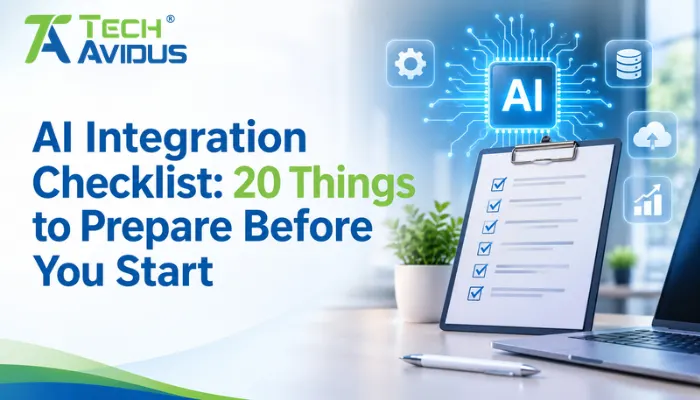
Before starting your next AI project, here are 20 important things to consider to make your implementation more structured, secure, and scalable.
20 Important Things to Prepare Before Starting
1. Define Your Business Objectives
Start by identifying the specific business problem you want AI to solve. Whether it involves automating repetitive tasks, improving customer experiences, or analyzing large datasets, your objectives should be clearly documented.
Avoid adopting AI simply because it is trending. Focus on practical applications that address existing operational challenges and support measurable business improvements.
2. Identify the Right Use Cases
List the business processes where AI could deliver meaningful improvements. Consider customer support automation, document processing, predictive analytics, recommendation systems, and intelligent search.
Prioritize use cases according to business value, technical feasibility, data availability, and implementation complexity.
3. Evaluate Your Existing Infrastructure
Review your current software applications, databases, servers, cloud environments, and communication systems. Understanding your infrastructure helps identify compatibility issues before development begins.
Check whether your existing systems support API connectivity, secure data exchange, and the processing requirements of the proposed AI solution.
4. Assess Your Data Quality
AI systems depend heavily on relevant, accurate, and consistent data. Review your available datasets for missing information, duplicate records, outdated entries, and inconsistent formatting.
Establish data cleaning, validation, and preprocessing procedures before connecting datasets to AI models.
5. Identify Data Sources and Accessibility
Determine where your business information is stored, including CRM platforms, ERP systems, databases, cloud storage, and third-party applications.
Confirm that the development team has appropriate access permissions and understands how information will move between connected systems.
6. Select the Appropriate AI Technology
Different business requirements need different AI technologies. Depending on your objectives, you might need machine learning, natural language processing, computer vision, generative AI, or large language models.
Evaluate available technologies based on accuracy, scalability, integration capabilities, documentation, and long-term support.
7. Decide Between Custom and Ready-Made Solutions
The choice between building a tailored solution and adopting an existing platform depends on your business requirements, technical flexibility, and future growth plans. Review Custom Ai Integration vs Off The Shelf options carefully before making a decision.
Ready-made tools can simplify initial adoption, while custom solutions provide greater control over workflows, integrations, and specialized business requirements.
8. Review API and Integration Requirements
Identify the applications that must communicate with your AI solution. Review API documentation, authentication methods, supported data formats, rate limits, and integration dependencies.
A clear integration architecture helps developers prevent communication failures and maintain consistent data exchange between applications.
9. Establish Security Requirements
Define security policies before allowing AI systems to access business applications or sensitive information. Consider encryption, authentication, role-based access, secure API connections, and vulnerability assessments.
Security should be included throughout development rather than treated as a final deployment activity.
10. Understand Privacy and Compliance Obligations
Identify the personal, financial, customer, or confidential information that your AI solution may process. Determine which privacy laws, contractual requirements, and industry regulations apply to your business.
Document data retention policies, consent requirements, access restrictions, and procedures for handling sensitive information.
11. Plan Your System Architecture
Create a technical architecture that explains how the AI model, application layer, database, APIs, and external services will work together.
Consider scalability, system dependencies, processing requirements, and fallback mechanisms. A documented architecture makes future development and maintenance easier.
12. Set a Realistic Implementation Timeline
Break the project into manageable stages, including discovery, technical planning, development, integration, testing, and deployment.
When estimating How Long Does Ai Integration Take, consider the number of connected systems, data readiness, model complexity, security requirements, and testing needs. A small integration may take less time than a complex enterprise implementation, so avoid relying on a universal timeline.
13. Prepare Your Budget and Resources
Identify the resources needed for development, infrastructure, software licenses, testing, deployment, and ongoing maintenance.
Allocate resources according to project priorities and expected business value. Include provisions for unexpected technical challenges and future improvements.
14. Assign Roles and Responsibilities
Successful implementation requires coordination between developers, project managers, IT teams, data specialists, security professionals, and business stakeholders.
Clearly define ownership for technical decisions, approvals, testing, data management, and post-launch support to avoid communication gaps.
15. Evaluate Scalability Requirements
Your initial AI implementation should be capable of supporting future business growth. Consider increasing data volumes, additional users, new integrations, and changing processing requirements.
Plan for flexible infrastructure and modular architecture so that the solution can evolve without requiring unnecessary redevelopment.
16. Define Testing and Validation Methods
Prepare testing scenarios to evaluate accuracy, reliability, performance, security, and compatibility. Test the system with realistic business data and different user scenarios.
Include edge cases, unexpected inputs, model limitations, and integration failures to identify problems before production deployment.
17. Establish Human Oversight
AI-generated results should not automatically replace human judgment in every business process. Identify situations where human review, approval, or intervention is necessary.
For example, financial decisions, sensitive customer interactions, and high-impact recommendations may require additional verification before action is taken.
18. Prepare Your Team for Adoption
Employees should understand how the new system works, where AI will support their responsibilities, and when manual intervention is required.
Provide practical training, usage guidelines, and documentation. Early employee involvement can also help identify workflow challenges that technical teams might overlook.
19. Create a Monitoring and Maintenance Plan
AI systems require ongoing monitoring to maintain performance and reliability. Define how your team will track response quality, API availability, processing errors, model behavior, and system performance.
Also establish procedures for model updates, security patches, incident handling, and troubleshooting after deployment.
20. Define Success Metrics
Decide how you will measure the effectiveness of your implementation. Relevant indicators may include task completion time, processing accuracy, customer satisfaction, automation rates, and system availability.
Establish baseline measurements before implementation so that you can compare performance and identify areas for improvement.
Important Factors to Consider During Implementation
Preparing for an AI project also means understanding the differences between business environments and technical requirements.
For example, Enterprise Ai Integration generally involves complex infrastructure, multiple departments, legacy applications, access controls, and organizational governance. These requirements make architecture planning and cross-team coordination especially important.
On the other hand, Ai Integration For Startups often focuses on faster deployment, limited development resources, flexible architecture, and validating a specific business use case before expanding.
The AI Integration Process should therefore be designed around the organization's size, existing technology, available resources, and long-term objectives rather than following a fixed implementation model.
Advantages and Limitations of Proper Preparation
Planning before implementation provides several advantages, but businesses should also understand the challenges involved.
Advantages
- Better technical alignment: Early infrastructure assessments help developers choose compatible technologies and reduce integration complications.
- Improved data reliability: Data validation and preparation help AI systems work with more consistent and relevant information.
- Stronger security: Identifying privacy and access requirements early helps establish appropriate safeguards.
- Easier scalability: Planning for future requirements reduces the likelihood of major architectural changes.
Limitations
- Additional planning effort: Requirements gathering, documentation, and technical assessments require time and coordination.
- Uncertain AI performance: Even carefully selected models may produce inconsistent results and require ongoing evaluation.
- Changing requirements: Business needs and AI technologies can evolve during implementation.
- Third-party dependencies: External APIs, platforms, and model providers may introduce availability, compatibility, or service limitations.
Practical Implementation Scenarios
Consider a growing eCommerce business planning to introduce an AI-powered customer support assistant.
Before development, the team reviews its customer support history, identifies frequently asked questions, checks CRM compatibility, and defines which conversations require human intervention.
Developers then connect the AI solution with the existing customer support platform, test response accuracy, establish data access restrictions, and monitor performance before making it available to customers.
Similarly, a software company introducing AI-powered document processing might first examine document formats, database connectivity, access permissions, and validation requirements. These preparation steps help the development team identify technical issues before they affect daily operations.
These scenarios demonstrate why preparation should be treated as an essential part of AI development rather than an administrative task.
Best Practices for a Successful Implementation
- Start with a focused project: Choose one practical business problem instead of attempting to automate multiple departments simultaneously. Validate the initial solution before expanding its capabilities.
- Prioritize responsible development: Follow recognized guidance for AI risk management, privacy, transparency, and reliability. The NIST AI Risk Management Framework provides useful guidance for organizations developing and deploying AI systems.
- Document technical decisions: Maintain clear records of architecture, integrations, model versions, data sources, and security requirements. This documentation supports troubleshooting and future improvements.
- Test before production: Use controlled testing environments to evaluate the solution under realistic conditions. Resolve critical issues before introducing the system into everyday business operations.
- Plan for continuous improvement: Review performance regularly and collect feedback from employees and users. Use these insights to improve workflows, update models, and address changing requirements.
Quick Recap: What Should You Prepare First?
Successful AI implementation begins with clearly defined business objectives, reliable data, compatible infrastructure, and an appropriate technology strategy.
Businesses should prepare security policies, integration architecture, testing procedures, employee training, and performance indicators before deployment.
The most effective approach is to start with a focused use case, validate its performance, and expand gradually as business requirements evolve.
Conclusion
Preparing before implementation is one of the most important steps toward building reliable, secure, and scalable AI-powered business solutions. From selecting suitable technologies and preparing quality data to defining security requirements and establishing performance metrics, every decision contributes to the success of the project.
Businesses should avoid rushing into development without understanding their technical requirements and operational goals. A structured preparation strategy makes it easier to identify potential challenges, manage implementation, and build solutions that deliver meaningful business value.
If your business is planning its next AI project, TechAvidus can help you evaluate your requirements, plan integrations, and develop solutions aligned with your business objectives. Explore our AI Integration Service and request a free consultation to discuss your project requirements with our team.
.jpg "Raju Parmar")
Raju Parmar
Raju Parmar is an AI integration specialist passionate about connecting intelligent technologies with real-world business solutions. He focuses on integrating AI-powered tools, APIs, machine learning models, and automation systems into existing business workflows. With a strong understanding of modern AI technologies, Raju helps businesses improve operational efficiency, streamline processes, and build smarter digital experiences through practical and scalable AI integration solutions.