Key Takeaways
- 1. Start with clear business objectives before selecting AI technologies.
- 2. Evaluate data quality, infrastructure, and integration requirements early.
- 3. Choose AI models and architecture based on actual business needs.
- 4. Test functionality, security, accuracy, and performance before deployment.
- 5. Continuously monitor and improve AI systems after launch.
Introduction
Artificial intelligence is transforming how businesses operate, automate workflows, improve customer experiences, and make data-driven decisions. However, successfully implementing AI requires more than selecting a model or connecting an API. Businesses need a structured approach that aligns AI technology with their operational goals, existing systems, and long-term growth plans.
A well-planned AI integration process helps organizations move from identifying business opportunities to developing, testing, and launching reliable AI-powered solutions. Each phase plays an important role in ensuring that the final implementation solves real problems rather than introducing unnecessary complexity.
Whether you are a startup exploring automation or an established organization modernizing its technology infrastructure, understanding these six phases can help you make better implementation decisions.
Understanding the Six Phases of AI Implementation
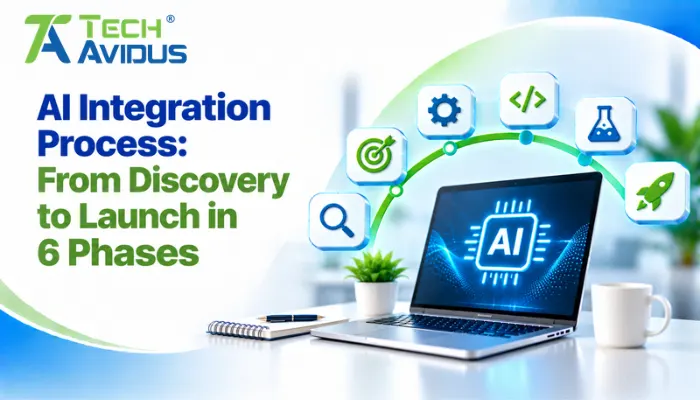
A successful AI implementation follows six connected phases: discovery, planning, architecture design, development, testing, and deployment. Each stage creates a foundation for the next, helping businesses reduce implementation risks and achieve measurable operational improvements.
Phase 1: Business Discovery and Requirement Analysis
The first phase focuses on understanding where artificial intelligence can create genuine business value. Before developing anything, businesses must identify operational challenges, automation opportunities, and the outcomes they expect from the solution.
During discovery, development teams work with stakeholders to understand existing workflows, business requirements, technical limitations, and user expectations.
For example, an eCommerce business might want to automate customer support, recommend relevant products, or predict inventory requirements. Each objective requires a different AI capability and implementation strategy.
Key activities include:
- Business goal identification: Define the problems AI should solve, such as repetitive manual tasks, delayed responses, or inefficient data processing. Establish measurable success indicators to evaluate the implementation.
- Workflow assessment: Examine existing applications, databases, APIs, and business processes to identify where AI can fit naturally. This prevents unnecessary changes to systems that already work effectively.
- Feasibility evaluation: Assess technical readiness, available data, security requirements, and integration complexity before committing to development.
The discovery phase ensures that the project begins with a clearly defined business purpose.
Phase 2: Strategy Development and Technology Selection
Once business requirements are established, the next step is selecting the right implementation strategy and technologies. The objective is to create a solution that meets current requirements without limiting future scalability.
Businesses should evaluate whether they need machine learning, natural language processing, generative AI, computer vision, or a combination of technologies.
This is also where organizations compare implementation approaches. A startup may prioritize a focused solution with minimal infrastructure, while an established company may require enterprise-wide connectivity, governance, and access controls.
When evaluating development resources, businesses may choose a Dedicated AI Developer for specialized technical ownership or work with a broader development team for architecture, integration, and ongoing support.
Similarly, an AI Integration Agency vs Freelancer decision should consider project complexity, required expertise, accountability, maintenance, and long-term support rather than just development capacity.
Important considerations include:
- Technology compatibility: Evaluate whether the selected AI models, frameworks, APIs, and cloud platforms work with existing applications. Consider integration flexibility and vendor dependencies.
- Development approach: Compare Custom AI Integration vs Off The Shelf solutions based on business requirements, customization needs, data control, and scalability. Ready-made tools may suit standard requirements, while custom development can address specialized workflows.
- Resource planning: Define technical responsibilities, development milestones, infrastructure requirements, and ongoing maintenance ownership.
The right strategy provides a practical foundation for development and deployment.
Phase 3: Solution Architecture and Data Preparation
The third phase establishes how the AI solution will connect with business applications, process information, and deliver results. A reliable architecture is essential for maintaining performance, security, and scalability.
Data preparation is equally important because AI systems depend on relevant, accurate, and properly structured information.
For instance, an AI-powered customer support platform may need access to product information, customer records, order histories, and knowledge bases. The architecture must define how this information will be retrieved and processed securely.
Typical activities include:
- Data assessment and preparation: Review available datasets for accuracy, completeness, consistency, and relevance. Remove unnecessary or duplicate information and establish appropriate data access permissions.
- System architecture design: Define API connections, database access, authentication mechanisms, cloud infrastructure, and communication between applications. Consider how the system will handle increasing workloads.
- Security planning: Establish encryption, access controls, data retention policies, and privacy safeguards. Sensitive business information should only be accessible to authorized components and users.
For larger organizations, Enterprise AI Integration requires additional attention to legacy applications, governance policies, compliance requirements, and cross-department connectivity.
The architecture phase ensures that the solution can operate reliably within the existing technology environment.
Phase 4: AI Development and System Integration
After architecture approval and data preparation, development begins. This phase involves building or configuring AI capabilities and connecting them with the applications that support daily business operations.
Depending on the requirements, developers may use Python, TensorFlow, PyTorch, LangChain, OpenAI APIs, cloud AI platforms, or other suitable technologies.
Consider a business implementing an intelligent document-processing system. The development team may combine document extraction, natural language processing, and database integration to capture information and transfer it into an existing business application.
The main development activities include:
- AI model development or configuration: Select, customize, or train suitable models based on the required functionality. Validate their outputs against representative business scenarios.
- API and application integration: Connect AI capabilities with CRM platforms, ERP systems, websites, mobile applications, and internal databases. Ensure information moves securely between connected systems.
- Workflow automation: Implement automated processes such as document classification, customer query handling, recommendation generation, and information extraction.
Ai Integration For Startups often focuses on delivering a practical minimum viable solution first, allowing businesses to validate functionality before expanding into additional workflows.
At this stage, developers should also document integration dependencies and establish clear error-handling mechanisms.
Phase 5: Testing, Validation, and Quality Assurance
Testing determines whether the integrated AI solution performs as expected under real-world conditions. A system that works during development may still encounter problems when connected to actual business applications and larger datasets.
Testing should cover both traditional software functionality and AI-specific behavior.
For example, an AI chatbot should be evaluated not only for response speed but also for answer accuracy, context understanding, incorrect responses, and appropriate handling of sensitive requests.
Important testing activities include:
- Functional and integration testing: Verify that APIs, databases, authentication, and connected applications exchange information correctly. Check whether automated workflows complete their intended tasks.
- AI performance evaluation: Assess output accuracy, relevance, consistency, response time, and reliability using representative test scenarios. Identify situations where human review is necessary.
- Security and user acceptance testing: Check access permissions, data protection, system vulnerabilities, and user experience. Collect feedback from intended users before production release.
The National Institute of Standards and Technology (NIST) provides the AI Risk Management Framework and Generative AI Profile, which offers guidance for identifying and managing risks throughout the development, evaluation, and deployment of AI systems.
Testing should continue throughout development rather than being treated as a final checkpoint.
Phase 6: Deployment, Monitoring, and Continuous Improvement
The final phase moves the tested solution into its production environment. However, launching an AI application does not mean the implementation journey is complete.
Businesses must monitor system behavior, evaluate performance, resolve technical issues, and improve functionality as requirements evolve.
A practical deployment approach may begin with a controlled release to a limited group of users before expanding access across the organization.
Post-launch activities include:
- Production deployment: Configure hosting, application access, API connections, monitoring tools, and production security settings. Verify that the system operates correctly in its live environment.
- Performance monitoring: Track response times, API failures, resource consumption, output quality, and user feedback. Establish alerts for unexpected behavior.
- Continuous optimization: Improve prompts, update models, refine datasets, and resolve integration issues based on observed performance. Schedule regular reviews to keep the system aligned with business requirements.
A structured launch also includes documentation, user training, support responsibilities, and a rollback plan in case unexpected issues affect production operations.
Advantages and Limitations of AI Integration
AI implementation can improve business operations, but its benefits depend on appropriate planning, technology selection, and ongoing management.
Advantages
- Improved operational efficiency: AI can automate repetitive activities and reduce manual processing. Employees can focus more on decision-making and higher-value responsibilities.
- Better customer experiences: Intelligent chatbots, personalized recommendations, and automated support workflows can help businesses respond more consistently.
- Data-driven decisions: AI-powered analytics can identify patterns in large datasets and support informed business decisions.
- Scalable business operations: Well-designed solutions can support growing workloads and additional business processes without requiring every activity to remain manual.
Limitations
- Data quality challenges: Incomplete or inaccurate information can reduce AI output reliability. Businesses must invest in data preparation and validation.
- Integration complexity: Connecting AI capabilities with legacy applications and multiple platforms may require additional technical planning.
- Security and privacy concerns: Improper data handling can expose sensitive information. Appropriate governance and access controls are essential.
- Ongoing maintenance: AI models, APIs, and business requirements change over time. Regular monitoring and updates are necessary.
Real-World Examples of Successful Implementation Scenarios
Practical implementation scenarios help demonstrate how different businesses can apply AI to solve specific operational challenges.
Example 1: Intelligent Customer Support for eCommerce
An online retailer receives hundreds of customer questions about orders, returns, product availability, and delivery updates. A traditional support team handles most requests manually.
An AI-powered support assistant can connect with the retailer's product database and order management system to retrieve relevant information and respond to common queries. Complex or sensitive requests can be transferred to human representatives.
Example 2: Automated Document Processing for Financial Operations
A financial services business handles large volumes of invoices and application documents. Manual data extraction creates delays and increases the possibility of entry errors.
An AI-based document processing solution can extract relevant information, classify documents, and transfer validated records into existing business applications. Human verification can remain part of the workflow for sensitive transactions.
Example 3: Predictive Insights for Manufacturing
A manufacturing company wants to identify equipment issues before they interrupt production. Its existing systems collect operational and equipment-related data.
A predictive analytics solution can evaluate historical and real-time information to identify unusual patterns and potential maintenance requirements. The results can help maintenance teams investigate problems earlier.
These are illustrative implementation scenarios rather than claims about specific TechAvidus client projects. Each solution requires validation against the organization's actual data, workflows, and operational requirements.
Best Practices for a Successful Implementation
Following proven development practices helps businesses create AI solutions that are useful, secure, and maintainable.
- Begin with a focused use case: Avoid automating every business activity at once. Start with a clearly defined problem and expand after validating the initial solution.
- Prioritize data governance: Establish rules for data access, storage, processing, and quality. Include privacy and security considerations from the beginning.
- Choose scalable architecture: Design integrations that can accommodate additional applications, users, and workloads. Avoid unnecessary dependencies that make future changes difficult.
- Include human oversight: Define when users should review AI-generated recommendations or outputs. Critical decisions should have appropriate approval and escalation mechanisms.
- Measure performance regularly: Track relevant business and technical indicators, including accuracy, response time, workflow completion, and user satisfaction.
- Plan for maintenance: Assign responsibility for monitoring, troubleshooting, model updates, and API changes before the solution goes live.
A successful implementation depends on continuous collaboration between business stakeholders, developers, data specialists, and security teams.
Quick Recap: How Does AI Move from Discovery to Launch?
A successful AI implementation begins by identifying a genuine business problem and defining measurable objectives. Teams then select suitable technologies, prepare data, design the architecture, develop integrations, and validate the solution through structured testing.
The final stage involves production deployment, performance monitoring, and continuous improvement. Following these six phases helps businesses build AI solutions that support their operational goals while maintaining reliability, security, and scalability.
Conclusion
Moving from an AI idea to a production-ready solution requires a clear strategy, technical expertise, and a structured development approach. Each of the six phases—from discovery and planning to integration, testing, and deployment—contributes to building a reliable solution that delivers meaningful business value.
Businesses should focus on solving real operational challenges rather than adopting AI simply because it is a growing technology trend. The right architecture, suitable technologies, reliable data, and continuous monitoring make a significant difference to long-term success.
At TechAvidus, we help businesses turn their AI ideas into practical, scalable applications through expert development, system integration, and ongoing technical support. If you are planning your next AI initiative, explore our AI Integration Service and connect with our team for a free consultation to discuss your requirements and implementation roadmap.
.jpg "Mayur Parmar")
Mayur Parmar
Mayur Parmar is an AI Integration expert specializing in connecting artificial intelligence technologies with business applications and digital workflows. He focuses on integrating AI models, APIs, automation tools, and intelligent systems to improve operational efficiency, streamline processes, and enhance user experiences. With a strong interest in practical AI solutions, Mayur helps businesses leverage AI capabilities to build smarter, more scalable, and efficient applications that support innovation and long-term business growth.