Key Takeaways
- 1. A shared MCP server can support multiple SaaS customers through one platform.
- 2. Tenant isolation must protect customer data across every request and operation.
- 3. Authentication and authorization should determine which capabilities each user can access.
- 4. Tenant-specific configurations can support different customer requirements.
- 5. Monitoring, testing, and security reviews are essential before production deployment.
Introduction
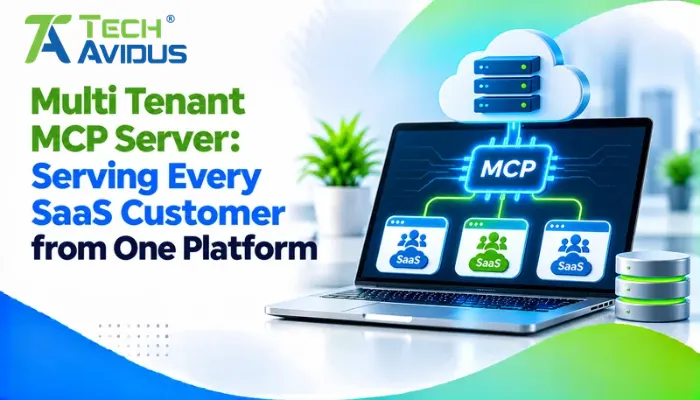
A multi-tenant MCP server allows a SaaS platform to expose selected tools, resources, and application capabilities to multiple customers through a shared integration layer. Each customer can use the same underlying service while their data, permissions, and configurations remain separated.
For SaaS businesses, this architecture can simplify how AI agents connect with product functionality. Instead of deploying an entirely separate MCP server for every customer, teams can design a shared platform that identifies each tenant and enforces the correct access rules.
However, sharing infrastructure does not mean sharing customer data. Tenant identification, authorization, data isolation, and request handling must be designed carefully from the beginning.
What Is a Multi-Tenant MCP Server?
A multi-tenant MCP server is an MCP implementation designed to serve multiple customers while maintaining separate access to their data and resources.
In a SaaS environment, each customer represents a tenant. The server receives requests from compatible AI clients, identifies the relevant tenant context, and accesses only the data and operations authorized for that tenant.
For example, a SaaS CRM platform may serve hundreds of business customers through one application environment. Each customer may use an AI assistant to retrieve contacts, summarize sales activity, or create follow-up tasks. The MCP server must ensure that a request from one customer cannot retrieve another customer's records.
A typical architecture includes:
- AI client: Connects to the MCP server and requests available capabilities. It operates within the authenticated user's permitted context.
- Shared MCP server: Handles incoming requests, identifies tenant context, validates permissions, and communicates with backend services.
- Tenant-aware backend: Retrieves or updates the correct customer's data. It enforces tenant restrictions at the application or data-access layer.
- Authentication and authorization layer: Verifies identities and determines which operations are allowed. It prevents access based only on untrusted tenant identifiers supplied by a client.
How Does a Multi-Tenant MCP Server Architecture Work?
A multi-tenant MCP architecture processes each request using verified identity and tenant context before accessing customer-specific resources.
The workflow generally follows these steps:
- Client connection: A compatible AI client connects to the MCP server using the supported connection method. The server establishes the session and validates the required authentication.
- Tenant identification: The application determines which customer account the authenticated user belongs to. Tenant context should come from trusted identity or session information, not an arbitrary request parameter.
- Permission validation: The server checks whether the user can access the requested capability and relevant data. Permissions should be evaluated for the specific operation.
- Backend execution: The server calls the appropriate API or service using the verified tenant context. The backend should independently enforce tenant-level access restrictions.
- Response handling: The server returns only the information authorized for that request. Sensitive information from other tenants must never enter the response.
This separation helps make a shared service manageable without compromising customer boundaries.
How Should a Multi-Tenant MCP Server Handle Tenant Isolation?
Tenant isolation ensures that each customer can access only their own data, configurations, and authorized operations.
There are several ways to implement this depending on the SaaS platform's architecture.
1. Shared Database with Tenant-Level Filtering
Multiple customers use the same database, but records include tenant identifiers that separate customer data.
Every query must apply the authenticated tenant context. Database-level protections, such as row-level security where supported, can provide an additional safeguard against accidental cross-tenant access.
2. Separate Schemas or Databases
Each tenant can have a separate database schema or database, depending on the platform's requirements.
This approach can provide stronger separation, but it introduces additional infrastructure, connection management, and maintenance considerations.
3. Dedicated Infrastructure for Specific Customers
Some SaaS platforms may require dedicated environments for customers with particular security or compliance requirements.
A hybrid architecture can support shared infrastructure for most customers and dedicated resources for selected tenants. The appropriate model depends on operational needs and risk requirements.
What Authentication and Authorization Does the Architecture Need?
A secure implementation must verify both who is connecting and what that identity is allowed to do.
Important considerations include:
- User authentication: Verify the identity of the user or client connecting to the server. Use an authentication mechanism appropriate to the deployment and client environment.
- Tenant-aware authorization: Associate authenticated identities with the correct customer account and permissions. Do not trust tenant identifiers supplied independently by the client.
- Capability-level permissions: Restrict access to individual operations based on user roles and business rules. A user permitted to view records should not automatically receive permission to modify them.
- Session management: Ensure that tenant context remains correctly associated with each request and session. Prevent credentials or session information from being reused across customers.
- Audit logging: Record relevant operations, access decisions, and security events. Protect logs from unnecessary exposure of sensitive customer information.
The official MCP architecture documentation explains the protocol's client-server architecture and provides a useful technical foundation for designing these connections.
How Should You Design Tenant-Specific MCP Capabilities?
A multi-tenant server should provide common capabilities while applying customer-specific permissions and configurations.
The design of mcp tools resources and prompts should account for differences between customer accounts.
For example:
- Shared tools: Common operations such as retrieving records or generating summaries can be made available across tenants. Each execution must use the authenticated customer's context.
- Tenant-specific resources: Customers may have different projects, documents, reports, or account information. The server should retrieve resources only from the appropriate tenant.
- Configurable prompts: Reusable prompts can support common workflows while allowing relevant tenant-specific instructions. Avoid including sensitive customer information in shared prompt templates.
A carefully designed capability layer helps maintain consistency without assuming that every customer has identical permissions or workflows.
Advantages and Limitations of a Shared MCP Architecture
A shared architecture can simplify SaaS integration management, but it also requires careful security and operational planning.
Advantages
- Centralized maintenance: Developers can maintain a shared server rather than managing a separate deployment for every customer. Common updates and improvements can be handled through a coordinated release process.
- Consistent integration experience: Customers can access common product capabilities through a standardized interface. This makes it easier to maintain consistent behavior across the platform.
- Flexible expansion: New capabilities can be introduced to the shared service as the product evolves. Tenant-specific permissions determine which customers can use them.
Limitations
- Tenant isolation complexity: A mistake in request handling or data filtering can expose one customer's information to another. Isolation must be tested throughout the complete request path.
- Shared infrastructure risks: High traffic or resource-intensive requests from one tenant may affect other customers. Rate limits, resource controls, and monitoring help manage this risk.
- More complex configuration: Customers may have different roles, feature access, and integration requirements. The server needs a clear way to manage these differences without creating inconsistent behavior.
Practical Example: One MCP Platform for Multiple SaaS Customers
Consider a SaaS project management platform serving different business customers.
Each customer wants an AI assistant that can retrieve project updates, summarize tasks, and create new assignments. Instead of maintaining separate MCP deployments for every customer, the platform uses a shared server.
When a user connects, the system verifies their identity and determines their tenant. The server then checks their permissions before retrieving project information or executing an operation.
During testing, the development team checks whether users can access only their assigned projects, whether unauthorized task updates are rejected, and whether tenant context is maintained across requests.
The same server can support common workflows for different customers while the backend enforces customer-specific access rules.
This hypothetical scenario illustrates the architecture; actual implementation details depend on the SaaS platform's identity and data model.
Best Practices for Building a Multi-Tenant MCP Server
A production-ready implementation needs tenant-aware architecture, secure request handling, and continuous validation.
- Treat tenant context as a security boundary: Derive tenant identity from verified authentication information. Never rely exclusively on a client-provided tenant ID.
- Enforce isolation in the backend: Apply tenant restrictions to database queries and business operations. Do not depend only on the MCP server or AI client to filter customer data.
- Keep permissions specific: Grant users only the capabilities required for their roles. Review access whenever new tools or operations are introduced.
- Test cross-tenant scenarios: Attempt unauthorized access using different users, sessions, and tenant contexts. Include negative tests that confirm one customer's data cannot be retrieved by another.
- Monitor shared resources: Track request volume, errors, latency, and resource consumption by tenant. Apply suitable limits to prevent one customer's activity from affecting the wider platform.
- Plan for configuration and maintenance: Document tenant-specific settings, authentication behavior, and capability availability. Review these whenever the backend or integration architecture changes.
Recap: How Does a Multi-Tenant MCP Server Serve Multiple Customers?
A multi-tenant MCP server allows multiple SaaS customers to share integration infrastructure while keeping their data and access separate.
- Authenticate: Establish trusted user and tenant identity.
- Authorize: Apply tenant-specific access controls.
- Isolate: Protect customer data across operations.
- Configure: Manage shared tools and tenant-specific resources.
- Monitor: Track usage and test cross-tenant security.
The goal is to reuse infrastructure without compromising customer data security. Explore our MCP Server Development service to build secure, scalable multi-tenant integrations.
Conclusion
A multi-tenant MCP server gives SaaS businesses a way to serve multiple customers through a shared AI integration platform. Its success depends on more than centralized infrastructure: tenant isolation, authentication, authorization, and backend security must work together.
Start by reviewing your existing SaaS architecture, defining tenant boundaries, and selecting the right data-isolation model. Then validate the implementation with realistic cross-tenant security tests before expanding its capabilities.
Planning a multi-tenant MCP architecture for your SaaS platform? Book a free consultation with Techavidus to discuss your requirements and development approach.
.jpg "Savan Surani")
Savan Surani
Savan Surani is an expert in MCP (Model Context Protocol) Server Development, specializing in building secure, scalable, and efficient solutions that connect AI models with external tools, APIs, and data sources. He focuses on developing custom MCP servers, streamlining AI integrations, and enabling seamless communication between AI applications and business systems. With a strong focus on automation, system interoperability, and reliable architecture, Savan helps businesses build intelligent, connected, and scalable AI-powered solutions.