Key Takeaways
- 1. Start with departmental requirements and identify processes where AI can deliver measurable business value.
- 2. Build a scalable architecture that connects AI solutions with existing enterprise systems.
- 3. Establish data security, governance, and human oversight before expanding implementation.
- 4. Train employees and encourage collaboration between technical and business teams.
- 5. Monitor performance continuously and improve solutions as organizational needs evolve.
Introduction
Artificial intelligence is changing how modern businesses operate, from automating repetitive tasks to improving customer experiences and supporting strategic decisions. However, implementing AI in a single department is different from introducing it across an entire organization. Businesses need a structured approach that connects technology, people, data, and existing workflows.
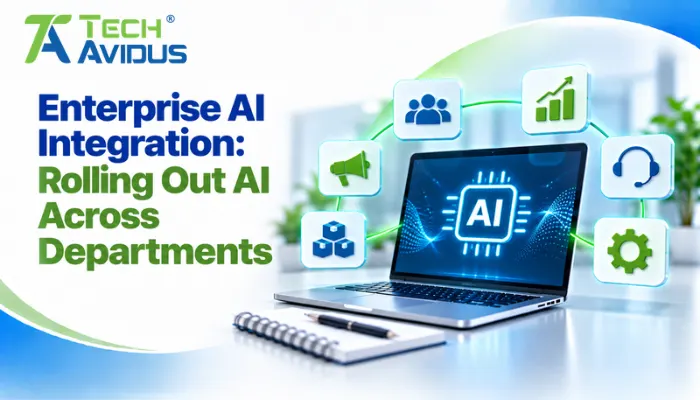
Enterprise Ai Integration helps organizations bring intelligent capabilities into different business functions while maintaining consistency, security, and operational efficiency. Whether a company wants to automate customer support, improve financial forecasting, optimize recruitment, or strengthen supply chain operations, successful implementation requires more than simply adopting AI tools.
The key is to introduce AI gradually, understand departmental requirements, and create a connected technology environment that supports long-term business goals.
How Can Businesses Introduce AI Across Different Departments?
Organizations can introduce AI across departments by identifying repetitive processes, selecting appropriate technologies, connecting existing systems, and measuring operational improvements.
Every department has different responsibilities, challenges, and data requirements. Therefore, businesses should avoid implementing one generic AI solution across every function.
1. Identify Department-Specific Opportunities
The first step is understanding where AI can solve actual business problems.
For example, sales teams may need better lead qualification, while finance departments may want automated invoice processing. HR teams might benefit from intelligent candidate screening, whereas customer support teams may require AI-powered chatbots.
A department-level assessment helps businesses prioritize opportunities based on business impact, technical feasibility, and employee requirements.
2. Build a Connected Technology Infrastructure
AI systems must communicate effectively with existing enterprise applications to deliver meaningful results.
Businesses often use CRM platforms, ERP software, HR management systems, cloud databases, and collaboration tools. Integrating these systems creates a connected environment where information can move securely between departments.
APIs, middleware, cloud infrastructure, and data pipelines can help connect different applications without unnecessarily replacing existing technology.
3. Establish Data Governance and Security
Reliable AI outcomes depend on accurate, accessible, and appropriately protected data.
Organizations should establish clear policies covering data access, privacy, information retention, model monitoring, and employee permissions. Sensitive financial, customer, and employee information must receive appropriate protection.
The NIST AI Risk Management Framework provides useful guidance through its Govern, Map, Measure, and Manage functions for identifying and managing AI-related risks throughout the system lifecycle.
4. Prepare Employees for AI Adoption
Technology adoption is successful when employees understand how to work alongside intelligent systems.
Businesses should provide practical training, explain how AI recommendations are generated, and clarify which decisions require human approval. Involving employees during implementation also helps identify workflow problems before organization-wide deployment.
Which Departments Can Benefit from AI Implementation?
AI can support almost every business function, but its applications should reflect the department's specific responsibilities and objectives.
Sales and Marketing
AI can analyze customer interactions, identify potential leads, personalize marketing campaigns, and assist sales representatives with follow-ups.
Predictive analytics can also help teams recognize customer behavior patterns and prioritize opportunities more effectively.
Human Resources
HR departments can use AI to organize applications, support candidate matching, automate employee queries, and analyze workforce trends.
However, recruitment and employee-related decisions should include human oversight to reduce unfair outcomes and prevent excessive reliance on automated recommendations.
Finance and Accounting
Financial teams can use intelligent automation for invoice extraction, transaction classification, expense monitoring, and financial forecasting.
These applications can reduce repetitive administrative work while allowing finance professionals to focus on reviewing exceptions and making informed financial decisions.
Customer Support
AI-powered chatbots and virtual assistants can answer common questions, retrieve relevant information, and direct complex requests to appropriate support representatives.
Connecting these systems with CRM platforms and knowledge bases helps provide more consistent customer interactions.
Operations and Supply Chain
AI can support inventory forecasting, demand planning, production monitoring, and logistics optimization.
By analyzing operational information, businesses can identify potential disruptions and make better-informed resource allocation decisions.
What Is the Right Approach to Selecting AI Solutions?
Choosing the right implementation approach requires balancing business requirements, technical complexity, scalability, and available expertise.
Companies exploring AI Development Services should first determine whether their requirements involve workflow automation, predictive analytics, generative AI, intelligent document processing, or enterprise application integration.
The choice between external expertise and internal development resources also matters. A Dedicated Ai Developer can support ongoing implementation, customization, maintenance, and technical coordination when a business needs consistent development ownership.
Similarly, evaluating an Ai Integration Agency vs Freelancer requires considering project complexity, security expectations, required expertise, and long-term support. An agency may offer access to multiple specialists, while a freelancer may suit a clearly defined and limited assignment.
Businesses should also evaluate Custom Ai Integration vs Off The Shelf solutions. Ready-made products can accelerate implementation when requirements are standard, whereas custom solutions provide greater flexibility for unique workflows, existing software environments, and specialized business processes.
The right decision depends on organizational priorities rather than choosing the most advanced technology available.
Advantages and Limitations of Organization-Wide AI Adoption
Introducing AI across departments can improve operational efficiency, but businesses must also address implementation challenges.
Advantages
- Improved Productivity: Automating repetitive administrative tasks allows employees to focus on strategic and customer-facing responsibilities. Departments can streamline everyday workflows without relying entirely on manual processes.
- Better Decision-Making: AI can analyze large volumes of organizational information and identify patterns that may otherwise be difficult to recognize. This supports more informed planning across finance, sales, and operations.
- Connected Business Operations: Integrated applications help departments access relevant information and reduce disconnected workflows. Better coordination can improve collaboration and information visibility.
- Scalable Processes: Well-designed AI systems can support growing workloads and changing operational requirements. Businesses can expand successful use cases without rebuilding every workflow from the beginning.
Limitations
- Data Quality Challenges: Incomplete, outdated, or inconsistent information can affect AI-generated results. Organizations need data preparation and validation processes before deployment.
- Security and Privacy Risks: Connecting multiple enterprise applications increases the importance of access controls, encryption, and monitoring. Businesses must establish clear security responsibilities.
- Employee Resistance: Some employees may be uncertain about changing established workflows. Communication, training, and employee involvement are essential for smoother adoption.
- Integration Complexity: Older applications and disconnected databases may require additional development work. Careful architecture planning helps prevent operational disruptions.

Real-World Scenarios: How AI Can Work Across Departments
Consider a growing eCommerce company that manages sales, customer service, finance, and inventory through separate applications.
Initially, the company introduces an AI-powered customer support assistant connected to its product database and CRM. The assistant handles common product questions and helps support representatives retrieve relevant customer information.
Next, the finance department adopts intelligent document processing to extract invoice information and organize financial records. Meanwhile, the operations team uses demand forecasting to support inventory planning.
Finally, the sales and marketing departments use customer behavior analysis to improve audience segmentation and campaign planning.
These implementations create value independently, but their larger benefit comes from connecting relevant information through secure enterprise systems.
Another example is a manufacturing business that introduces predictive maintenance. Its operations team uses equipment data to identify unusual performance patterns, while procurement uses maintenance insights to plan spare-parts availability.
These are illustrative implementation scenarios rather than documented TechAvidus client case studies. They demonstrate how businesses can expand AI adoption through practical, department-specific projects.
Best Practices for Successful AI Implementation
A successful rollout requires clear ownership, measurable objectives, technical planning, and continuous improvement.
Start With a Pilot Project: Choose one department with a clearly defined business challenge. Test the solution with a limited group, evaluate its performance, and identify improvements before expanding.
Create an Integration Roadmap: Document existing applications, data sources, dependencies, and security requirements. A structured roadmap helps technical teams understand how different systems should communicate.
Define Performance Metrics: Measure relevant outcomes such as processing time, error rates, customer response quality, employee adoption, and workflow completion. Establish baseline measurements before implementation.
Maintain Human Oversight: AI should support employees rather than automatically control every business decision. Define approval processes for sensitive, financial, legal, and customer-related activities.
Monitor and Improve Continuously: AI solutions require regular evaluation as business requirements, data, and technologies change. Monitor system performance, investigate unexpected results, and update workflows when necessary.
Encourage Cross-Department Collaboration: IT teams should work with department leaders and employees throughout implementation. This ensures that technical decisions address real operational requirements.
Summary: Building an AI-Ready Enterprise
Rolling out AI across departments requires a coordinated strategy that connects technology with business objectives.
Organizations should begin with practical use cases, prepare their data infrastructure, establish governance policies, and introduce solutions through controlled pilot projects.
Sales, HR, finance, customer support, and operations can all benefit from intelligent automation and data-driven insights. However, long-term success depends on integration quality, employee adoption, security, and continuous performance monitoring.
A scalable approach allows businesses to expand AI capabilities while maintaining control over their technology environment.
Conclusion
Rolling out artificial intelligence across departments is a strategic business initiative that requires careful planning, technical expertise, and collaboration. Organizations that prioritize practical use cases, secure integrations, employee readiness, and continuous optimization can build a more connected and efficient working environment.
The most effective approach is to start small, demonstrate measurable improvements, and expand successful implementations across the organization. With the right architecture and implementation strategy, businesses can turn individual AI applications into a connected enterprise capability.
TechAvidus helps businesses develop intelligent software solutions, connect enterprise applications, and implement scalable technologies aligned with their operational requirements. If your organization is planning its next AI initiative, explore how our AI Integration Service can help you build a connected and future-ready business.
Ready to bring AI into your business workflows? Request a free consultation with TechAvidus to discuss your enterprise AI roadmap.
.jpg "Raju Parmar")
Raju Parmar
Raju Parmar is an AI integration specialist passionate about connecting intelligent technologies with real-world business solutions. He focuses on integrating AI-powered tools, APIs, machine learning models, and automation systems into existing business workflows. With a strong understanding of modern AI technologies, Raju helps businesses improve operational efficiency, streamline processes, and build smarter digital experiences through practical and scalable AI integration solutions.