Key Takeaways
- 1. MCP can connect AI applications with approved healthcare tools and information sources through a standardized interface.
- 2. Secure implementation requires strong authentication, role-based access, audit logs, and patient data protection.
- 3. AI agents can support administrative and information-retrieval workflows without replacing clinical judgment.
- 4. Healthcare teams should begin with limited, low-risk workflows and validate safety before expanding access.
Introduction
Healthcare organizations are exploring AI agents to reduce administrative work, connect clinical systems, and make patient information easier to access. However, healthcare environments require strict data protection, controlled access, and reliable system integration. This is where mcp in healthcare can become useful.
The Model Context Protocol (MCP) provides a standardized way for AI applications to connect with external tools, data sources, and services. When implemented carefully, it can help AI agents interact with healthcare systems while keeping authorization, privacy, and clinical oversight central to the design.
What Is MCP in Healthcare?
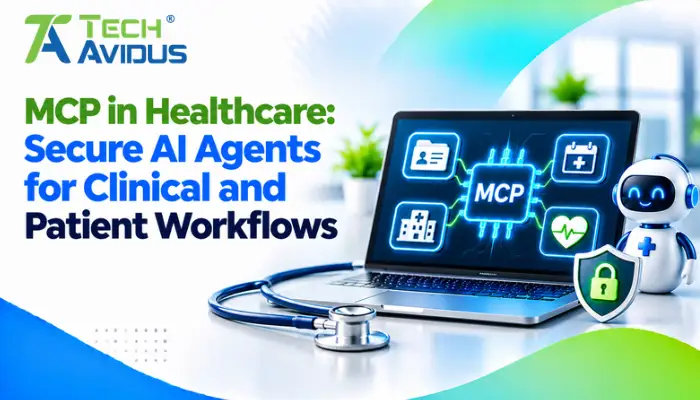
MCP in healthcare refers to using the Model Context Protocol to connect AI assistants and agents with healthcare applications, clinical information systems, and approved operational tools.
Instead of building a separate integration for every AI application, MCP provides a common protocol through which an AI client can discover and use capabilities exposed by an MCP server.
For example, an authorized AI assistant might retrieve appointment availability, search approved clinical reference material, or prepare an administrative summary. The assistant should only access information permitted by the user's role and the organization's policies.
How Does MCP Work in a Healthcare Environment?
MCP works through communication between an AI application, an MCP client, and one or more MCP servers.
A typical healthcare workflow involves:
- AI application: A clinician-facing assistant or administrative AI tool receives a request and determines which approved capability may help.
- MCP client: The client manages communication with the relevant MCP server and handles protocol interactions.
- MCP server: The server exposes approved tools and resources, such as appointment lookup or access to a controlled document repository.
- Healthcare system: The server connects to an authorized backend, such as an EHR, scheduling platform, or hospital information system.
The server should validate identity, permissions, and request parameters before accessing protected information. It should also return only the data necessary for the requested task.

Where Can Healthcare Organizations Use MCP?
MCP can support workflows across clinical operations, administration, and patient services when the underlying systems provide secure and authorized access.
1. Clinical information retrieval
An AI assistant can search approved clinical guidelines, internal protocols, or reference documents. This can help clinicians locate relevant information without manually navigating multiple repositories.
The assistant should clearly identify its sources and avoid presenting retrieved information as a diagnosis or treatment decision.
2. Patient appointment management
An MCP server can expose scheduling functions that allow an authorized assistant to check appointment availability or prepare booking requests. This can reduce repetitive administrative interactions.
Any action that changes a patient's appointment should require appropriate identity verification and confirmation.
3. EHR and patient record access
An integration can allow an AI application to retrieve specific patient information from an Electronic Health Record system. Access must be restricted by user role, patient relationship, purpose, and organizational policy.
Where applicable, healthcare data exchange standards such as HL7 FHIR can support structured access to clinical information.
4. Healthcare administration
AI agents can assist with tasks such as summarizing approved operational documents, checking referral status, or retrieving billing workflow information. These uses can reduce manual coordination across departments.
Sensitive actions, including changes to patient records or financial information, should remain subject to explicit authorization and review.
How Can MCP Support Secure Healthcare AI Agents?
Secure healthcare AI agents need more than a protocol connection. They require an architecture that protects patient information at every stage, from authentication to data retrieval and action execution.
1. Authentication and Role-Based Access
Every user and connected system should have a verified identity. Permissions should determine which tools and patient records can be accessed.
A receptionist, nurse, physician, and billing administrator should not automatically receive the same access. Authorization must be checked by the backend for every sensitive operation.
2. Patient Data Privacy
Healthcare integrations may process protected health information (PHI) and other sensitive data. Systems should minimize the information shared with an AI model and avoid exposing unnecessary patient details.
Data encryption, secure credential management, retention controls, and appropriate vendor agreements should be part of the implementation.
3. Audit Logs and Monitoring
Healthcare organizations need to understand who accessed information, which tool was called, and what action was performed.
Audit logs should capture relevant events without unnecessarily duplicating sensitive patient data. Monitoring can also help identify unusual access patterns or repeated authorization failures.
4. Human Oversight for Clinical Actions
AI-generated information should not automatically become a clinical decision. Diagnosis, treatment recommendations, medication changes, and other high-impact decisions require appropriate professional review.
A safer design separates information retrieval from clinical decision-making and requires confirmation before consequential actions.
What Are MCP Tools, Resources, and Prompts in Healthcare?
MCP tools, resources, and prompts provide different ways for an AI application to interact with healthcare capabilities.
- Tools perform specific actions, such as checking appointment availability or retrieving a referral status. Sensitive tools should enforce authorization and confirmation requirements.
- Resources provide contextual information, such as approved clinical guidelines or hospital policy documents. Access should be limited to the information relevant to the user's task.
- Prompts provide reusable interaction templates for workflows, such as preparing a discharge-summary draft. They should guide the AI without replacing clinical review or institutional protocols.
These capabilities should be designed around clearly defined healthcare use cases rather than exposing unrestricted access to entire systems.
MCP vs. Traditional Healthcare API Integrations
MCP and APIs serve related but different purposes in healthcare technology.
Traditional APIs provide defined endpoints for applications to exchange data or execute operations. MCP provides a standardized interface through which compatible AI applications can discover and use available tools and resources.
MCP does not replace healthcare APIs, FHIR interfaces, or existing integration infrastructure. An MCP server can use those systems behind the scenes while presenting selected capabilities to an AI application.
For example, a hospital may already use FHIR APIs to retrieve patient observations. An MCP server can expose a controlled tool that allows an authorized AI assistant to request specific observations through that existing integration.
Advantages and Limitations of MCP in Healthcare
MCP can make healthcare AI integrations more consistent, but it does not automatically make them secure, compliant, or clinically reliable.
Advantages
- Standardized AI integration: A consistent protocol can reduce the need to build separate AI-facing interfaces for every connected application.
- Workflow flexibility: Organizations can expose selected capabilities across scheduling, document retrieval, and administrative systems.
- Controlled access: Well-designed servers can apply permission checks before allowing an AI application to use a healthcare capability.
- Scalable architecture: New approved tools can be introduced as organizational needs and integration readiness evolve.
Limitations
- Security responsibility remains: MCP does not automatically provide healthcare-grade security or regulatory compliance. Organizations must design and validate their own controls.
- Legacy system complexity: Older EHR and hospital systems may require additional middleware or custom integration work before they can expose useful capabilities.
- AI reliability concerns: AI agents can misunderstand requests or produce inaccurate summaries. Clinical workflows need appropriate verification.
- Operational governance: Healthcare teams must maintain permissions, monitor access, test integrations, and manage protocol or system changes over time.
Practical Example: Connecting an AI Assistant to a Hospital Scheduling System
Consider a hypothetical hospital that wants to reduce the time staff spend answering appointment-availability questions.
The hospital has an existing scheduling platform and wants an internal AI assistant to help authorized staff check available slots.
A possible implementation would work as follows:
- The staff member asks the AI assistant to check appointment availability for a particular department.
- The AI client identifies the relevant scheduling tool exposed by the MCP server.
- The server verifies the staff member's identity and permissions.
- The server queries the scheduling platform and returns only the relevant available slots.
- The assistant presents the options, while the staff member confirms any booking action.
The MCP server does not need unrestricted access to patient records. It can expose only the scheduling functions required for the workflow.
This example illustrates how a limited, well-governed integration can support administrative efficiency without handing clinical or operational control to an AI agent.

Best Practices for Implementing MCP in Healthcare
Healthcare organizations should approach MCP implementation as a security-sensitive integration project, not simply an AI chatbot deployment.
- Start with a low-risk workflow: Begin with approved document retrieval or appointment availability rather than autonomous clinical actions. Validate the workflow before expanding its scope.
- Map data access requirements: Identify which systems, records, and fields the AI application actually needs. Avoid broad permissions when a narrow access scope is sufficient.
- Use established healthcare standards: Consider HL7 FHIR and existing interoperability interfaces where appropriate. Preserve the security and validation rules of connected systems.
- Test authorization boundaries: Verify that users cannot access records or tools outside their permissions. Include negative tests, cross-patient access checks, and failure scenarios.
- Keep humans in control: Require authorized staff to review clinical outputs and confirm sensitive actions. Make it clear when information has been generated or summarized by AI.
- Monitor and maintain integrations: Review audit logs, update dependencies, rotate credentials, and retest integrations when connected systems or permissions change.
What Should Healthcare Organizations Consider Before Adopting MCP?
Before implementation, healthcare leaders should define the problem they want to solve and determine whether MCP is appropriate for that workflow.
Important considerations include:
- Clinical risk: Could an incorrect result affect patient care or safety?
- Data sensitivity: Will the integration process PHI or other regulated information?
- System readiness: Can existing healthcare platforms expose the required information through secure interfaces?
- Governance: Who approves access, monitors usage, and reviews AI-generated outputs?
- Compliance: Have privacy, security, legal, and compliance teams assessed the complete data flow?
The right starting point is a narrowly scoped use case with measurable operational objectives and clear human accountability.
Recap: How Does MCP Fit into Healthcare AI?
MCP provides a standardized way for AI applications to connect with approved healthcare tools and information sources.
Healthcare organizations can use it for appointment workflows, clinical information retrieval, and administrative operations. Secure adoption requires authentication, role-based access, patient data protection, auditability, and human oversight.
MCP complements existing healthcare APIs and interoperability standards but does not replace them or guarantee regulatory compliance. Explore our MCP Server Development service to build secure AI integrations tailored to healthcare workflows.
Conclusion
MCP can help healthcare organizations connect AI agents with clinical and administrative systems through a standardized integration approach. Its value depends on selecting the right workflows and building security, privacy, and human oversight into the architecture from the beginning.
Start with a clearly defined use case, assess your existing systems, and validate the complete data flow before expanding deployment.
Planning a secure AI integration for your healthcare platform? Contact Techavidus for a free consultation and discuss your project requirements.
.jpg "Savan Surani")
Savan Surani
Savan Surani is an expert in MCP (Model Context Protocol) Server Development, specializing in building secure, scalable, and efficient solutions that connect AI models with external tools, APIs, and data sources. He focuses on developing custom MCP servers, streamlining AI integrations, and enabling seamless communication between AI applications and business systems. With a strong focus on automation, system interoperability, and reliable architecture, Savan helps businesses build intelligent, connected, and scalable AI-powered solutions.