

Key Takeaways
- 1. AI-generated code should receive human review before becoming a production dependency.
- 2. Authentication, authorization, APIs, dependencies, and sensitive data handling deserve particular attention.
- 3. Rapid AI-assisted development can create duplicated logic, inconsistent patterns, and hidden technical debt.
- 4. A code audit is valuable before major launches, integrations, scaling, or security-sensitive releases.
- 5. Automated tools can help identify issues, but contextual human review remains important.
AI coding tools can turn an idea into a functional application remarkably quickly. But generating an app is only one part of software development. As an AI-generated application grows, its code, dependencies, integrations, authentication, and business logic need closer examination.
The phrase signs your AI app needs a code audit becomes especially relevant when an application moves from experimentation toward real users, sensitive data, or production workloads. A professional code audit can reveal security weaknesses, technical debt, dependency risks, and architectural problems that may not be obvious during normal testing.
Why Should AI-Generated Applications Be Audited?
An AI-generated application should be audited when its code becomes important to business operations, user data, security, or long-term maintenance.
AI tools can generate functional code without fully understanding an application's business requirements or threat model. OWASP specifically recommends thorough review of AI-assisted code and highlights risks such as vulnerable dependencies, security flaws, excessive permissions, and insufficient human oversight.
A code audit examines more than whether the application works. It considers how the application behaves under unexpected inputs, how data moves through the system, whether permissions are correctly enforced, and whether the architecture can be maintained.
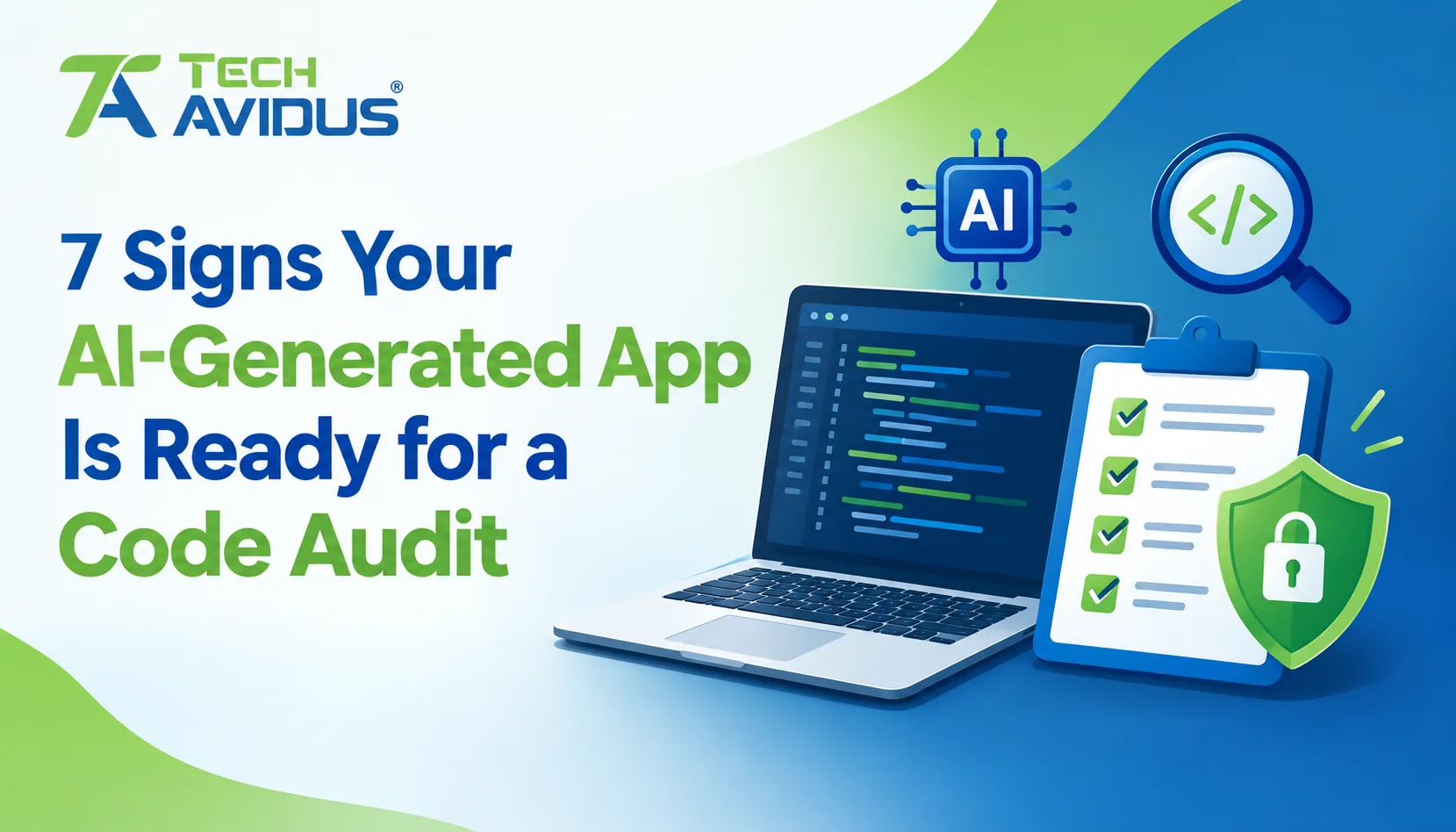
7 Signs Your AI-Generated App Is Ready for a Code Audit
1. The Application Has Grown Beyond Its Original MVP
A small AI-generated prototype can evolve rapidly once new features, integrations, and user requirements are added.
When multiple development sessions have introduced new components, APIs, database operations, and authentication flows, the original structure may no longer be consistent. An audit can identify duplicated code, unnecessary dependencies, weak abstractions, and architectural inconsistencies.
2. You Are Preparing for a Production Launch
Moving from a prototype to production changes the level of responsibility surrounding the application.
Production readiness requires more than successful demonstrations. Authentication, authorization, input validation, error handling, logging, configuration, database access, and deployment settings should be reviewed before exposing the application to real users.
3. You Cannot Easily Explain What the Code Is Doing
One practical warning sign is when the development team can use the application but struggles to explain important parts of its implementation.
AI-generated code may contain unfamiliar libraries, complex functions, repeated logic, or workarounds created during iterative prompting. If developers cannot confidently trace a feature from its user input to its database or API interaction, a deeper code review is worthwhile.
4. Security-Sensitive Features Have Been Added
Applications handling accounts, payments, personal information, administrative functions, or private business data deserve additional scrutiny.
A security-focused review should examine access control, authentication, session handling, input validation, secrets management, API permissions, and sensitive data exposure. OWASP's Secure Code Review guidance recommends examining architecture, entry points, authentication, authorization, data flows, business logic, cryptography, logging, and configuration.
5. AI-Generated Dependencies Keep Appearing
AI coding assistants can recommend packages and dependency versions that require verification.
An application may accumulate libraries that are outdated, unnecessary, poorly maintained, or vulnerable. OWASP's current guidance specifically warns about hallucinated packages and outdated dependencies in AI-assisted development.
A code audit can review dependency usage, package versions, permissions, configuration, and whether each third-party component is actually required.
6. Fixes Are Starting to Feel Like Temporary Patches
Repeated bug fixes can be a sign that the underlying architecture needs attention.
For example, a team may repeatedly modify the same authentication function, add exceptions to API logic, or create separate fixes for similar database problems. These patches may solve individual symptoms while making the codebase harder to maintain.
This is where an AI-generated app code audit can help distinguish isolated defects from broader technical debt.
7. The Application Is About to Be Scaled or Heavily Integrated
Scaling introduces new questions about performance, reliability, data access, APIs, third-party services, and deployment.
Before connecting an AI-generated application to larger systems, an audit can identify bottlenecks and fragile integrations. This is particularly useful when the application will become part of a wider SaaS platform, internal workflow, mobile ecosystem, or customer-facing product.
What Does a Code Audit Actually Check?
A professional audit normally combines automated analysis with contextual human review.
Security reviewers may examine authentication and authorization controls, input handling, API endpoints, database queries, secrets, dependency risks, error handling, logging, and configuration. They can also trace important data flows and investigate business-logic vulnerabilities that automated scanners may not fully understand.
For AI-generated software, the review should additionally consider how AI-assisted development affected the codebase. Unexpected file changes, generated dependencies, weak tests, and overly broad changes can all deserve attention. OWASP notes that AI-generated tests should not automatically be treated as independent evidence of security or correctness.
Advantages and Limitations of Auditing AI-Generated Code
Advantages
Improved security visibility: An audit can expose vulnerabilities and risky implementation patterns before they become production problems.
Better maintainability: Reviewing architecture and duplicated logic can make future development easier and reduce unnecessary complexity.
Stronger production confidence: Teams gain a clearer understanding of what needs remediation before deployment or scaling.
Limitations
An audit is not a guarantee of complete security. Applications continue to change, so findings should be addressed through an ongoing security and development process.
Automated scanning has boundaries. Tools can identify many known patterns, but contextual issues such as business-logic flaws may require human analysis.
Real-World Scenario: From AI Prototype to Production
Imagine a startup uses an AI development platform to build a customer dashboard. The prototype works successfully, and the team adds authentication, payments, an external API, and administrative functionality through several rounds of AI-assisted development.
During testing, everything appears functional.
Before launch, however, a code audit reveals inconsistent authorization checks between different API endpoints, unused dependencies, duplicated database logic, and insufficient validation around an administrative workflow.
None of these problems necessarily prevented the prototype from working. They became important because the application's role had changed.
This is a common practical transition: the code may be good enough for demonstrating an idea but not yet sufficiently reviewed for operating as production software.
What About Lovable-Based Applications?
AI-powered application builders can accelerate development, but the same principle applies when an application moves beyond its prototype stage.
A Lovalbe app rescue process, for example, may involve reviewing generated code, identifying technical debt, fixing broken integrations, improving application structure, and addressing security concerns before further development continues.
For teams building or extending applications with Lovable, a structured review can help determine whether the existing implementation is ready for additional features or requires refactoring first.
Best Practices for Auditing AI-Generated Applications
Start with the application's architecture and business requirements rather than immediately reviewing individual lines of code.
Identify sensitive data, critical workflows, external integrations, privileged operations, and important trust boundaries. Then review authentication, authorization, input validation, database access, dependencies, secrets, logging, and deployment configuration.
Use automated security tools as part of the process, but combine them with manual code review. OWASP describes manual secure code review as complementary to automated SAST and DAST approaches, particularly for business logic and context-specific vulnerabilities.
Finally, document findings by severity and remediation priority. A useful audit should not simply identify problems; it should help the development team understand what needs to change and why.
Recap: When Is an AI-Generated App Ready for an Audit?
An AI-generated application is a strong candidate for a code audit when it is moving toward production, handling sensitive information, accumulating dependencies, becoming difficult to understand, or experiencing repeated technical issues.
The most important principle is simple: working code is not automatically production-ready code.
An audit provides an opportunity to examine security, architecture, maintainability, dependencies, and business logic before those concerns become harder to address.
Conclusion
AI-assisted development can dramatically shorten the journey from concept to working application, but speed does not eliminate the need for engineering discipline.
If your application has moved beyond experimentation, now is the right time to examine its architecture, security controls, dependencies, data flows, and maintainability. A structured code audit can help your team understand what is working, what needs improvement, and what should be addressed before the next stage of growth.
If you have an AI-generated application that needs a deeper technical review, TechAvidus can help assess the codebase and identify practical areas for improvement. Book a free consultation with TechAvidus.

Bhavesh Ladva
Bhavesh Ladva is an AI Developer and rapid product development expert with over 10 years of experience in AI, machine learning, deep learning, and NLP. He specializes in turning ideas into functional, scalable products using modern AI-powered development tools such as Lovable, Bolt, Claude, and other emerging AI platforms. His experience spans AI integrations, APIs, automation, cloud platforms, and intelligent workflows, enabling him to take products from concept to production efficiently.