Conversational AI Candidate Search integrated into a leadership development platform

Want to Integrate AI into Your Existing Platform?

Add intelligent search and conversational AI without replacing your existing system.

The Existing Search Challenge

A Leader Repository People Could Only Search by Filter

A leadership development organisation in the UAE keeps a central repository of leader and candidate profiles: roles, education, leadership programmes and assessment scores.

Until this project, the only way into that data was a filter bar. Recruiters, business users and programme teams picked an Industry, a Sector, a Gender and a Degree, pressed Apply, then sorted by score.

The organisation wanted people to ask the repository questions instead, in English or Arabic. It came back to TechAvidus, after an earlier OpenAI project together, to integrate AI into the existing platform with a ChatGPT-style conversational AI assistant on the same data.

Filter-Based Search

The existing way to find leader profiles

Industry Sector Gender Degree
Apply filters and sort by score
Central Leader & Candidate Repository

Why Filter-Only Search Kept Missing Good Candidates

If you're trying to fix a Replit-generated app without rebuilding it, here is what this project demonstrates.

Challenge 01

Business Challenge

Filters only work when the searcher already knows which attributes matter. Someone looking for "the strongest leaders in energy" had to turn that question into dropdown combinations, and a qualified candidate could be missed because nobody tried the right one. Decision-makers had no way to ask the repository a question or get an analysis back from it.

Challenge 02

Technical Challenge

Turning varied phrasing, typed or spoken, in English or Arabic, into accurate SQL against a relational schema that was already in production.

Handling three different kinds of request (find candidates, analyse the data, search broadly) without one generic prompt blurring them together.

Saving every prompt with its response, then answering the next prompt in the same session using that earlier exchange. The context had to merge correctly on every turn and stay fast, without loading the primary database.

Ranking candidates with a multi-factor model recruiters can understand and trust, rather than an order nobody can explain.

An AI Layer on Top, With the Filters Left in Place

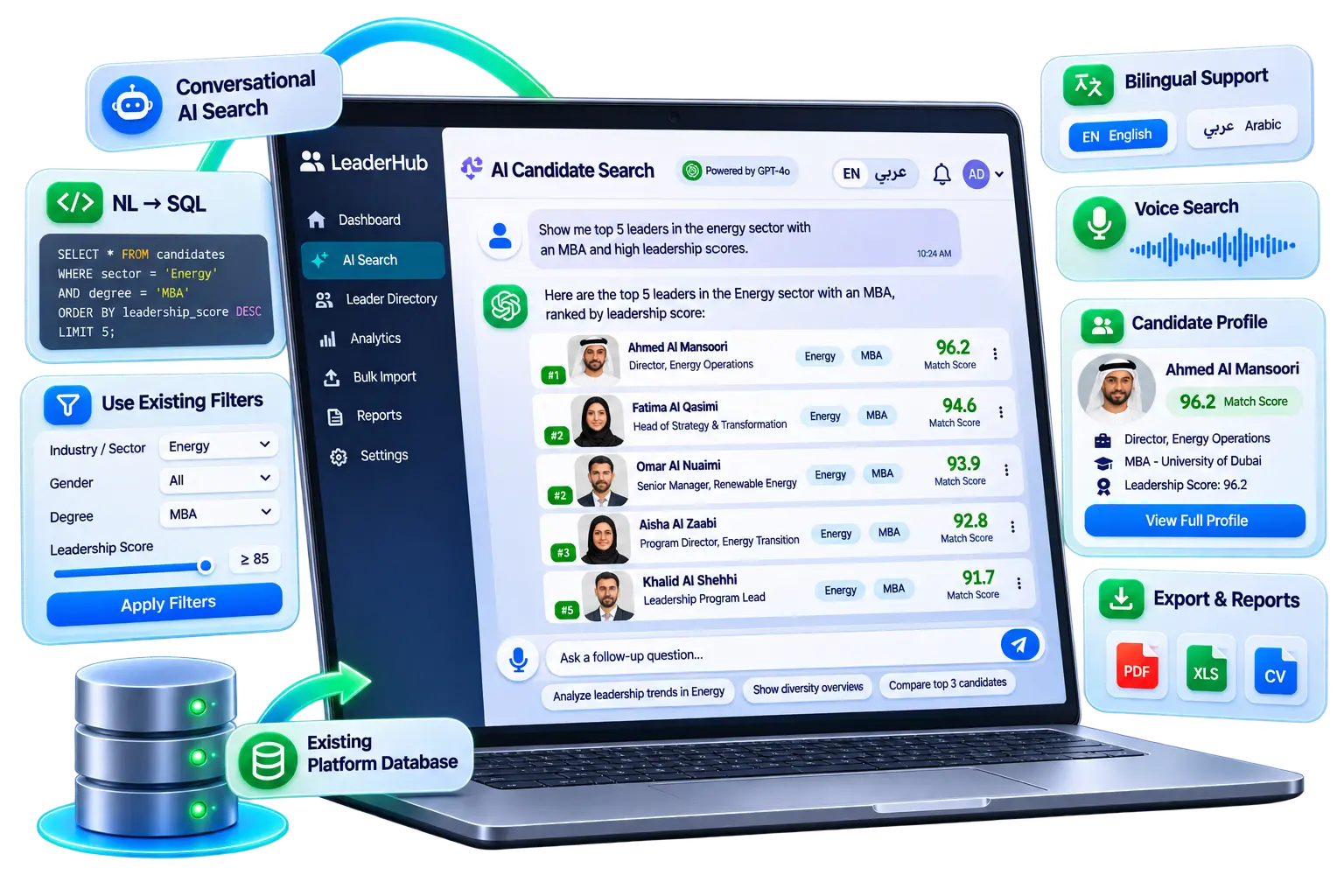
TechAvidus added the AI layer on top of the existing platform and kept the filter-based Leader Directory working beside it. The backend runs on Java Spring Boot and MySQL, with OpenAI's GPT-4o behind the assistant.

Existing Platform

Filter-Based Leader Directory

AI Layer

Conversational AI Assistant

OpenAI GPT-4o · Java Spring Boot · MySQL

Existing filter-based search retained

What the Work Covered

Nine connected areas of platform enhancement

Conversational Assistant

The conversational assistant, with saved prompt history and follow-up questions that build on earlier answers

Intent-Based Routing

Routing each request by intent before any database query is written

Natural-Language Search

Natural-language search that turns questions into SQL against the existing database

Weighted Ranking Engine

A weighted ranking engine with scoring weights administrators can adjust

Platform Insights & Profiles

An analytics dashboard, detailed leader profiles and an extended Leader Directory

AI Summaries & Reports

AI-generated candidate summaries, CV downloads, profile exports, and Excel and PDF reports

Bulk Data Import

Bulk import of leader and candidate records

Voice & Bilingual Experience

Voice search, and English and Arabic across every screen

AWS Deployment

Release through a CI/CD pipeline on AWS

Backend, frontend and QA engineers delivered it over a multi-month engagement in 2026.

Implementation Approach

How We Built an AI Candidate Search Assistant on the Existing Database

To build an AI candidate search assistant on top of a live repository, the team started with the data model, not the prompt. Every AI-generated query would target the tables and fields already in use, and the new search path had to sit beside the filter workflow people already knew. So both were reviewed before anything was designed.

Step 01

Classify the question before writing any SQL.

A request for five energy leaders and a request to analyse AI-related data need different handling. Every message is therefore classified first, as a candidate lookup, an analytical request or a global search. One generic prompt for all three would have raised ambiguity on every call, and a misrouted request changes what recruiters see.

Candidate Lookup Analytical Request Global Search
Step 02

Query the database the filters already use.

The filters and the AI should never disagree about the data. SQL is generated against the existing relational schema, not a separate search index that would have to be kept in sync with it. AI answers and filter results come from the same system of record.

One existing relational system of record
Step 03

Keep conversation state out of the main database.

A chat reads and writes context on every turn. That state lives in Redis rather than MySQL, so follow-up questions stay fast and the database the rest of the platform depends on carries no extra load.

Redis MySQL remains focused on platform data
Step 04

Return structured output, not text to parse.

The interface needs the same fields every time to draw a profile card. OpenAI function calling forces each response into a fixed JSON shape, so the front end never parses freeform model text.

OpenAI Function Calling · Fixed JSON Shape

How a Question Becomes Ranked Leader Profiles

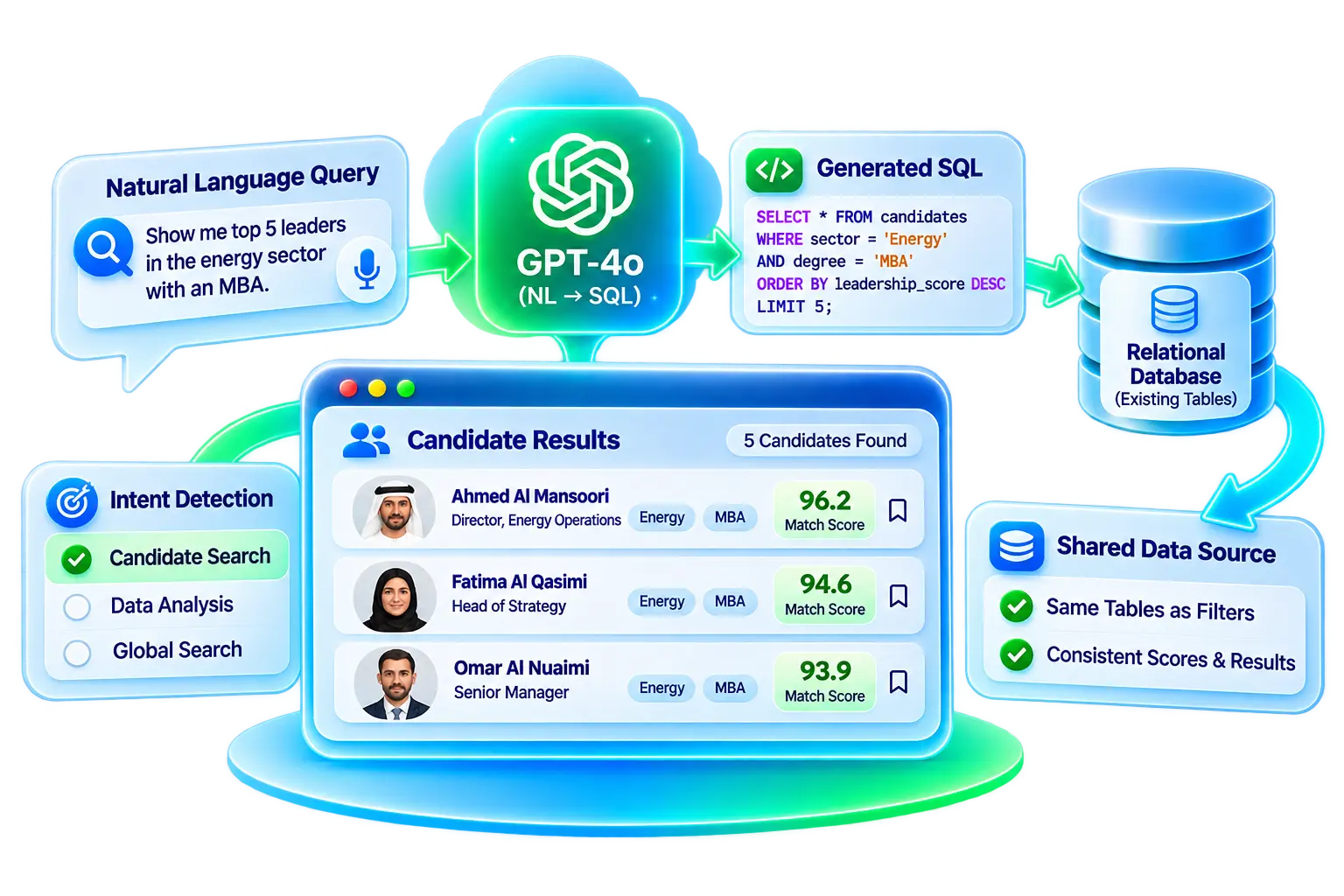
With those decisions in place, the platform runs conversational AI search for an existing database: one request path from a typed or spoken question to an answer, on the same data the rest of the platform reads.

01

A user types or speaks a question in English or Arabic.

02

The Spring Boot API receives it and classifies the intent.

03

A prompt is prepared for that path only.

04

GPT-4o generates the SQL, which runs against MySQL.

05

Function calling formats the results as structured JSON.

06

The chat shows ranked leader-profile cards or an analytical write-up.

Shared Platform

Conversation context is held in Redis and read on every turn. The directory, dashboard, profiles, exports and data import all work on the same MySQL database, behind JWT authentication.

Behind the conversation

The natural-language-to-SQL pipeline

This is the step that lets a plain question reach structured data. After intent detection and prompt preparation, GPT-4o writes a SQL statement for the request. The statement executes against the relational database, and the rows go back through function calling to become the JSON the interface renders as profile cards. Because the AI path and the filter path read the same tables, a recruiter who switches from asking to filtering sees the same leaders with the same scores.

Natural language to SQL pipeline
Production controls

How we handle AI-generated SQL in production

When a language model writes the query, the rules around the database have to be strict. On this platform, generated SQL runs under three rules:

Validation before execution.

Only a single SELECT on approved tables is allowed, with no stacked or write statements. A rejected query falls back to filter search or asks the user to rephrase.

User-level scoping.

Queries run within the signed-in user's permissions.

Query logging.

Generated SQL is logged for review and prompt tuning.

The Stack Behind the Leadership Search Platform

Java Spring Boot and MySQL support the existing platform, with GPT-4o, Redis, and AWS powering the AI search experience.

Backend & Database
Java Spring Boot (REST APIs), MySQL
AI Model and API
OpenAI GPT-4o via the OpenAI API
Structured Output
OpenAI function calling (structured JSON outputs)
AI Patterns
Intent classification, natural language to SQL (text-to-SQL), multi-turn conversation context, prompt history, weighted multi-factor scoring
Session and Conversation Memory
Redis
Authentication
JWT
Cloud and Deployment
AWS, Docker, CI/CD
Front End & Version Control
Custom conversational web interface, Git
Languages and Input
English, Arabic, voice search

What Recruiters and Programme Teams Can Do Now

Those pieces add up to eight things people can do on the platform. The assistant comes first, and the rest support searching, reviewing and sharing what it finds.

ChatGPT-style conversational AI assistant
Core Feature

Users type or speak a question and get ranked leader-profile cards back, in a carousel when there are more than four results. Suggested prompts on the welcome screen show new users what they can ask. Nobody has to know which dropdowns add up to "the best leaders in energy."

Prompt history and follow-up context

Every prompt is saved with its response in a sidebar grouped by Today, Previous 7 days and Previous 30 days, with a search box for older chats. Inside a session, the next question builds on the last answer, so "now give the top IT industries" refines the earlier search. Getting that merge right on every turn is what makes it feel like a conversation.

Intent routing

Each request is classified before it runs. "Show me five leaders in the energy industry" comes back as profiles. "Analyse AI-related data" comes back as a structured write-up with insights, programme affiliations and recommendations. A wrong classification would change what recruiters see.

Ranked recommendations with adjustable scoring

Results are ordered by a weighted score combining leadership, experience, education, assessment and achievement scores with industry relevance and programme participation. Administrators can adjust the weights. Recruiters see the best-fit candidates first, with a total score they can point to when explaining a shortlist.

Analytics dashboard

For programme teams, this is people analytics across the whole repository. Headline counts sit at the top, followed by gender and sector distribution, score-percentile bands, an industry comparison and a Leader Spotlight with Rising Stars. Users can open a spotlight segment or scroll into the ranked leader grid below.

Profiles, directory and exports

A full profile shows the score breakdown, education and programme history. From there, a user can download an AI-generated summary or CV, export profiles straight from chat results, or produce Excel and PDF reports. Anyone who prefers filters still has the Leader Directory, sorted by the same score.

Bulk data import

Administrators load new leader and candidate records in bulk instead of one at a time. That keeps the repository current as each new programme cohort joins, and imported records reach the dashboard, directory and AI search together, since all three read the same database.

Multilingual AI search assistant: voice, English and Arabic

A microphone in the chat composer takes spoken questions, and an En | Ar switch sits in the header of every screen. The language setting also decides the language of the AI's answers, so an Arabic-speaking recruiter can ask in Arabic and read the results in Arabic.

Where GPT-4o and Redis Do the Work

Two integrations carry the assistant: one to understand and answer each question, one to remember the conversation around it.

AI Integration

OpenAI API integration (GPT-4o)

Spring Boot
OpenAI API
Structured Output

Connected through REST calls from the Spring Boot backend to the OpenAI API

The GPT-4o integration handles natural-language understanding, intent-specific prompt preparation, SQL generation and response formatting

The hard part

One model serving three request types reliably, returning structured outputs through function calling that the front end renders as profile cards, and answering in the user's selected language

Session Management

Redis session management and conversation memory

Conversation Session
Session Cache
Prompt History
Chat Context
Redis

Read and written by the Spring Boot backend on every chat turn

Holds session caching, prompt history and the context used to answer follow-up prompts

The hard part

Merging the previous exchange into each new prompt correctly, and doing it fast enough to feel like a chat

Released Through CI/CD to AWS

The platform reaches production through a CI/CD pipeline that TechAvidus engineers worked in directly.

01 · Deployment
CI/CD Pipeline

CI/CD with Docker containers, deployed on AWS.

Docker
AWS
02 · Quality Assurance
Release Testing

TechAvidus unit-tested its work before each release.

Unit testing before release
03 · Release
Live Production

The platform is live in production for the organisation's users.

Live in Production
From Pipeline to Production

Docker-based CI/CD deployment, unit testing before each release, and a platform running live on AWS.

Production Live

What the AI Integration Delivered

A more natural way to discover leaders, a connected technical architecture, and a production-ready platform at scale.

01 · User Experience

Product Capability

Faster candidate discovery with AI

One typed or spoken question, in English or Arabic, replaces choosing Industry, Sector, Gender and Degree filters, pressing Apply and sorting by score.

English Arabic Voice & Text
Follow-ups instead of new searches

A second question refines the first answer, and any past conversation can be reopened from the history sidebar.

Conversation history and follow-up context
02 · Architecture & Engineering

Technical Outcome

AI answers and filter results agree

Both read the same MySQL system of record, with no second search index to keep in sync.

Conversation memory stays off the main database

Context for every turn runs in Redis.

Intent routing and structured responses

Every request is routed before SQL is generated, and every response returns as structured JSON.

Intent Routing
MySQL + Redis
Structured JSON
03 · Production & Scale

Delivery Evidence

Live in Production
Full scope delivered and running

Live in production with the full scope in place: assistant, intent routing, NL→SQL pipeline, recommendation engine, dashboard, profiles, exports, data import, voice and bilingual support.

Bilingual across every screen

English and Arabic on every screen, including the AI's own responses.

English العربية · Arabic
Repository at scale

Running on a repository of thousands of leader profiles spanning 17 industries, 30+ leadership programmes and nearly 400 universities.

17
Industries
30+
Programmes
~400
Universities
Released through CI/CD

Released through CI/CD on AWS with Docker.

From a Client Who Came Back

A returning client. Another successful collaboration.

CTO UAE logo

"I worked with TechAvidus on an OpenAI project, where the team did a great job. I rehired them for this project (Java Spring Boot) and am once again very happy with the results. The team delivered excellent work, and I look forward to working with them again in the future."

CTO · Leadership Development Organisation, UAE

What This Proves About AI Integration

If you plan to integrate AI into existing platform workflows, this project shows four things TechAvidus can do.

01
Seamless Integration

Add AI as a layer, not a replacement.

A ChatGPT-style conversational AI assistant now runs on the same database as the original filter search, with prompt history and follow-up context, and the directory still works for people who prefer it. That pattern is the centre of our AI Integration Services work.

Existing Database Conversational AI Filter Search Retained
02
Reliable AI Answers

Engineer answer quality from the first step.

Requests are routed by intent before any SQL is written, outputs come back structured, and generated queries run behind production safeguards. That matters for any product where users will query their own data in plain language.

03
Transparent Decisions

Make rankings explainable and tunable.

Weighted, multi-factor scoring shows recruiters why a candidate ranks first, and administrators can change the weights. The same approach fits any shortlist that has to be defended to someone else.

04
Multilingual Experiences

Deliver for multilingual, Gulf-region users.

Arabic and English run through every screen and every AI answer, with voice input on top, for teams whose users don't all work in one language.

English العربية · Arabic Voice Input

Questions About Conversational AI Search on
an Existing Database

Find answers to common questions about integrating conversational AI search with an existing platform and database.

No. An AI database search solution for enterprise data can sit beside the search your users already know. On this project, the assistant was added on top of the existing platform and reads the same MySQL database as the filter-based Leader Directory. People who prefer dropdowns still use them, people who prefer to ask use the chat, and both see the same leaders and scores. The AI did not need its data copied into a separate index to work.

Mostly how many kinds of question the assistant has to handle, and how complex the data behind them is. Here, three request types (candidate lookup, analysis and global search) each needed their own routing path. Other factors:
  • the size and complexity of the data schema the AI queries
  • the number of languages, and whether voice input is needed
  • how complex the ranking model is, and whether administrators tune it
  • analytics, export and data-import requirements
  • how deep the query safeguards and testing need to go

Yes. This platform ranks candidates with a weighted, multi-factor score that combines leadership, experience, education, assessment and achievement scores with industry relevance and leadership-programme participation. Administrators can adjust the weights. The total score sets the order in both the chat results and the directory, and each profile breaks it down by factor. A recruiter can see why one leader sits above another instead of trusting an unexplained list.

Yes. On this platform, an En | Ar switch sits in the header of every screen, from the dashboard to the directory and the chat. The selected language sets both the interface text and the language of the AI's responses, so an Arabic-speaking user can search and read answers in Arabic. Voice input works through a microphone in the chat composer. Questions in either language go through the same intent routing and SQL pipeline.

Yes. Every prompt is saved with its response, and within a session the next question is answered using the earlier exchange. A user can ask for leaders in a sector, then follow up with "now give the top IT industries" and get a refined answer instead of a fresh search. Past conversations sit in a sidebar grouped by date, with a search box, so an earlier search can be reopened without retyping it. The conversation memory runs in Redis, which keeps each turn fast.

Yes. When a request is classified as analytical, the assistant returns a structured write-up instead of profile cards. Asked to analyse AI-related data, for example, it produces sections on insights, the programmes AI-related individuals belong to and their affiliations, followed by recommendations. Programme teams can ask the repository a question and get an answer they can act on, alongside the dashboard's assessment-score percentiles and sector charts.

More AI Integration Work

Explore how AI integration can extend your existing platform and add new capabilities to established workflows.

AI INTEGRATION & DEVELOPMENT

Build on What Your Platform Already Does

If this AI candidate search case study is close to what you're planning, the services behind it are AI Integration Services and our wider AI development services .

Relevant Case Studies

Why Founders Choose TechAvidus to
Stabilize Their AI-Generated Codebase

Our team brings product engineering and AI expertise to help turn ambitious software ideas into dependable applications.

105+ Team Members | 11+ Years in Software & AI Engineering | 92% Client Satisfaction Rate
Top Rated Plus on Upwork (4.8/5) Google (4.7/5) Highly Rated On Clutch & GoodFirms
YOUR DATA. A SMARTER WAY TO SEARCH.

Ask, Don't Filter: Put AI Search on Your Own Data

Users stuck searching your data with filters? Give them a more natural way to find answers. Add conversational AI to your existing platform without replacing the workflows that already work.

Book a Free AI Integration Discovery Call
Explore how AI can work with your existing data and platform.
A smarter search experience
Traditional filtering
Choose fields. Apply filters. Sort results.
Conversational AI search
Ask naturally. Get relevant answers.
Example question

"Find the strongest leaders in the energy industry."

Your Existing Data AI Powered