STEP 01 · THE CONTEXT
Enterprise Messaging
The client is an enterprise messaging and conversational-AI (CPaaS) platform, operating at global scale.


Allow Google Analytics to measure how I use the site to enhance functionality and service.

Allows us to show personalized advertisements based on your browsing behavior.

Share my activity data with cookies for targeted advertising.

Customize my ad experience by allowing cookies to personalize the ads I see.
A focused integration built to fit an existing multi-channel platform.




















The client is an enterprise messaging and conversational-AI (CPaaS) platform, operating at global scale.
Its AI agent platform already ran on the Model Context Protocol, with several specialized MCP servers live – one per channel – so its own customers could already connect their messaging workflows to Claude, ChatGPT, and other AI agents on more than one channel.
WhatsApp was the one major channel still missing a server of its own, and it needed to ship as part of the platform's continued build-out – on a fixed timeline, without slowing the other channels' ongoing development.
The WhatsApp channel needed to ship as part of a larger, already-live multi-channel MCP platform, on a fixed timeline, without disrupting the platform's other channels or pausing their ongoing development. Missing that window would mean the platform's newest channel shipping later than the others, on a system its own engineering team was still actively building out.
Missing that window would mean the platform's newest channel shipping later than the others.
Without disrupting the platform's other channels or pausing their ongoing development.
On a system its own engineering team was still actively building out.
Reconciling WhatsApp Business Platform's template/session-window messaging rules - pre-approved templates required outside an active, customer-initiated 24-hour session - with an AI agent generating freeform message content on the fly.
Building a new channel server that conforms exactly to an existing multi-MCP platform's established conventions (transport, auth, tool schema), rather than introducing a pattern of its own.
Implementing authentication (API key / OAuth 2.1) consistent with the platform's existing security model, without adding new credential storage.
"TechAvidus ramped up exceptionally fast, understood our technical ecosystem, and delivered the WhatsApp MCP integration on time with minimal guidance."
TechAvidus delivered full ownership of the WhatsApp channel's MCP server, built from scratch inside the platform's existing multi-channel MCP architecture.
A full error-handling surface covering:
End-to-end validation using Claude Desktop as a test AI client.
One backend/MCP engineer held full ownership of the WhatsApp channel's delivery - from architecture review through to validated handover. The platform's other channels, already live on the same multi-MCP system, were untouched throughout.
Architecture review to end-to-end validation
Before writing any code, TechAvidus reviewed the platform's existing architecture, analyzed its codebase and APIs, evaluated dependencies, and completed a risk assessment - the same due diligence any engineer would need before touching a live, unfamiliar multi-channel system.
TechAvidus's work was bounded to full ownership of the single WhatsApp channel server, not the platform's broader multi-channel system. Against a fixed timeline and a large, unfamiliar codebase, this bounded scope meant faster ramp-up and lower onboarding risk - at the cost of limited visibility into the rest of the platform's architecture, a trade-off already made before the engagement began.
Rather than a direct REST API, the WhatsApp channel was built as a Remote MCP Server that exposes WhatsApp messaging as an MCP tool, with channel-specific logic kept isolated behind that abstraction. This kept the platform protocol-compliant, let future messaging providers get swapped in with minimal orchestration changes, and avoided exposing WhatsApp-specific business logic directly inside AI workflows.
The new channel was built to conform to the platform's already-established multi-MCP conventions - transport, auth, and schema - rather than requiring any change on the AI-agent-reasoning side. It also reused the platform's existing authentication mechanism (API key / OAuth 2.1) instead of introducing new credential storage. Both choices reduced regression risk against the platform's other live channels.
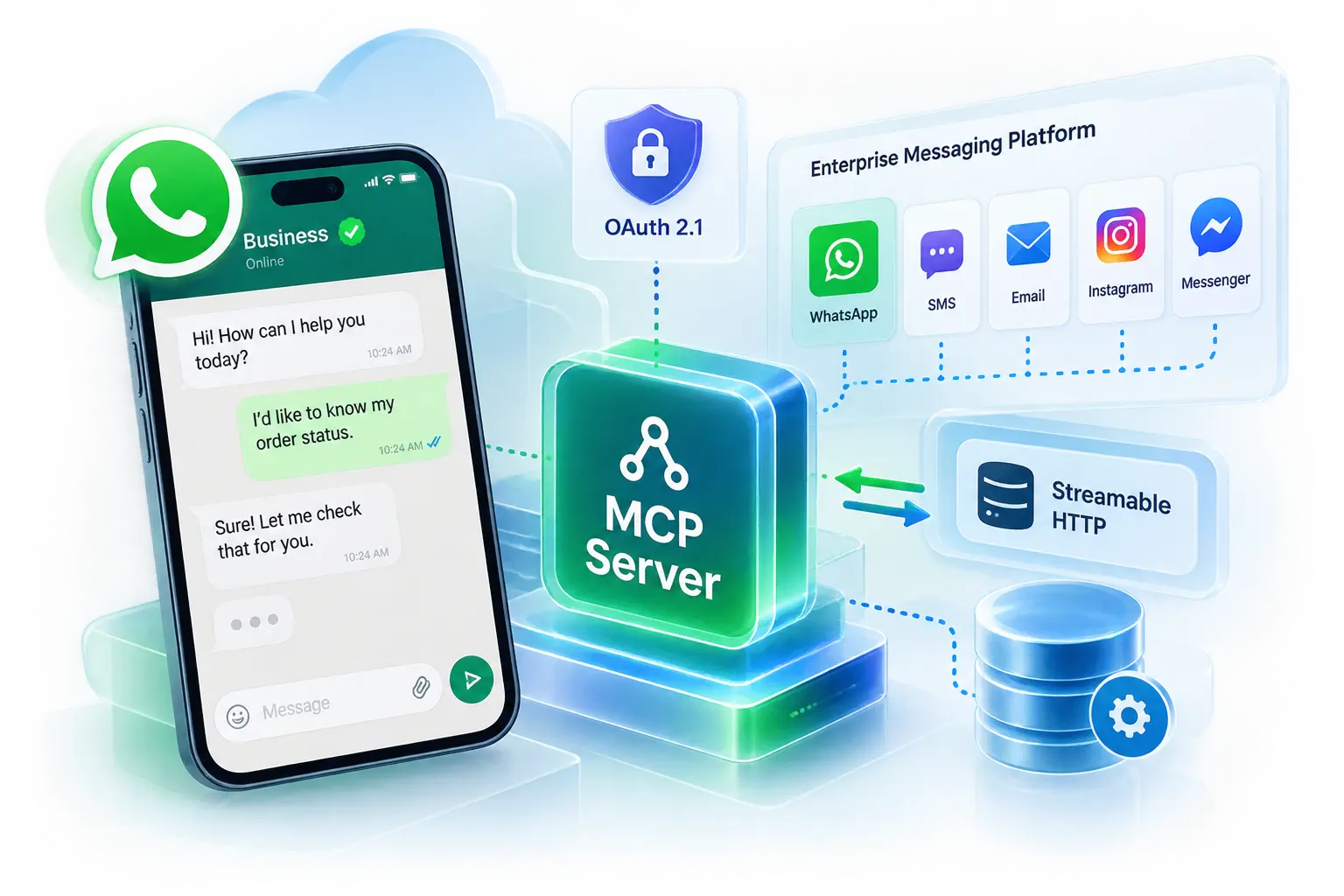
The client's AI agent platform is built around multiple specialized MCP servers, each responsible for one business domain - WhatsApp, SMS, and others - rather than a single monolithic integration. AI clients connect to the right server over Streamable HTTP, and each server owns its own tools and business logic. The WhatsApp channel server TechAvidus built sits alongside these sibling servers, handling tool discovery, authenticated tool invocation, WhatsApp message-send execution, and delivery-status retrieval on its own.
An AI agent - such as Claude Desktop - selects the WhatsApp MCP tool in response to a user request or workflow.
The request is authenticated (API key / OAuth 2.1) and validated against the tool's schema before anything is sent.
The server translates the validated request into a WhatsApp Business Platform send action.
WhatsApp Business Platform delivers the message.
A delivery-status report is retrieved and returned to the AI agent through the same MCP interface.
One standardized MCP interface connects the AI request to messaging execution and status retrieval.
For the platform's own customers, this means WhatsApp messaging works through the same standardized MCP interface for WhatsApp messaging as every other channel already live on the platform - no separate, bespoke integration to build or maintain on their end.
Lets any MCP - compliant AI agent send WhatsApp Business messages, draft messages via AI, and retrieve delivery-status reports through a standardized MCP tool interface, instead of a direct channel - specific integration. The hard part was reconciling WhatsApp's template/session-window rules with content an AI agent generates on the fly. The platform's own customers get WhatsApp messaging through the same interface used for its other channels, without building a separate integration themselves.
Retrieves and returns WhatsApp delivery-status reports through the same MCP interface used to send the message, so a completed send and its outcome stay inside one workflow. The platform's customers see delivery confirmed back to their AI agent or orchestration layer without a separate status check.
Enforces authenticated access (API key/OAuth 2.1) on every MCP request and covers the full error surface: invalid sender, missing parameters, transport failures, authentication failures, WhatsApp delivery errors. The channel reuses the platform's existing security model rather than adding new credential storage. Failures are caught and handled cleanly instead of surfacing as silent errors to the AI agent.
One standardized interface. Messaging, delivery-status retrieval, authentication, and error handling work within the platform's existing MCP architecture.
The WhatsApp channel server connects to one system: WhatsApp Business Platform, through the platform's existing WhatsApp messaging infrastructure. The integration runs over MCP (Streamable HTTP transport), with the WhatsApp Business Platform API underneath handling the actual message send.
What made it complex wasn't the connection itself - it was reusing the platform's existing authentication model without adding new credential storage, and reconciling WhatsApp's template/session-window messaging rules with content an AI agent generates on the fly. That's the same question a lot of enterprise messaging platforms are asking right now: how do you let Claude or ChatGPT send WhatsApp messages through your own platform, without exposing your API directly to every AI client that connects?
The completed WhatsApp channel server was validated end-to-end before handover, with testing scoped to manual integration verification rather than an automated pipeline.
Full conversational workflow tested using Claude Desktop as a test AI client, from message request through to delivery-status retrieval.
Verified behavior for invalid phone numbers and authentication failures.
Feature completion confirmed for the WhatsApp channel, delivered inside the platform's broader multi-channel MCP system.
WhatsApp messaging was integrated into the existing MCP ecosystem, with error handling, end-to-end validation, and no disruption to sibling channels.
The platform's WhatsApp channel now sends AI-agent-initiated messages, drafts message content via AI, and returns delivery-status reports - the same standardized workflow already available on the platform's other channels.
Full error-handling coverage shipped with the channel: invalid-sender detection, missing-parameter validation, MCP transport-failure handling, authentication validation, and WhatsApp delivery-error propagation.
The new channel was built to the existing multi-MCP platform's own conventions - transport, auth, and schema - introducing no regression risk to the sibling channel servers already running in production.
Full ownership of the WhatsApp channel MCP server delivered and confirmed complete in roughly six weeks, validated end-to-end with Claude Desktop as a test AI client.
From architecture review to end-to-end validation with Claude Desktop.
Delivered without changing the platform's established multi-channel architecture or disrupting its existing production channels.
"Our challenge wasn't finding someone who could write code - it was finding someone who could understand a large, mature AI platform, work within our existing architecture, and deliver a scoped MCP integration without affecting the rest of the system. TechAvidus ramped up exceptionally fast, understood our technical ecosystem, and delivered the WhatsApp MCP integration on time with minimal guidance and no disruption to our ongoing development."
If you're weighing how to build a custom MCP server for a messaging channel inside a platform you already run - one your own customers could use to connect their messaging product to Claude or ChatGPT - here's what this project proves:
The WhatsApp channel was built to conform exactly to the platform's already-live multi-MCP architecture - same transport, same auth model, same tool conventions as its sibling channel servers - with no regression risk introduced elsewhere. This is what MCP Server Development looks like when the platform already exists.
WhatsApp's template/session-window messaging rules had to hold even when an AI agent was generating the message content itself, not a person filling out a form.
The channel reused the platform's existing security model rather than adding new credential storage, while still covering every failure mode - invalid sender, missing parameters, transport failures, authentication, WhatsApp delivery errors - before it shipped.
Get Recommendations, Custom Solutions, Developer's Resume, or Estimations.
We would like to understand your needs. Before we start, please fill in the form or send your RFP or inquiry via hello@techavidus.com →




Fill out your information and we will assemble the scope.