Lightz Camera Action Case Study Banner

Have a Replit App to Validate?

Get clarity on what to fix, keep, and improve.

Municipal Technology Case Study

A Municipal Minutes Platform Built on Replit Agent, Never Independently Reviewed

A small local-government software vendor had used Replit Agent to build a municipal meeting minutes app. Authentication, dashboards, user management, and meeting uploads already worked, and the platform was set up for an initial group of municipalities. What the client lacked was an independent engineering answer. Could this codebase carry production use, more municipalities, and the AI workflow planned for Phase 1, or did it need a rebuild first? They brought in TechAvidus to answer that before spending more, and to build the AI workflow itself.

Already Working

Authentication, dashboards, user management, and meeting uploads.

The Open Question

Could the codebase support production use, more municipalities, and the planned AI workflow?

The Engagement

Assess the existing codebase independently and build the Phase 1 AI workflow before deciding whether a rebuild is necessary.

Why the Keep-or-Rebuild Call
Had to Come Before the AI Work

Business Challenge

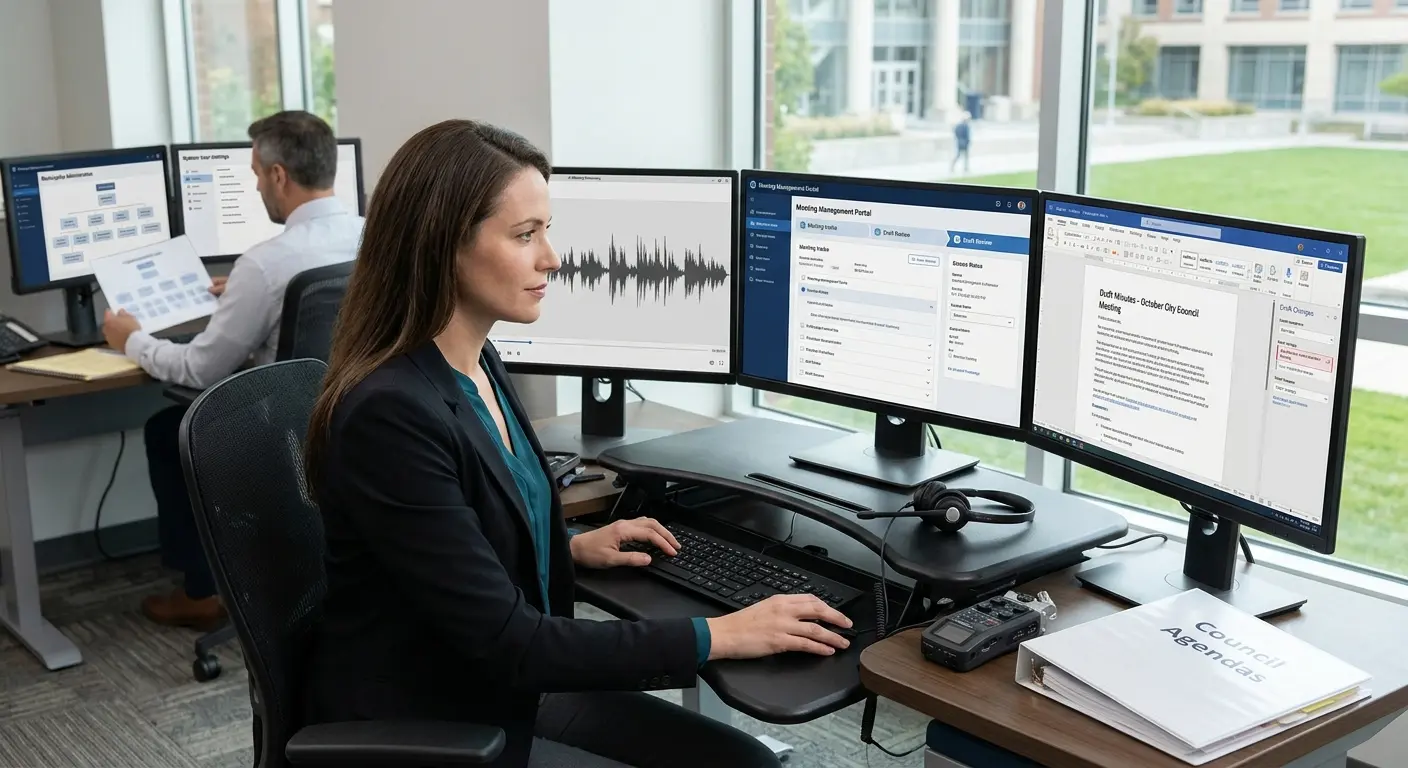
Clerks were still producing minutes by hand: transcribe the recording, format it, review it, publish it. A two-hour meeting could take 3–4 hours of admin work. The client wanted to automate municipality meeting minutes and add more municipalities, but couldn't commit budget to either until someone confirmed the Replit Agent foundation would hold. A wrong call cost money in both directions: rebuilding code that didn't need it, or scaling code that couldn't take it.

Manual Effort

A two-hour meeting could require 3–4 hours of administrative work.

Technical Challenge

The only record of how the system worked was the codebase itself. Replit Agent had generated it, and no separate documentation existed.

The data model was multi-tenant, with logical isolation between municipalities. In Phase 1, municipalities were provisioned directly in the database rather than through an admin interface, so isolation had to be confirmed in the code, not assumed.

Speech-to-text output, agenda alignment, and the generated minutes all had to stay consistent across different recording conditions, speakers, and meeting formats.

Agendas arrive as Word or PDF documents, and each transcript had to be matched to the right agenda items before any minutes were drafted.

Every AI-generated draft had to stay editable and pass a clerk's review before it could become a permanent public record.

A Two-Month Audit and AI Build Inside the Existing Codebase

PHASE 1 DELIVERY

Build on What Already Worked

The client didn't need to build an AI meeting minutes app from scratch. It needed the AI workflow added to the one it already had, once a team had confirmed that app was worth building on. Over two months in 2025, a three-person TechAvidus team delivered:

2 Months Delivery timeline
3 People TechAvidus team

What Phase 1 Delivered

From codebase assessment to AI workflow and future planning

6 deliverables
01

Repository and Architecture Audit

A repository audit of the Replit Agent-generated application against the approved Phase 1 Scope of Work, with an architecture review and a walkthrough of the municipality workflow as implemented in code.

02

Existing Code Improvements

The minor improvements the audit identified in the existing code.

03

Speech-to-Text and AI Minutes

An OpenAI Whisper speech-to-text pipeline, plus an LLM-driven workflow that generates draft meeting minutes from each transcript and its uploaded agenda.

04

Scalability Review

A scalability review for adding more municipalities.

05

AI Operating Cost Assessment

An assessment of AI operating costs, with optimization work scheduled for a later phase.

06

Phase 2 Engineering Roadmap

An engineering roadmap for Phase 2, walked through with the client's stakeholders in review sessions.

What Remained on the Phase 2 Roadmap

A self-serve interface for creating municipalities and expanded reporting stayed on the Phase 2 roadmap. Everything else in the Phase 1 scope was validated and delivered.

Planned for Phase 2

Why We Kept the Replit Agent Code Instead of Rewriting It

The roadmap only made sense once the team knew what it was building on, so the work started with a production readiness assessment, not a rewrite estimate.

Decision 01

Measure the Code Against the Contract First

With no documentation to work from, the team read the Phase 1 Scope of Work and audited the repository directly, comparing what was implemented against what had been contracted. That gave an architecture review of an AI-generated app grounded in the client's own scope rather than in general opinions about AI-generated code. Findings were checked with the client's stakeholders in joint review sessions.

Decision 02

Preserve the Foundation, Spend Effort on Business Logic

Authentication, dashboards, user management, and meeting uploads were working as intended and needed only minor improvements. User management, municipality administration, meeting processing, and the AI workflow already sat in separate areas of the code. A full rewrite was the alternative, and it was rejected: keeping the stable components meant less delivery risk, less effort, and lower cost than redeveloping them. New engineering went into municipality-specific logic, the AI workflow, and production readiness.

Decision 03

Keep AI Inside the Meeting-Processing Workflow

Transcription and minutes generation serve one objective, turning a meeting into a draft record. So the AI steps live in the meeting-processing workflow, not spread across the rest of the app.

Decision 04

Finish Validation Before Any Phase 2 Expansion

Building Phase 2 features on top of unchecked code would compound whatever technical debt it held. Validation was completed first. AI token usage was reviewed during production-readiness planning, and the cost-optimization work itself was scheduled for after Phase 2.

How a Meeting Recording BecomesEditable Draft Minutes

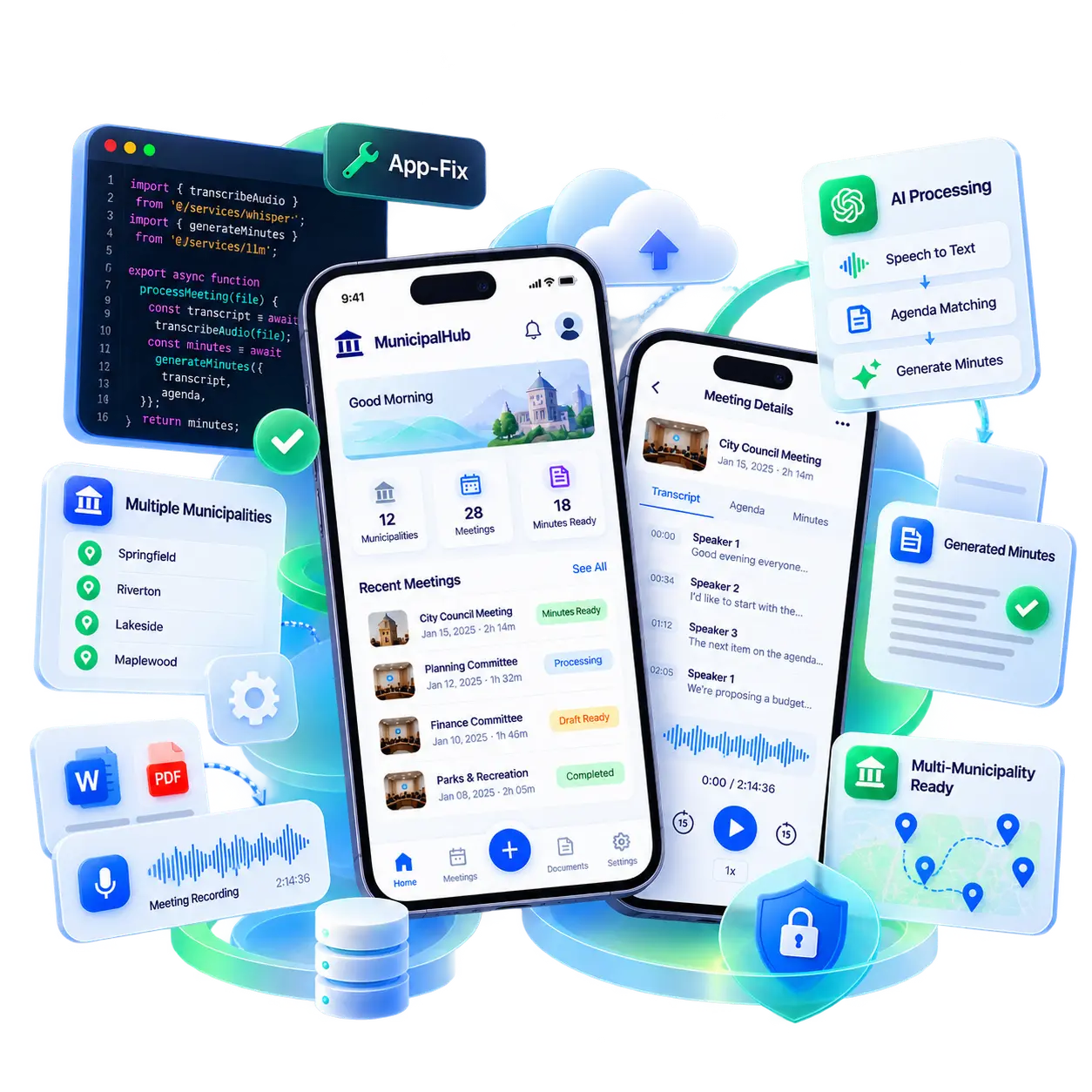
The preserved application and the new AI workflow now run as one system, organized in four layers:

01. Presentation User-facing interfaces
Super Admin portal Municipality user portal Meeting review interface
02. Business Logic Application operations
User management Meeting processing Agenda mapping AI orchestration Minutes generation Record management
03. AI Processing Meeting-to-minutes pipeline
Whisper transcription Agenda alignment LLM draft generation
04. Data Stored records and files
Municipality records Users Meetings Audio files Agenda documents Draft minutes Final minutes
End-to-end workflow

One Meeting. Seven Controlled Steps.

A single orchestration layer controls the order of the AI steps for each meeting:

Orchestration layer Coordinates each processing step in sequence.

Tenant Isolation Across Every Layer

Tenant isolation runs underneath all of it. Every meeting belongs to exactly one municipality, and a user's municipality is applied at login and held for the whole session. That means the same platform can take on more municipalities without one municipality's recordings or minutes becoming visible to another.

01. Create the meeting

A municipality user creates a meeting and uploads an MP3 or WAV recording and the agenda.

02. Validate uploads and ownership

The system checks the file formats, confirms an agenda is attached, links both files to the user's municipality, and blocks duplicate meetings.

03. Transcribe the recording

OpenAI Whisper transcribes the recording.

04. Align the transcript with the agenda

The transcript is aligned to the items in the uploaded agenda.

05. Generate draft minutes

An LLM generates structured draft minutes from the aligned transcript.

06. Clerk reviews and edits

The draft appears in the review interface, where a clerk edits and approves it.

07. Publish the permanent record

Once published, the minutes are stored as a permanent record and can no longer be edited.

The Stack Behind the Lightz Camera Action App

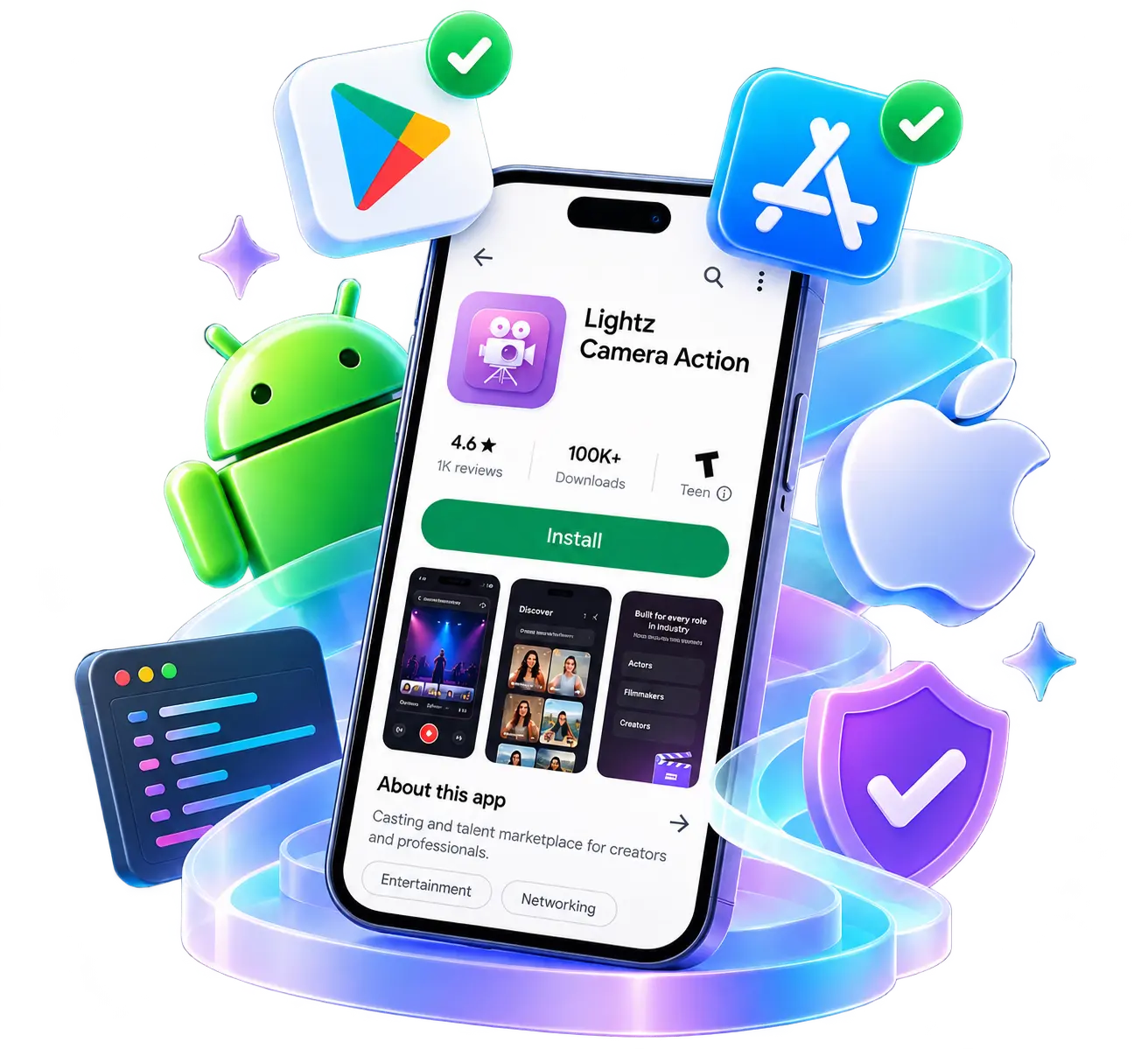
TechAvidus stabilized the existing React and Supabase app, wrapped for Android and iOS with Capacitor and Cordova.

Original Build Tool
Replit Agent
Frontend (Existing, Preserved) & Version Control
React.js, Tailwind CSS, Git
Backend (Existing, Preserved)
Node.js
Speech-to-Text (Built in This Engagement)
OpenAI Whisper
Minutes Generation (Built in This Engagement)
OpenAI LLM
Agenda Ingestion
Word and PDF Document Processing
Database & Authentication
PostgreSQL & Username and password, with municipality-scoped, role-based access

What Clerks and Administrators Can Do in the Platform

Clerks and administrators using the meeting minutes platform
Meeting intake

Staff create a meeting, attach the recording and agenda, and the system queues it for processing. This step was preserved and verified against the Phase 1 scope. It matters because the AI pipeline is only as dependable as what it receives: unsupported audio formats, missing agendas, and duplicate meetings are stopped here.

AI meeting processing
Built in this engagement

Whisper turns the recording into a transcript, the transcript is matched to the agenda, and an LLM writes structured draft minutes. The hard part is consistency across recordings with different speakers, audio quality, and meeting formats. For a clerk, it means starting from a first draft instead of a blank page.

Draft review and publication

Clerks correct and save drafts as many times as they need. Only authorized users can publish, and published minutes become immutable. A person stays responsible for every official record, and no AI output reaches the public record without that review.

Meeting history and search

Past meetings and their minutes can be searched, filtered, and reopened, always limited to the user's own municipality. Staff can pull up an earlier meeting from the platform itself instead of keeping separate records.

Municipality administration

Municipalities, users, and roles are set up with tenant-isolated, role-based access. In Phase 1, municipalities are created directly in the database. A self-serve admin interface is on the Phase 2 roadmap.

Connecting Audio, Agendas & AI-Generated Minutes

Four integrations make up the AI workflow, all added to the preserved application rather than built as a separate system:

The AI processing pipeline

From raw meeting audio to a review-ready draft

4 integrations
01
OpenAI Whisper

Converts uploaded meeting recordings into machine-readable transcripts

Audio to text
02
OpenAI LLM

Generates structured draft minutes from each transcript together with its agenda

Transcript to draft
03
Document processing

Ingests Word and PDF agendas before minutes are generated

Agenda input
04
AI workflow orchestration

Sequences transcription, agenda alignment, generation, and the hand-off to review

Process coordination
The Alignment Challenge

The difficult part was alignment. The output had to be a structured draft that a non-technical clerk can edit with confidence, built from transcripts of very different recordings and matched to agendas formatted however each municipality writes them.

Phase One Outcomes

What Phase One Delivered

From an existing application to an AI-powered meeting minutes workflow.

Phase 1 Delivered
MILESTONE 01
Product Capability

Municipality staff can now turn an uploaded recording and agenda into an editable draft of the meeting minutes, using a Whisper speech-to-text pipeline and an LLM minutes-generation workflow, both built in this engagement.
MILESTONE 02
Technical Outcome

No rebuild was needed. The independent audit confirmed that the Replit Agent-generated authentication, dashboards, user management, and meeting uploads were solid enough to keep, and the minor improvements it identified were applied.

The AI workflow was built inside the existing React.js, Node.js, and PostgreSQL codebase, without replacing the underlying stack.

React.js Node.js PostgreSQL
MILESTONE 03
Delivery Evidence

The full approved Phase 1 Scope of Work was validated and delivered in 2 months.

A scalability assessment, an AI operating-cost assessment, and a Phase 2 engineering roadmap were delivered alongside the build.

Phase 1 delivery journey
Product capability, technical implementation, and delivery evidence.
Complete

What This Project Shows About Building on AI-Generated Code

If you're trying to fix a Replit-generated app without rebuilding it, here is what this project demonstrates.

01
An honest keep-or-rebuild verdict, based on your own scope.

The audit measured an undocumented Replit Agent codebase against its Phase 1 contract and found the foundation worth keeping. The client avoided paying for a rewrite it didn't need. This is how TechAvidus approaches Vibe Coding Rescue.

Codebase assessment
02
AI features added to code someone else's tool generated.

For a team that wants to develop an AI meeting minutes platform for municipalities on the code it already has, this shows a Whisper transcription and LLM drafting workflow built into an existing, constrained codebase, with a human review step before anything is published. See AI integration into existing software.

AI workflow integration
03
A roadmap for what comes next, not just a pass or fail.

The client finished Phase 1 with a scalability assessment, an AI cost assessment, and a Phase 2 plan, so the next budget decision rests on engineering findings instead of guesswork.

Future-ready planning

Questions About Validating and Extending a Replit App

Not necessarily. An independent audit can show that large parts of the foundation are worth keeping. On this project, the Replit Agent-generated authentication, dashboards, user management, and meeting uploads were all working as intended and needed only minor improvements. The engineering effort went into municipality-specific logic, the AI workflow, and production readiness instead of re-creating code that already worked.

Four factors usually decide it: the size and complexity of the existing codebase, how many business-specific or AI features still need to be built on top of it, whether multi-tenant or multi-client scale is already a requirement, and whether a forward-looking engineering roadmap is part of the work. This project involved all four: an existing multi-tenant codebase, a new AI workflow, a scalability review, and a Phase 2 roadmap.

It starts with a structured production readiness assessment, then targeted engineering on what the assessment finds. For this Replit app, that meant reviewing the Phase 1 Scope of Work, auditing the repository, comparing what was built against what was contracted, and evaluating the architecture before deciding what to keep. The keep-or-replace decision came out of that assessment, not before it.

No. A repository audit doesn't depend on documentation. This client's Replit Agent codebase had none beyond the code itself, so the team worked from the code, the Phase 1 Scope of Work, and review sessions with the client's stakeholders, and still reached a clear keep-or-rebuild recommendation and a Phase 2 roadmap.

Not on this platform, by design. Whisper and the LLM produce an editable draft only. A clerk reviews and corrects it, only authorized users can publish it, and published minutes become a permanent record that can't be altered. The AI shortens the first-draft step. Responsibility for the official record stays with municipal staff.

Relevant Case Studies

Why Founders Choose TechAvidus to
Stabilize Their AI-Generated Codebase

105+ Team Members | 11+ Years in Software & AI Engineering | 92% Client Satisfaction Rate
Top Rated Plus on Upwork (4.8/5) Google (4.7/5) Highly Rated On Clutch & GoodFirms

Have an AI-Built App You're Not Sure About?

Already have a Replit, Lovable, or bolt.new-built app with real users? Start with an engineering audit before you scale it or add AI.

Explore Lovable App Rescue