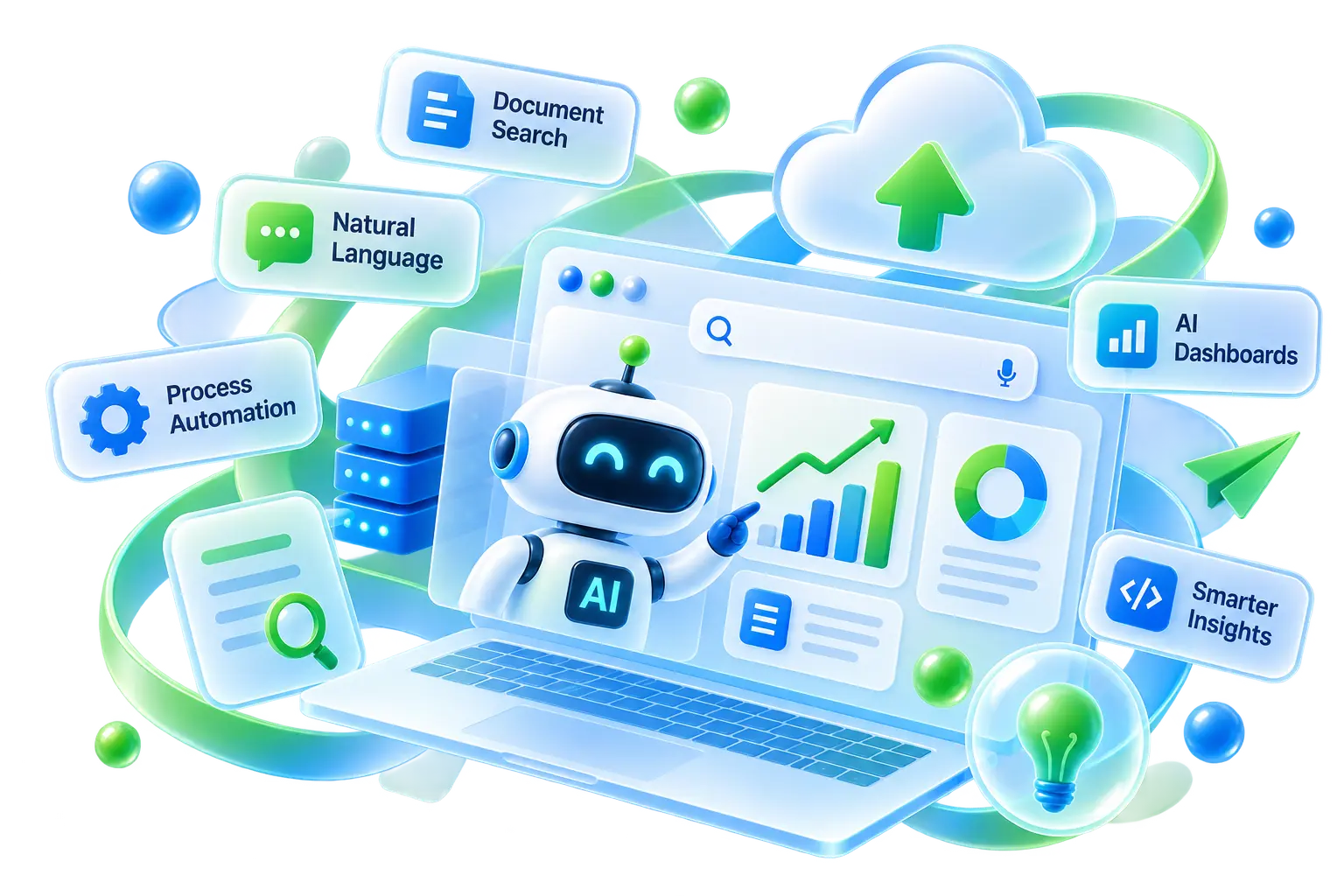
AI Integration Platform Architecture Blueprint Mockup

The Market Isn't Waiting for Your Next Hiring Cycle

AI is on your roadmap, and either a competitor already shipped the feature or a customer asked when yours is coming. The same forcing event shows up as unscalable manual decisions on an operations platform, or as a document library users can't search effectively on a compliance-gated one.

92% vs 7%

Roughly 92% of companies plan AI features; about 7% actually ship them.

The Cost of Waiting

No-code AI add-on tools are commoditizing the easy cases right now, and hiring an AI engineer internally costs months before any code ships. Waiting isn't a neutral choice.

Deep System Integration

AI integrated into the product's real data, APIs and workflows rather than a standalone chatbot/widget.

Delivered, In Production

Real results embedded directly into existing platforms, data schemas, and production environments.

FundsPro

A non-profit fundraising platform's own team couldn't query donation data without going through an analyst. We built a natural-language interface to that data — a custom NL→SQL pipeline on Azure OpenAI — so any team member can ask the question directly, in plain English, against the platform's real schema.

Intellect Bay

An academic recruitment marketplace needed to score incoming resumes against role fit β€” after the platform was already live. We added AI-assisted resume parsing and candidate scoring on top of the existing Angular and Java Spring Boot system, post-launch, at the client's request, without touching what was already working.

MyRealtyWorks

A real estate CRM's users were manually summarizing account activity and drafting outreach by hand. We added an AI layer β€” account summaries, natural-language CRM query, drafted messaging β€” directly onto the existing authenticated CRM APIs. No new data store. No rebuild.

What Clients Say

"We worked with TechAvidus to add AI capabilities to our existing platform. The team understood our existing system well and integrated the new AI features without disrupting the core application. They were easy to work with, proactive in suggesting different AI models based on what made the most sense for our application, and responsive throughout the project to make sure we got things right."

Michael Inzerillo Founder, MyRealtyWorks

They were always open to suggestions and felt like a development partner rather than just a vendor. Even months after launch, when we came back with a major feature update driven by the latest AI capabilities, they were quick to jump in.

Nathan Founder, Intellect Bay

Why TechAvidus

105+ Team Members
11+ Yrs Software & AI
90% Employee Retention
ISO 9001:2015 Certified

TechAvidus has been building production software since 2015, as an AI integration company that starts from your live system instead of a blank canvas.

Built Into What You Already Run

We embed AI into a product's own live data model and interface, not a chatbot bolted on the side. We've done that many different ways: document intelligence over recruitment records (Intellect Bay), an AI layer inside a live CRM (MyRealtyWorks), and a natural-language layer over financial data (FundsPro). Different stacks, different data shapes β€” the same integration discipline each time. That's the same depth we'd bring to a warehouse management system or a document library, not just a SaaS product.

Security & Permissions Built In

MyRealtyWorks' AI layer stays inside each user's existing permission boundary rather than being granted broader access. Our Document Q&A build grounds every answer in retrieved content, with an explicit "no answer found" fallback instead of a guess. For sensitive-data integrations, the data-handling story gets confirmed in the workshop, before any build starts β€” not promised in the abstract afterward.

We Don't Default to One Model

MyRealtyWorks' Founder put it directly: we were "proactive in suggesting different AI models based on what made the most sense for our application." The model behind your integration should match your data sensitivity, response quality needs, and cost β€” not our default preference.

Native Product Capability

This also ships as a capability inside the product your customers already pay for, not a new initiative with its own adoption curve β€” which is what makes it a retention and competitive-differentiation play, not just an architecture upgrade.

AI Capability Workshop

The AI Capability Workshop finds out what this looks like for your specific codebase β€” fixed cost, 1–2 weeks β€” and ends with an architecture decision document and an integration roadmap you can use even if you don't build with us.

Commercial Transparency & Proof

Proof, Not a Pitch

AI embedded into live, already-shipped products β€” not a lab demo β€” with a Founder's testimonial on record above, not just our own description of the work.

  • Analysis first, build second β€” no build scope gets locked in until the deep analysis tells us what's actually there in your existing system.
  • The build phase runs time-and-materials with a not-to-exceed ceiling, sized from the workshop's findings - not an open-ended clock.
  • Cost moves with your codebase's complexity, how many systems you're touching, how structured your data already is, whether compliance requirements apply, and whether the integration runs real-time or batch.
  • No contract beyond the workshop itself.
  • You own the integration's IP from day one β€” no ambiguity on transfer at any stage.

Who We Serve

We partner with teams that need AI deeply embedded into live platforms, complex operational workflows, and proprietary data systems.

B2B SaaS Product Teams

B2B SaaS product teams adding AI to what they've already built. You already have a working product, customers using it, and an AI feature on the roadmap. FundsPro's natural-language data layer and MyRealtyWorks' AI CRM layer both shipped this way β€” as an addition to the existing product, not a parallel project competing for the same engineers.

Operational Decision Platforms

Platforms built around operational decision-making. Manual routing, stocking, and supplier decisions that stop scaling as volume grows. The same integration approach can be applied to operational decision workflows β€” connecting AI to the systems and data your teams already use, instead of adding a dashboard nobody opens.

Compliance-Gated SaaS

Document-heavy, compliance-gated SaaS platforms. Legal tech, compliance software, research and non-profit platforms sitting on large proprietary document libraries. We added AI-assisted resume parsing and scoring to Intellect Bay's document library, and built a production RAG system for a mid-size software company's internal document search β€” both with a data-handling answer ready before the compliance question gets asked.

What We Deliver

Every integration comes down to the same design question: how does the model connect to your data, your APIs, your permissions, and the workflow around it β€” whether that's a CRM, an ERP, or another operational system you already run. That decision shapes everything below.

NL→SQL Integration

Ask your own data a question in plain English and get a real answer back β€” without your team learning a query language or waiting on an analyst. We built this for FundsPro: a natural-language interface over structured financial data, translating a plain-English question into the right query against the actual schema.

RAG and Document Intelligence

Point AI at documents your platform already holds β€” contracts, records, assessments, application files β€” and get grounded answers back, not invented ones. Our production build for a mid-size software company's internal document search grounds every answer strictly in retrieved content, with an explicit "no answer found" response when the context doesn't support one, instead of a best-effort guess. This is what AI integration for legacy systems and modern platforms alike actually requires: retrieval discipline, not a generic chatbot.

AI Dashboards for Operational Decisions

An insight layer on data you already collect, built on the same architecture pattern behind FundsPro's data layer β€” applied to surfacing what's actually happening in your operations, instead of a static report nobody had time to build a habit around reading.

Document Parsing and AI-Assisted Scoring

Structured extraction from documents that used to require a person reading each one β€” resumes, applications, records β€” turned into a consistent relevance or match score. We built this for Intellect Bay: AI-assisted resume parsing and candidate scoring, added after their marketplace was already live, at their request.

AI-Drafted Communication and Account Summaries

AI that reads your existing account and activity data and drafts the summary or the message β€” a person still reviews and sends it. MyRealtyWorks' CRM layer does exactly this: account summaries and message drafts pulled from their existing CRM APIs, inside the permission boundary each user already has.

How We Work

A structured, low-risk engagement process engineered specifically for adding AI capabilities into live production platforms.

01 / WORKSHOP

Bring Your Codebase to an AI Capability Workshop

You share your existing architecture and data with us; we assess what's actually feasible before anything gets built. FundsPro's production code started the same way β€” workshop first, build second.

02 / CEILING

Set Your Build Ceiling Before We Start

You review the workshop's architecture decision document and roadmap, then set a not-to-exceed cost ceiling and make the go/no-go call. Nothing gets built on spec beyond what the workshop scoped.

03 / BUILD

Watch the Build Happen Against Your Own Data

Your technical champion reviews real architecture decisions as we make them, against your actual codebase and data β€” not a sandbox or a demo β€” and can redirect at any checkpoint.

04 / VERIFY

Confirm It Holds Up Before It Ships

For data-sensitive integrations, this is where the data-handling story gets checked against your real documents, not promised in the abstract β€” your engineering or compliance stakeholder reviews and signs off before rollout, using the same evidence the workshop surfaced.

05 / HANDOFF

Take Ownership With Documentation, Not Just Code

Your team receives handoff documentation and owns the integration operationally from day one. The same 90% retention that keeps your account team in place also means the engineers who built it are still around if you need to revisit it. We also check in after launch to confirm the integration is holding up as real usage patterns emerge, and adjust prompts, retrieval, or model choice if it isn't.

Start Your Build

Ready to Embed AI Into Your Live System?

Start with a low-risk AI Capability Workshop to evaluate your architecture, confirm data feasibility, and set a clear roadmap before committing to a build.

How We Price This

AI integration scope varies by codebase, data quality, and compliance need more than almost any other service we offer β€” so we size the real cost with a workshop instead of quoting a guess upfront.

Structure

A fixed-cost AI Capability Workshop first, then β€” if you proceed β€” a build phase priced time-and-materials with a not-to-exceed ceiling.

Duration and Commitment

The workshop runs 1–2 weeks, fixed. Build-phase duration is set per deal, from what the workshop finds. There's no lock-in beyond the workshop itself, and you own the IP from day one.

What Moves the Cost

  • Codebase size and complexity
  • Number of systems and integrations the work touches
  • How structured your data already is β€” unstructured data adds real scope
  • Compliance requirements (SOC2 or HIPAA-type constraints add materially)
  • Whether the integration runs real-time or batch

What's Included

The workshop delivers an architecture decision document and an integration roadmap β€” real, usable deliverables, even if you don't build with us. The workshop does not include the build itself; that's scoped separately once the workshop is done.

Ready to Scope Your AI Integration?

Start with a low-risk discovery conversation or request an initial estimate tailored to your codebase and data structure.

Frequently Asked Questions

No β€” we build the integration on top of your existing APIs and data model rather than replacing any part of your core platform. MyRealtyWorks' AI layer, for example, reuses their existing authenticated CRM APIs and stays inside each user's existing permission boundary; nothing about the underlying CRM changed to support it. The AI Capability Workshop is where we confirm the same is true for your codebase, before any build work starts.

Not in the systems we build. Our retrieval-based approach grounds every answer strictly in your retrieved document content, with an explicit "no answer found" response when the available context doesn't support one β€” never a best-effort guess. That's the behavior running today in a production document-search system we built for a mid-size software company.

The workshop runs 1–2 weeks, fixed cost. You walk away with an architecture decision document and an integration roadmap β€” real deliverables you can act on even if you don't build with us. If you move forward, the build phase starts from exactly what the workshop scoped, priced time-and-materials with a not-to-exceed ceiling.

The first 1–2 weeks are the AI Capability Workshop β€” an architecture review against your real codebase and data, ending in a roadmap and a cost ceiling you approve. The rest of the first month moves into build: the first architecture decisions get made against your actual data, with your technical champion reviewing and able to redirect at each checkpoint, not waiting until the end to see anything.

Two phases. First, a fixed-cost AI Capability Workshop β€” 1–2 weeks β€” that scopes the real integration and produces an architecture decision document and roadmap. Second, if you proceed, the build runs time-and-materials with a not-to-exceed ceiling set from what the workshop found, not quoted blind upfront.

Five things move the number: how large and complex your codebase is, how many systems the integration has to touch, how structured your data already is, whether compliance requirements like SOC2 or HIPAA-type constraints apply, and whether the integration needs to run in real time or can run in batch. The workshop prices these against your specific system instead of guessing.

The workshop is built to answer that before you commit to a build. You get an architecture decision document and roadmap for $3,500–$6,000 regardless of whether you proceed β€” so the first money you spend buys a clear answer, not a sunk-cost build. Compare that to hiring: recruiting, compensating, and ramping an AI engineer internally typically takes 2–4 months before any code ships, with no roadmap deliverable if it doesn't work out. Once it's live, the categories worth tracking are usually manual effort reduced, response or processing time, user adoption, and answer accuracy β€” track whichever of those maps to your actual workflow, not a generic dashboard metric.

You won't get handed off to a different team once the contract's signed. The team that scopes your workshop is the team that builds and supports your integration afterward, and 90% of our engineers stay year over year β€” so the person who learned your system in week one is typically still the one answering your questions months later.

Onboarding starts with the workshop itself. You walk us through your existing architecture and data, we ask the questions that determine what's feasible, and you get a written roadmap out of it. The build phase follows that same architecture decision document, with no separate re-scoping step.

We don't promise a fixed date and hope it holds. We commit to a defined scope from the workshop, a not-to-exceed cost ceiling, and milestone visibility throughout the build β€” so you always know where the engagement stands.

No. The workshop is a standalone, fixed-cost engagement with no obligation to continue. If you move into the build phase, that also runs time-and-materials with a not-to-exceed ceiling β€” there's no multi-year commitment attached to either phase.

You can, and a weekend prototype will prove the concept works. What it won't show you is what breaks it in production β€” data access boundaries, response grounding, cost per query at real usage, and what happens when the model gets something wrong in front of a customer. That's the part we're built to handle; the API call itself was never the hard part.

It gets built into the decision loop itself, not layered on top as a separate screen. The same integration pattern that put MyRealtyWorks' AI directly inside their existing CRM workflow β€” not a standalone tool alongside it β€” is what we'd apply to routing, stocking, or supplier decisions: wired into the process your team already runs, not a report someone has to remember to check.

That question gets answered in the workshop, before any build starts β€” not promised in the abstract afterward. Our default architecture recommendation for sensitive-data integrations is Azure OpenAI, where Microsoft's enterprise terms generally exclude training on customer data. The exact guarantee depends on your specific architecture and contract β€” the workshop confirms it for your compliance stakeholder before rollout.

No β€” the AI layer reuses your existing authenticated APIs and stays inside each user's existing permission boundary rather than being granted broader access. That's precisely how MyRealtyWorks' AI CRM layer works today: it can only see what the logged-in user could already see.

You've Already Decided AI Belongs on This Product.
The Question Is Who Builds It.

Comparing AI integration agencies for the job, or ready to see what this looks like against your own codebase? Start with the workshop 1–2 weeks, and you leave with an architecture decision document and a roadmap either way.