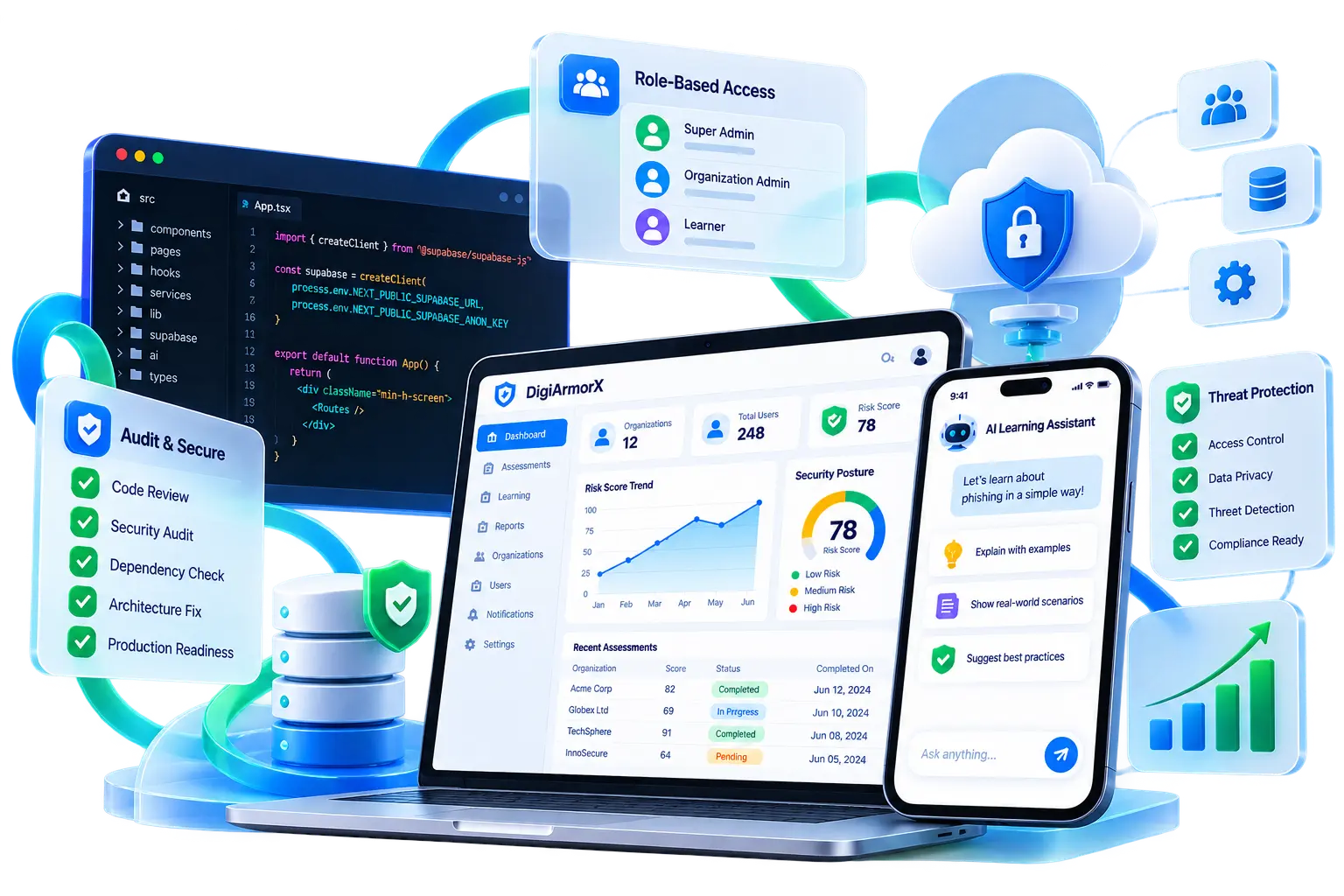
DigiArmorX AI App Rescue Case Study Banner
Project Overview

Quick Facts

Ongoing Engagement
Industry
Cybersecurity Training SaaS for Education
Project Type
AI-built app rescue (Lovable), followed by an AI feature engagement
Built With
Lovable React TypeScript Supabase
Engagement
Multi-month
Four-phase rescue
Delivery Team
3 Team Members
Business Analyst, Tech Lead, Developer
Client Relationship
Still Engaged
Post-launch support and a second AI engagement

Have a Lovable, Bolt, or Replit app with real users?

Start with a code audit - we'll tell you what's actually wrong before you pay for a fix.

The Challenge

A Founder With a Working Lovable MVP and No One to Vouch for the Code

The client is the founder of a small EdTech and Cyber Security company. Her SaaS app is a cybersecurity awareness platform: organizations assess their security and compliance readiness, and students and families learn safer digital habits.

She built a working MVP quickly with Lovable. What she didn't have was an engineer who could answer the question every serious buyer eventually asks: is this secure, and will it hold up? There was no production-grade hosting, and several modules were still unfinished. She brought in TechAvidus to take over the codebase and make it ready for production.

Client
EdTech and Cyber Security Founder
Starting Point
Working Lovable MVP
Primary Need
Security Confidence and Production Readiness

The Code Worked in the Demo.
Nobody Knew if It Would Hold Up Under Real Use.

Without someone who could vouch for the codebase, she couldn't reliably launch or operate the AI built product she had. The idea wasn't what was holding growth back. Not knowing what the vibe coded product was standing on was.

An inherited, AI-generated codebase of unknown quality.

No one on the TechAvidus team had written any of it, and the technical debt hadn't been measured.

A product where security mistakes are the product failing.

Role-based access control decides which organization sees which assessment data. A gap there isn't a cosmetic bug on a cybersecurity platform.

Risk-scoring logic that users act on.

Organizations make security decisions from their scores, so the scoring has to be right.

Several functional modules left unfinished

which needed completing without a rebuild of AI built product.

No production-grade hosting, monitoring, or CI/CD in place yet.

Why the Demo Wasn't Enough

AI-generated code is built to work in the demo. It isn't built to find the edge cases and misuse scenarios an audit goes looking for. Nothing in the original build flagged those gaps, because the tool that wrote it was never looking for them.

Two Engagements. One Evolving Platform.

A four-phase rescue to production, followed by a separate AI engagement that added privacy-first learning guidance.

Engagement 01

Four-Phase App Rescue

The first engagement took the Lovable-generated React and TypeScript app on Supabase through four phases: audit, stabilize, complete, launch.

01
Audit
02
Stabilize
03
Complete
04
Launch

TechAvidus reviewed the existing code, fixed what was fragile, finished the incomplete modules, and set up the staging and production infrastructure the platform needed to run in production.

Team

A Business Analyst, a Tech Lead, and a Developer, through to launch

Timeline

A phased, multi-month rescue, ending in a production launch and handover

Engagement 02

AI Learning Assistant

After launch, TechAvidus stayed on to support the platform. Later, the founder came back with a separate engagement to make a product AI ready: adding an AI Learning Assistant to the same production app, built on Azure OpenAI Service, that gives students learning guidance without sending the model any personal details.

Privacy-first guidance

Student learning guidance without sending the model any personal details.

Why We Audited First Instead of Starting Over

With an unreviewed codebase and a security product at stake, every decision came down to one rule: understand what exists before changing it.

01 / ASSESS

Vibe code Audit before touching anything.

The first phase covered the code, the architecture, the database, and vibe coding security audit, before a single change was made. The point was to find out what could be kept and in what order to fix the rest, rather than proposing a rewrite nobody had asked for.

02 / STABILIZE

Stabilize before building more.

Bug fixing, performance work, and security hardening ran as their own phase, ahead of feature completion. Finishing the remaining modules on top of access controls that hadn't been checked would have built more product on ground nobody had verified.

03 / PREPARE

Treat production infrastructure as its own phase.

Staging and production environments, backups, monitoring, and CI/CD were set up as a dedicated phase before launch, not bolted on afterward. The founder needed a platform her team could release to safely, not just code that ran.

04 / PROTECT

Keep identity out of the AI model.

When the AI Learning Assistant was added later, the design question was what the model actually needed to see. The answer was the learning context only: topic, grade level, and difficulty. Personal details are removed before every request, so they never reach the model.

Topic Grade level Difficulty

What Runs in Production Now:
Supabase, Role-Based Access, and a Privacy Gate for AI

Following that audit-first sequence, the platform kept its Lovable-generated foundation and gained what it lacked: verified access control, finished modules, and a production setup.

Production Architecture

From Application to Secure AI

Following that audit-first sequence, the platform kept its Lovable-generated foundation and gained verified access control, finished modules, and a production setup.

01 · Frontend

React + TypeScript

The Lovable-generated application with Tailwind CSS, stabilized rather than replaced.

02 · Backend

Node.js + Supabase

Node.js and serverless services handle API work. Supabase provides the database and hosting backend, with Supabase Auth handling sign-in.

03 · Security

Role-Based Access Control

Each organization's assessment and compliance data stays separated from every other organization's.

04 · Release

GitHub CI/CD

GitHub Staging Production

Separate staging and production environments with CI/CD from GitHub.

AI Request Privacy Flow

Only the learning context reaches Azure OpenAI Service.
Student Learning request
Privacy Gate Remove personal data
Azure OpenAI Learning context only
Guidance Validated response

Privacy-first AI: No names, user identifiers, or learner performance history are included in any request. For a platform used by students and families, that means the AI feature added no new place where personal data could leak.

How the AI Learning Assistant Handles a Request

The assistant sits inside the existing application, and every request follows the same path:

AI Request Lifecycle

From Student Input to Guided Learning

Privacy-protected processing
01 Student Request

A student asks for help with a learning topic.

02 Context Prepared

The application prepares the learning context.

03 Privacy Gate

Personally identifiable information is removed before anything leaves the app.

04 Secure AI Request

Only topic, grade level, and difficulty are sent to Azure OpenAI Service.

Topic Grade level Difficulty
05 AI Generation

The model generates learning guidance, constrained by structured system prompts and application-level controls.

06 Validated Response

The response is validated, then shown inside the app.

Privacy-first AI: No names, user identifiers, or learner performance history are included in any request. For a platform used by students and families, that means the AI feature added no new place where personal data could leak.

Technology Behind the Rescued Platform

The rescued platform keeps its original foundation, supported by the technologies used to stabilize and operate it.

Original Build Tool & AI Service
Lovable, Azure OpenAI Service
Frontend, Version Control & CI/CD
React, TypeScript, Tailwind CSS, GitHub
Backend & Authentication, Database- Hosting
Node.js, serverless services, Supabase, Supabase Auth

What the Stabilized Platform Now Handles

Explore the platform's core cybersecurity, organization management, reporting, and AI learning capabilities.

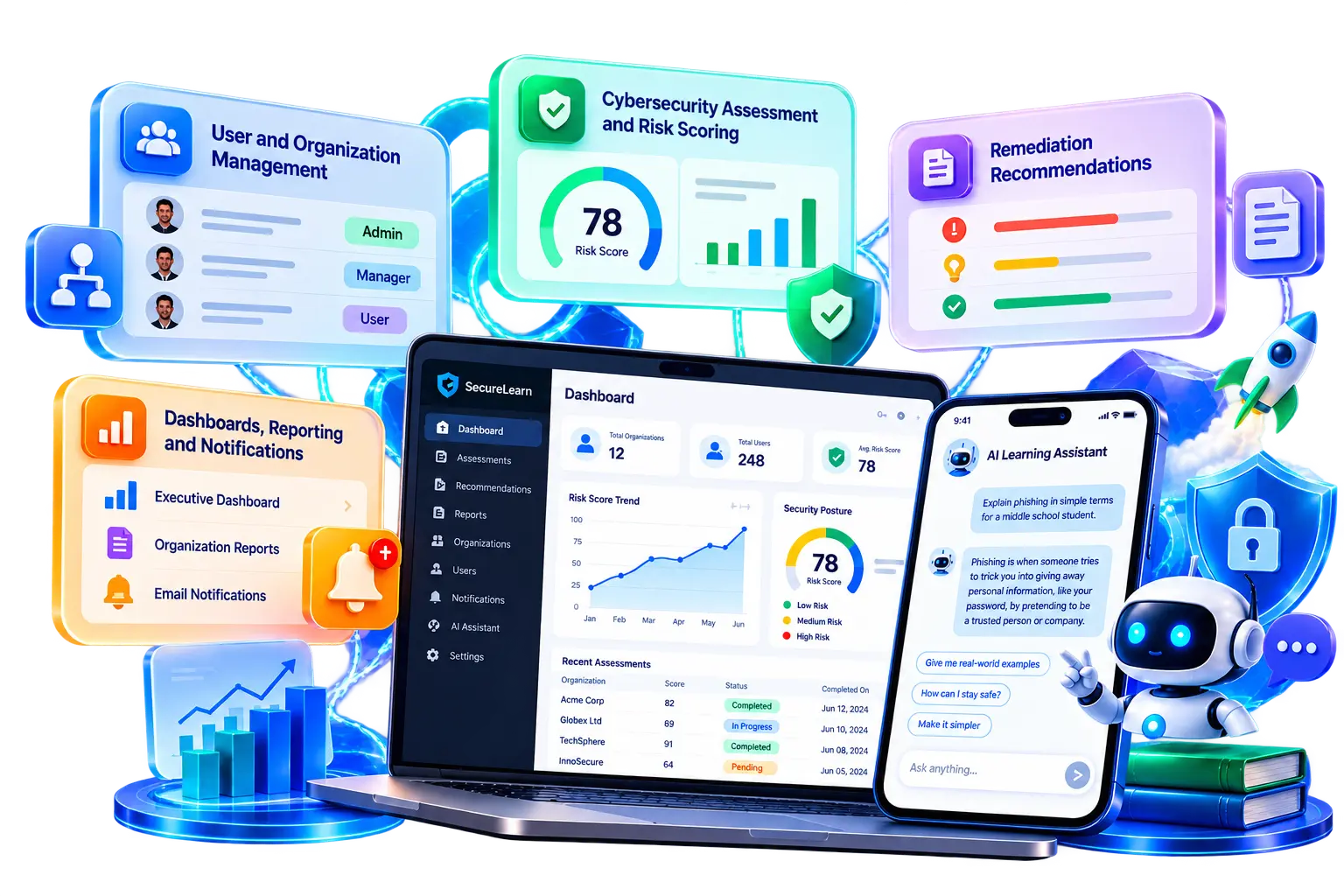
Cybersecurity platform dashboard showing organization management, risk scoring, remediation recommendations, reporting, and the AI Learning Assistant
Platform Capabilities

One platform. Five core capabilities.

The stabilized platform brings organization management, cybersecurity assessments, actionable remediation, reporting, and AI-powered learning together.

User and organization management
Cybersecurity assessment and risk scoring
Remediation recommendations
Dashboards, reporting, and notifications
AI Learning Assistant

Core Platform Capabilities

The production platform brings organization management, security assessments, remediation, reporting, and learning tools together.

User and Organization Management

Organizations, users, profiles, and access levels are managed through role-based access control. Getting this right was material on this platform, because it is what keeps one organization's security data out of another's view. Org admins manage their own teams without seeing anyone else's.

Cybersecurity Assessment and Risk Scoring

Organizations work through security and compliance-readiness assessments, and the platform calculates a risk score from their answers. Those results feed both the dashboards and the recommendations. A team ends up with a score it can act on, not a checklist.

Remediation Recommendations

Assessment results turn into security recommendations, risk-mitigation suggestions, and an improvement roadmap for each organization, so the next step after a low score is already spelled out.

Dashboards, Reporting, and Notifications

  • Executive dashboard with risk analytics and trend analysis
  • Organization-level reports for stakeholders
  • Email notifications for assessment reminders and compliance alerts

Leadership gets the organization's security picture in one view, and nobody has to remember when the next assessment is due.

AI Learning Assistant

Students pick a topic, grade level, and difficulty and get contextual learning guidance generated through Azure OpenAI Service. The hard part was privacy, not the model call: personal details are removed before each request, and every response is validated before it appears.

From Staging to Production, With Rollback Ready

The completed platform launched to production through a release setup that didn't exist when the engagement started.

Production Release Journey

From controlled testing to live operations

Production launched
01

Separate Environments

Changes are prepared and checked separately from the live platform.

Staging Production
02

Release Pipeline

CI/CD from GitHub supports release management and rollback.

GitHub CI/CD
03

Operational Readiness

Monitoring and backups are in place ahead of launch.

Monitoring Backups
04

Launch and Handover

Production launch and handover completed, with ongoing support afterward.

Production live

AI Response Validation

Every Learning Assistant response is validated before it is shown to the user.

AI response Validate Display

What the Vibe Coding Rescue Delivered

The rescue turned an unverified Lovable MVP into a production platform with a stronger technical foundation.

Outcome 01

Product Capability

The founder has a platform she can launch and operate: the Lovable codebase was audited, stabilized, and completed, then launched to production rather than rebuilt.

Students and families get contextual learning guidance from an AI Learning Assistant inside the same app.

Outcome 02

Technical Outcome

Bug fixing, performance work, and security hardening were finished before any remaining features were built on top.

No personal data reaches the AI model: every request carries only topic, grade level, and difficulty, with no names, user identifiers, or performance history.

The AI feature was added to the existing production app while keeping its architecture and security model in place.

Outcome 03

Delivery Evidence

Staging, production, CI/CD, monitoring, rollback, and backups were all in place before launch. None of them existed at the start.

The client came back for a second, separate engagement, and TechAvidus still supports the platform today.

Ongoing client relationship

One Partnership, Two Engagements

After the platform rescue, the client returned for a separate engagement to add a privacy-first AI Learning Assistant.

Engagement 01

After the Vibe Coding Rescue

"We built our MVP quickly with Lovable, but we needed experienced lovable engineers to take it further. TechAvidus quickly understood the existing codebase, improved stability, and helped us confidently move toward production. Mansi and Megha were responsive, proactive, and great to work with throughout the engagement."

Founder
Cybersecurity awareness SaaS platform
Engagement 02

After the AI Integration

"We continued working with TechAvidus to add AI-powered learning capabilities to make our platform AI ready to deliver more personalized guidance for students & family. They are now a trusted partner who understands both our product and our long-term vision."

Founder
Cybersecurity awareness SaaS platform

How Can We Help Make a
Lovable App Production Ready?

This Lovable MVP to production case study shows three things you can expect if your app is in the same position.

01 - Codebase Rescue
01

We take over AI-generated code we didn't write, and finish it without starting over.

This codebase was audited across code, architecture, database, and security before any change, then stabilized, completed, and launched. That's the sequence behind Vibe Coding Rescue and Lovable App Rescue.

Audit Stabilize Complete
Cybersecurity platform dashboard with risk scoring, organization management, remediation recommendations, reporting, and AI learning assistance
02

We'll rescue a product where access control is the whole point.

On a cybersecurity platform, the role-based separation between organizations and the risk-scoring logic were hardened before anything new was built. If you plan to build a cybersecurity awareness platform, or any app where a data leak is the product failing, that order matters.

03

The work doesn't stop at launch.

This founder kept TechAvidus on after go-live and came back to add an AI Learning Assistant with a privacy gate in front of the model. That's what a long-term tech partner for an AI-built SaaS looks like in practice: the team that learned the codebase is the team that extends it.

Explore Our Services

Ready to take your Lovable app further?

Questions About Rescuing a
Lovable-Built App

Find answers about auditing, stabilizing, and preparing a Lovable-built application for production.

Five factors drive it: the size of the inherited codebase, how many features were left unfinished, whether the product handles sensitive or regulated data, whether a new capability such as AI is added afterward, and whether ongoing support is part of the work. This project had all five: an unreviewed Lovable codebase, several unfinished modules, organization-level security data, a later AI feature, and support after launch. That's why it started with an audit, which puts a scope on each of those before any fix is priced.

No. This one was kept and finished, not rebuilt. The audit phase established what in the Lovable-generated React and Supabase codebase could stay, and stabilization fixed bugs, performance, and security before the remaining modules were completed on top of it. The audit, stabilize, complete, launch sequence is what kept this a rescue instead of a rewrite. A rebuild only makes sense when an audit shows the foundation can't be trusted, and that's a finding, not a starting assumption.

Because both skip the step that tells you what's actually wrong. More patches add changes to code nobody has reviewed. A full rewrite throws away working product to fix problems nobody has measured. On this platform, the audit scoped the real risk first: access control, scoring logic, unfinished modules, missing infrastructure. Each fix was then made in order, which avoided both failure modes.

Yes. That's how the AI Learning Assistant on this platform works. Personally identifiable information is removed before every request to Azure OpenAI Service, and only the topic, grade level, and difficulty are sent. Structured system prompts and application-level controls keep responses on topic, and each response is validated before a student sees it. The feature was added to the existing production app without changing its architecture or security model.

No. Privacy-first design supports compliance work, but it isn't a certification. The AI Learning Assistant was architected to support COPPA and FERPA privacy requirements by keeping personal data out of every AI request. This case study does not claim COPPA, FERPA, ISO 27001, or SOC 2 certification for the platform. Those depend on audits and processes beyond the software itself.

An engineering team that audits the codebase before touching it, not one that starts patching on day one. That's the sequence this platform went through: a full review of the code, architecture, database, and security, then fixes to what was fragile before anything else was built. If your Lovable app has a security problem, Vibe Coding Rescue and Lovable App Rescue start the same way: an audit that tells you what's actually broken before any fix is scoped or priced.

Yes, this platform is one example. It arrived as a Lovable-built MVP with several modules unfinished and no production hosting. TechAvidus audited the codebase, fixed what was fragile, completed the remaining modules, and set up staging and production environments before launch. The founder came back afterward for a second engagement, adding an AI Learning Assistant to the same app.

Four phases, in order: audit the existing code, architecture, database, and security before changing anything; stabilize what's fragile, meaning bug fixes, performance work, and security hardening; complete whatever modules were left unfinished; then set up the staging and production infrastructure needed to launch. On this project, that sequence is what kept it a rescue instead of a rewrite.

Not by default. Tools like Lovable are built to ship a working demo fast, not to pass a security review, and nothing in that build process looks for the edge cases or misuse scenarios an audit goes looking for. That's what we found on this platform: the code worked, but nobody had checked whether the access control and scoring logic would hold up under real use. An audit answers that question before you launch, not after.

An engineering team willing to audit an inherited codebase before deciding what to keep. TechAvidus took over this Lovable-built platform without having written any of the original code, reviewed what existed, and finished it rather than defaulting to a rebuild. If no one on your team can vouch for the codebase, that's the starting point, not a decision about build or buy.

Related Work

Explore related projects from our product engineering and application development work.

Vibe Coding Rescue

How we audit, stabilize, and finish apps built with Lovable, Bolt, Replit, and similar tools.

Explore Vibe Coding Rescue

Lovable App Rescue

The same audit-first approach, focused on Lovable-built apps.

Explore Lovable App Rescue
Your Next Step Starts Here

Have a Lovable App That Has to Hold Up in Production?

Tell us what you built and what's still unfinished. We'll start with an audit of your codebase and tell you what to fix first, what can stay, and whether a rescue makes sense at all.

Make Your App Production-Ready
Explore Vibe Coding Rescue
Audit first. Fix with purpose.