

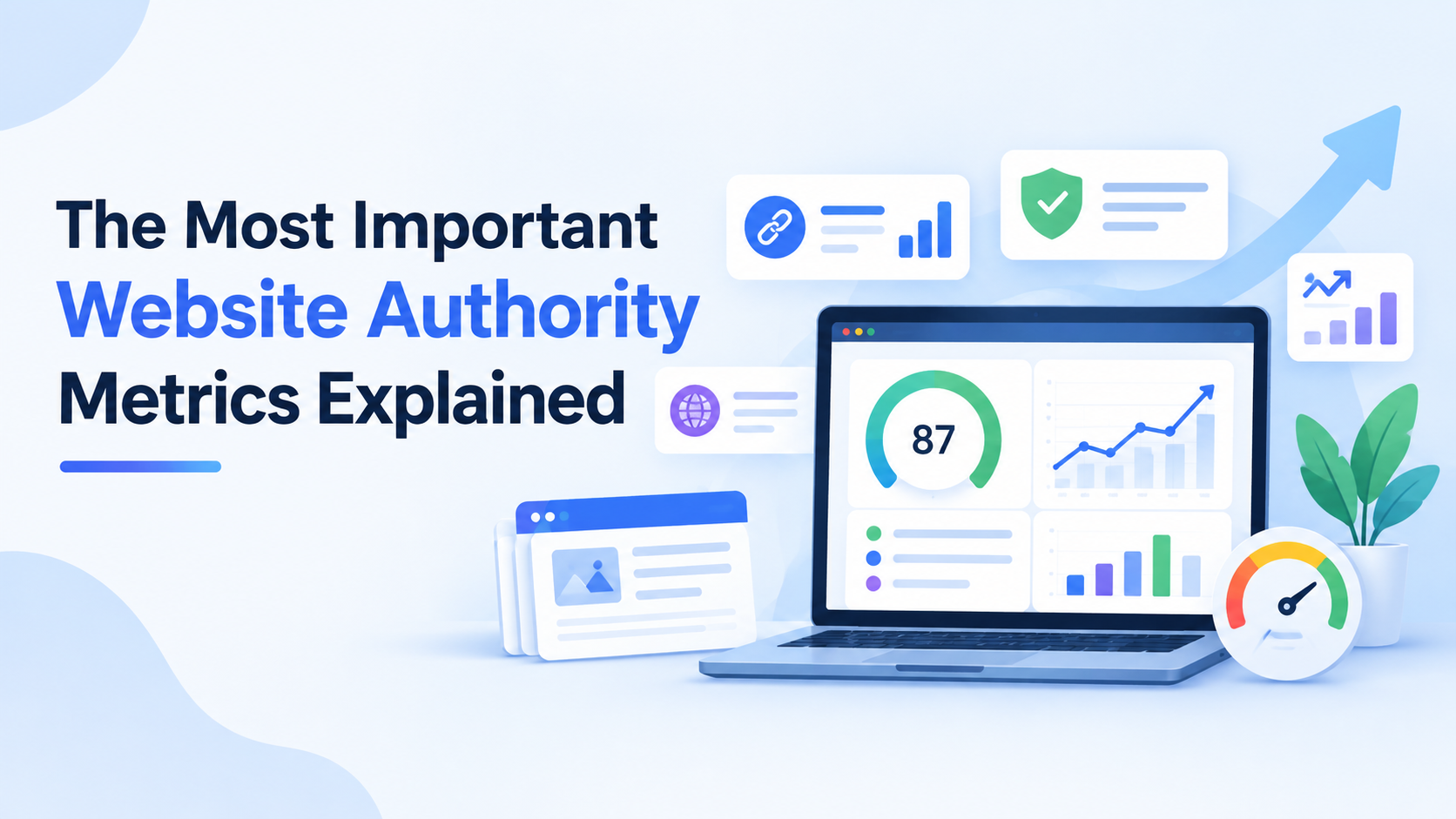
Website authority is actually a general SEO concept used to describe how credible and strong a website is perceived to be. Various third-party SEO tools use their own metrics to estimate aspects of this authority.
Many people think it is a single metric, but in reality it is influenced by a range of crucial factors. These factors help site owners evaluate the overall performance of their website to understand where it stands in the SERPs, what needs to be improved, and how their SEO efforts are paying off over time.
In this blog post, we are going to discuss some of the most crucial website authority metrics. So, read till the end.
4 Key Website Authority Metrics You Should Know
Below are some of the most important website authority metrics that you should know.
Domain Authority and Page Authority
Domain authority (DA) and page authority (PA) are two of the most popular authority metrics developed by Moz. These help users determine how credible and authoritative a website is in search engine results.
DA evaluates the overall strength of a website, and PA measures the ranking potential of an individual page. Both metrics are calculated on a scale of 1 to 100; the higher the score, the greater the chances of a website ranking well in the SERPs.
These SEO metrics are primarily based on link-related signals, such as the quality and quantity of linking domains.
The simplest and quickest way to calculate domain and page authority scores is through DA PA checker. All you need to do is enter the website URL, and the tool will assess its score within seconds.

It is essential to note that DA and PA aren’t considered official ranking factors by Google. But still, these are considered valuable metrics by SEO professionals to evaluate website authority.
Domain Rating (DR)
Domain Rating (DR) is another crucial authority metric that measures the overall strength of a website’s backlink profile on a scale of 0-100. The higher the DR score, the more authoritative the site appears based on the quality and quantity of websites linking to it.
Generally, sites with high domain rating are more likely to perform well in the SERPs compared to those with low scores. Just like DA and PA, DR is also not a Google ranking factor, but it is widely acknowledged and used by SEO experts.
You can seamlessly assess the domain rating score of any website using DR checker. It is simple to use, free, and highly accurate. A screenshot demonstrating its working is attached below.

Domain Rating is primarily influenced by factors related to a website's backlink profile, including the number and strength of referring domains and how many other websites those domains link to.
However, improving this authority metric requires a long-term approach, so don’t expect results overnight.
Backlink Metrics
A website’s backlink profile refers to the complete collection of inbound links pointing to its pages. Analyzing these links can provide valuable insights into a website’s authority and overall SEO performance.
But the quality of backlinks matters more than quantity. A few backlinks from relevant and trustworthy sources often provide greater SEO value than several low quality links from irrelevant sites.
There are numerous key backlink metrics that can help you evaluate a backlink profile:
- Total number of links – The overall number of links coming to your website. Don’t rush for the maximum numbers; instead, prioritize quality.
- Referring domains – The number of unique sites linking to you.
- Link relevance – It is the measure of how closely the linking websites relate to your targeted niche or industry. Google usually values relevant backlinks.
- Anchor text – It is a clickable text in a hyperlink. Use a mix of branded, generic, exact, and partial match anchor texts.
- Link type – Two types of links: Dofollow and nofollow. Dofollow links can pass ranking signals to your site. Nofollow links generally do not pass ranking credit, although Google treats the nofollow attribute as a hint and may use such links as part of its systems.
There are numerous tools available that can help you analyze these backlink metrics. Semrush is one of the popular choices.

Regularly monitoring your backlink profile and these metrics can help you identify toxic links before they actually cause harm to the overall performance.
Trust Flow and Citation Flow
Last but not least, Trust Flow (TF) and Citation Flow (CF) are valuable authority metrics developed by Majestic. These help evaluate the overall quality and influence of a website’s backlink profile.
Trust Flow measures the quality of links pointing to a website or a webpage on a scale of 0-100. A high score usually indicates that the site’s backlinks come from relevant, reliable, and credible sources rather than low-quality and spammy sites.
On the other hand, Citation Flow focuses on measuring the quantity and influence of backlinks without considering their quality. This means a website can have a high citation flow score simply because it acquired backlinks from a large number of domains.
Majestic offers a few daily searches for free users to calculate both these metrics easily.

The relationship between metrics is often more important than either score alone. That’s why comparing Trust Flow and Citation Flow can provide useful insights into the quality and balance of a website's backlink profile.
Wrapping it Up
Website authority is the measure of how credible and trustworthy the site is on search engine result pages. It can be evaluated using a range of third-party metrics and signals, including Domain Authority (DA), Page Authority (PA), Domain Rating (DR), backlink profiles, Trust Flow (TF), and Citation Flow (CF). We have talked about these metrics in detail and discussed ways to calculate them.
The Most Important Website Authority Metrics Explained

Keshu Keshvala
Keshu Keshvala is the Chief Marketing Officer at TechAvidus — a trusted software development company based in India, specializing in AI-powered web, mobile, and custom software solutions. With 10+ years of experience in the IT and software development industry, Keshu has played a key role in delivering enterprise-grade digital solutions that help clients reduce costs, improve efficiency, and achieve optimal results tailored to their business needs.