


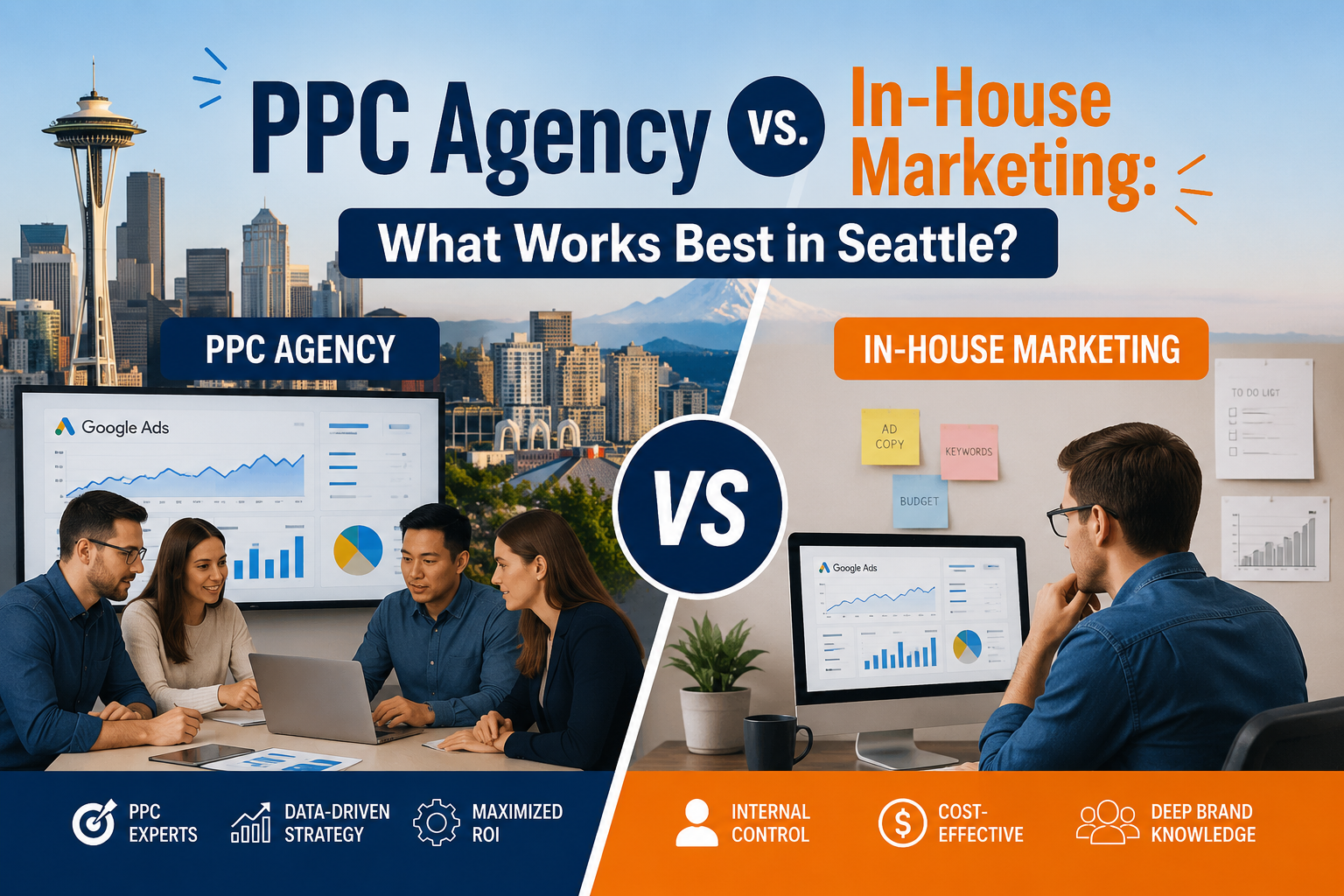
Businesses around Seattle have a few options for handling paid ad campaigns. Some orgs build an internal marketing team, while others go with an external PPC agency. Seattle businesses can count on, for things like campaign management and ongoing optimization. Honestly, both routes can work, yet the “best” pick usually hinges on your available budget, the end results you care about, what staff you already have, how complex the campaigns are, and also the longer-term marketing strategy.
Google Ads and pretty much any other PPC platform really need constant attention. A business still has to do keyword research, craft ads that feel relevant, handle bid strategy, watch conversions, check the search terms, and then tweak everything based on what the numbers show. So when you compare an in-house team versus a professional agency, it’s really about which option delivers the right mix of know-how, steady execution, and cost efficiency in the long run.
Understanding In-House PPC Marketing
In-house PPC management means your company either brings in employees or shifts existing marketing staff to run paid ad campaigns, rather than relying on a PPC Management company Seattle for campaign management. So basically you stay in direct control over campaign decisions, and the internal team can work pretty closely with sales, customer service, and, you know, the other departments too.
With an internal group, people can build a solid grasp of your products, who your customers are, the brand tone, and what the business is trying to reach. And that kind of background helps communication feel smoother, because employees already know what the company cares about and also how internal processes usually go.
Still, making PPC work well isn’t just “hire one person and give them access to Google Ads.” PPC management includes several areas of expertise, things like keyword discovery, campaign structure, ad copywriting, conversion tracking, landing page reviews, bidding, reporting, and then continuous optimization over time.
From what I have seen while researching, businesses that depend on a small internal team can end up struggling when campaign needs start growing. One person might end up handling PPC alongside SEO, social media, content, email promotion, and a bunch of other tasks. So the time for careful PPC optimization gets reduced, and the results can slowly feel less sharp.
What Does a PPC Agency Provide?
A professional Seattle PPC agency usually works as an external marketing partner, so a business gets help with paid ads without having to hire a whole bunch of people. In practice, it can feel simpler, because instead of staffing multiple roles, you can plug into a team with experience across different parts of PPC management and execution.
Often the agency will cover keyword research, campaign set up, ad copy creation, audience targeting, bid management, conversion tracking, and then reporting plus performance refinement. What you actually get can vary by provider, and it also depends on what the business needs, the goals, and the timing.
One of the biggest wins with an agency is specialized know-how. PPC platforms don’t sit still; they keep shifting. Advertisers still need to keep up with fresh features, different bidding options, audience signals, automation tools, and also measurement methods that matter.
A good PPC agency Seattle businesses pick should also have a sense for the local market. Seattle companies might focus on certain neighborhoods, nearby towns, or even distinct customer groups whose search behavior looks different. When the agency understands that, it’s easier to shape campaigns around both geographic intent and commercial intent, and that part can be the difference.
Comparing the Costs
Cost matters a lot when someone is trying to choose between an in-house team and an agency. An in-house approach means you still have to cover salaries, benefits, training, software, advertising tools, and all those other employee-related costs that quietly add up.
A business might also need more than one employee as its advertising activity grows. Like, one person could handle campaign management, and another may work on analytics, landing pages, or creative development. So it’s not just “one role"; it tends to become a small unit over time.
When using an agency, most businesses will pay a management fee on top of the advertising budget. That agency fee can be influenced by how complex the campaigns are, how much is spent each month, the number of platforms involved, or just the breadth of services you want.
Based on market research, businesses really should look at the total cost of each option, instead of only comparing an agency fee against an employee's salary by itself. Subscriptions for software, training expenses, recruitment costs, and even the hours required to manage campaigns can seriously shift the real cost of running an internal PPC operation.
Access to Specialized Expertise
Expertise is one of the most solid reasons businesses think about outside PPC management. A seasoned Seattle PPC company can end up working with a bunch of different businesses across separate industries and all kinds of campaign styles.
That kind of exposure helps PPC pros spot recurring issues and openings a lot faster, sometimes almost immediately. They might notice inefficient keyword targeting, messy campaign structure, shaky conversion tracking, or even spend that feels totally unnecessary, based on what they have already seen before.
Sure, an internal employee can build deep skills too, but that learning curve takes time. A business that needs immediate help may lean toward an agency that already has experienced PPC professionals in place, rather than waiting.
Still, companies shouldn’t treat “agency” like it automatically means equal know-how. Before signing on with any provider, they should check things like its experience level, its reporting process, how they communicate day to day, how they actually manage campaigns, and whether they truly understand the industry they are stepping into.
Campaign Optimization and Monitoring
PPC campaign stuff really needs regular optimization, like, not once and then forget it. Advertisers have to look at search terms, nudge bids, do small tests on ad variations, keep an eye on conversion data, and check how different regions perform, then figure out where budget reallocation might actually help.
An internal marketing team can handle all these steps pretty well when they’ve got enough time, bandwidth, and resources. But, if there are other competing marketing responsibilities, then sometimes the PPC efforts just get less attention than they should.
That’s where professional PPC services in Seattle come in handy for many businesses. A good agency can set up a steady monitoring routine and keep reviewing campaign performance in a consistent way, without waiting for someone’s free schedule.
The key issue isn’t only how often someone logs into the advertising account. The real emphasis should stay on making meaningful decisions, based on trustworthy performance data and not on guessing.
Local Market Knowledge
Seattle has this kind of diverse business scene, with firms running in tech, professional services, healthcare, retail, real estate, hospitality, and a bunch of other spaces too. Every industry kind of shows its own customer behavior, and even the advertising competition can feel pretty different depending on the sector.
A local Seattle PPC company might grasp the competitive vibe and those geographic targeting concerns that businesses in the area usually face. Still, just having a local location doesn’t automatically mean you’ll get better results. The agency needs to blend local insight with real PPC skill and serious data analysis, not just “being nearby."
An in-house team can also end up building really solid local knowledge, since the staff works right inside the business. The real gap often comes down to advertising experience levels the internal group has and how much time they can actually set aside for campaign refinement day by day.
Flexibility and Scalability
Business needs change pretty fast; one week it's a new service launch, next week it’s moving into another market, and then suddenly it’s a product rollout, or maybe they just bump up the advertising spend.
When this kind of ramp-up happens, an external agency can often bring extra support as campaign requirements get bigger. Instead of hiring each person in-house, businesses can get campaign managers, analysts, strategists, and other specialists kind of on demand.
So a Seattle PPC agency can be handy for companies expecting their ads to grow. But they should still double-check that the agency can handle larger campaigns without slipping in the day-to-day account handling quality.
On the in-house side, you get direct control, and the team can scale as the company adds more staff. Still, recruiting and training takes time, and those steps also raise operational costs.
Control and Communication
In-house marketing gives you that direct handle on campaigns. Like, employees can talk to management right away, and then they can make choices based on internal priorities pretty fast.
But when you go with an agency, it adds another kind of communication layer. The business still has to pass along the right information, review the performance summaries and reports, talk through campaign priorities, and then relay any changes to the overall advertising approach. And it kind of feels more formal at times, not always worse, just different.
That said, it doesn’t automatically mean agencies are less effective. A dependable PPC management company that Seattle-based businesses partner with should set up clean communication procedures, a reporting cadence, and specific points of contact so nothing gets lost.
You should ask questions like how often they send reports, who actually runs the account day to day, how quickly the team answers when you have questions, and how decisions about campaigns are communicated to you.
Which Option Is Better for Your Business?
There really isn’t one universal answer on if an agency or an in-house team is better. Honestly, it depends on your company’s capacity and advertising needs. Like, the “right” move isn’t really a one-size-fits-all situation, because there are so many little factors in play.
An in-house team can make sense for a bigger company that already has seasoned marketing pros, enough budget, and a genuine requirement for close, direct control over each marketing activity. Sometimes people just like keeping everything under one roof and moving in a more immediate way.
An agency might be the better fit for a small or fast-growing business that wants PPC knowledge without having to build a full internal unit. It can also be quite useful for those companies that need a hand cleaning up an existing account or expanding their campaigns in a more structured, strategic way.
From what I know, businesses should think through the decision by looking at the expected results, not just picking a side because it seems cheaper or easier.
How to Choose a PPC Agency in Seattle
If you decide to work with an agency, take time to evaluate potential providers; don’t just rush it. Try to find a team that gets what your business wants, like actually aligning with your goals, and can lay out its PPC strategy in a way that makes sense, not just buzzwords.
Ask them about how they set up campaigns, how keyword research is done, and what they do for conversion tracking, and also what kind of reporting you will see. Find out how often they optimize and whether they will suggest landing page improvements that match the ads. Budget management matters too, so make sure you understand who controls spend and how.
You should also be sure what “success” means to them and how they measure it day to day. Avoid providers that promise results that sound too perfect. PPC performance really depends on stuff like competition, market demand, your budget, website quality, offer strength, targeting choices, and a bunch of other variables.
A trustworthy Seattle PPC agency should stay focused on measurable outcomes and give transparent, easy-to-follow updates on campaign progress.
Final Thoughts
Both in-house marketing and agency-managed PPC can, if it’s done right, lead to pretty solid results for a lot of businesses. On one hand, an internal team gives you more control, stronger brand familiarity, and quicker back-and-forth conversations, but on the other side, an agency brings specialized know-how, more room to grow faster, and campaign management that stays focused day to day.
For companies that don’t already have a big PPC group sitting there, professional PPC services in Seattle can help by giving you access to experienced specialists without needing to bankroll an entire department from scratch, just to get started.
In the end, what works best normally depends on your objectives, your budget, how tangled the campaigns are, and what resources you actually have on hand. If you pick an internal team or a PPC management company in Seattle that you trust, then go for clean tracking, relevant audience targeting, ongoing tweaks, and outcomes you can measure in real business terms. A well-managed PPC plan should make better use of your ad spend and help you map a clearer route toward sustainable growth.

Keshu Keshvala
Keshu Keshvala is the Chief Marketing Officer at TechAvidus — a trusted software development company based in India, specializing in AI-powered web, mobile, and custom software solutions. With 10+ years of experience in the IT and software development industry, Keshu has played a key role in delivering enterprise-grade digital solutions that help clients reduce costs, improve efficiency, and achieve optimal results tailored to their business needs.