

Key Takeaways
- 1. A Lovable prototype should undergo a production-readiness review before being exposed to real users.
- 2. Architecture, database design, authentication, API integrations, and error handling need to be validated before launch.
- 3. Security and testing should happen throughout the development lifecycle, not only immediately before deployment.
- 4. A controlled release process makes it easier to identify and resolve problems without disrupting users.
- 5. Working with an experienced Lovable Ai Developer can help bridge the gap between rapid AI-assisted development and production engineering.
A Lovable prototype can move from an idea to a working application remarkably quickly. But a prototype that looks impressive in a browser is not automatically ready for real users, business data, security requirements, or ongoing maintenance. The journey from an early build to production requires deliberate engineering decisions around architecture, code quality, testing, authentication, performance, and release management.
That is where Lovable app deployment becomes more than simply pressing a publish button. The real challenge is making sure the application can operate reliably after launch.
For teams building with Lovable, the transition to a production-ready Lovable app is best treated as a structured production-readiness process rather than a single deployment task.
What Happens Between a Lovable Prototype and Production?
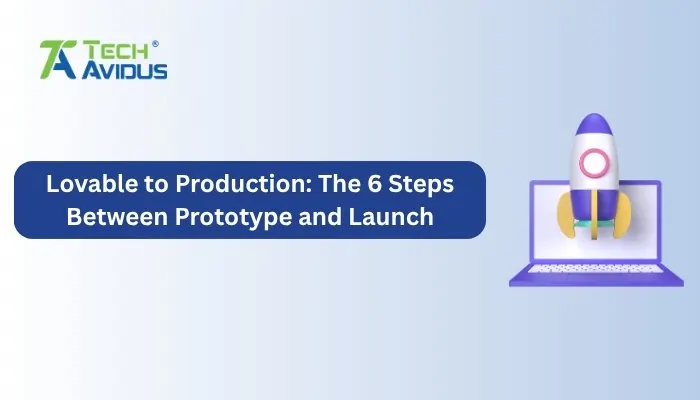
The six steps between prototype and launch are requirements validation, architecture review, code and data cleanup, security and testing, production configuration, and controlled release with monitoring.
A prototype is primarily designed to prove an idea. Production software has a different responsibility: it must behave consistently when real users, real data, integrations, permissions, and unexpected conditions enter the picture.
In practice, teams often discover that the visual interface is not the biggest production challenge. The difficult work is usually behind the interface—authentication rules, database relationships, API behavior, environment configuration, validation, error handling, and operational monitoring.
1. Validate the Prototype Against Real Business Requirements
The first step is to determine whether the prototype actually represents the product that needs to go live.
Before changing code, review every major user journey. Identify which screens are demonstrations, which features are functional, and which workflows still depend on temporary logic or mock data.
For example, a SaaS prototype might demonstrate:
- User registration and login
- Dashboard navigation
- Customer records
- Subscription workflows
- Notifications
- Reporting
During production preparation, each workflow should be mapped to a real business requirement. Questions such as “Who can access this data?” and “What happens if this API fails?” become just as important as the visual design.
A useful practice is to create a production-readiness checklist covering functionality, user roles, data flows, integrations, and business rules before beginning the final engineering phase.
2. Review the Architecture Before Scaling the App
The second step is an architecture review. The goal is to understand how the frontend, backend, database, authentication, APIs, and third-party services work together.
AI-assisted development can produce functional application components quickly, but production applications still require architectural decisions.
Review areas should include:
- Frontend component structure and maintainability
- Database schema and relationships
- Authentication and authorization
- API integrations
- Environment variables and secrets
- Error handling
- File and media storage
- Third-party dependencies
- Scalability considerations
This is often where an experienced Lovable Ai Developer adds significant value. Instead of simply modifying what the AI generated, the developer evaluates whether the implementation is maintainable and appropriate for the application's expected usage.
If the architecture is difficult to understand, production deployment becomes harder to troubleshoot later.
3. Clean Up Code, Data, and Business Logic
The third step is removing prototype shortcuts that could create problems in production.
Prototype development often includes temporary data, duplicated components, placeholder API responses, unused dependencies, loosely structured business logic, or development-only configuration.
Production preparation should separate temporary experimentation from core application logic.
For example, consider an application that displays customer information. A prototype might use sample records directly in a component. A production implementation should establish a proper data flow involving authentication, database queries, validation, permissions, loading states, and error handling.
The same principle applies to business rules. Pricing calculations, user permissions, transaction processing, and important validation should not depend solely on client-side behavior.
This cleanup stage can also improve maintainability because future developers can understand where functionality belongs and how different parts of the application interact.
4. Test Security, Authentication, and Real-World Failure Scenarios
The fourth step is production testing, with security receiving particular attention.
An application should be tested for more than whether the happy path works. Teams should deliberately test invalid inputs, unauthorized access, expired sessions, failed API requests, unexpected database responses, and other edge cases.
Security testing should cover areas such as:
- Authentication and password flows
- Authorization and role-based access
- Input validation
- API security
- Session management
- Sensitive data exposure
- Database permissions
- Error messages
- Configuration and deployment settings
The OWASP Web Security Testing Guide provides a recognized framework covering areas such as authentication, authorization, session management, input validation, API testing, and configuration/deployment testing.
OWASP also recommends integrating security into the software development lifecycle rather than waiting until the deployment phase.
From a practical perspective, this means security should be treated as part of production readiness—not as an optional final inspection.
5. Prepare the Production Environment
The fifth step is configuring the environment in which real users will access the application.
Production configuration can involve domain settings, environment variables, database connections, authentication providers, API credentials, storage, logging, error monitoring, and deployment settings.
One important rule is to keep development and production environments clearly separated. Development credentials, test records, debugging settings, and temporary integrations should never accidentally become part of the live environment.
A production checklist should confirm:
- Production database configuration is correct.
- Secrets are stored securely.
- Debugging features are disabled where appropriate.
- Authentication redirects use the correct domain.
- API endpoints point to the intended environment.
- Error handling does not expose sensitive implementation details.
- Logging and monitoring are configured.
- Backup and recovery procedures are understood.
OWASP's deployment-management guidance specifically highlights configuration review, removal of unnecessary components, secure error handling, logging, and protection of sensitive configuration information.
This stage is where Lovable Ai Development Services can extend beyond initial application creation into production engineering and operational readiness.
6. Launch Gradually and Monitor What Happens
The sixth step is the actual release—but launch should be treated as the beginning of production operations, not the end of development.
Before announcing the application broadly, perform a controlled release. Test the deployed version using realistic user journeys and verify that important functionality works in the live environment.
After launch, monitor:
- Application errors
- Authentication failures
- API failures
- Database performance
- Slow pages or requests
- User-reported issues
- Unexpected traffic patterns
- Integration failures
A useful release workflow is:
Build → Review → Test → Deploy → Monitor → Improve
This creates a repeatable process for future releases instead of treating every update as a one-off event.
Advantages and Limitations of Moving from Lovable to Production
Advantages
Faster transition from idea to working product:
Lovable can help teams turn product concepts into functional application experiences quickly. The production phase then focuses engineering effort on reliability, security, maintainability, and business requirements.
Clearer product validation:
A working prototype provides something concrete that stakeholders can test and refine before deeper engineering work is completed.
More focused development effort:
Once the prototype is understood, developers can concentrate on the areas that genuinely require production hardening rather than rebuilding the entire concept from scratch.
Limitations
A prototype may hide technical debt:
Fast development can leave behind duplicated logic, weak validation, temporary integrations, or architectural decisions that need refinement.
Production requirements are more demanding:
Real users introduce unexpected inputs, concurrency, security concerns, operational issues, and support requirements that a prototype may never encounter.
AI-assisted development still needs human engineering judgment:
AI can accelerate implementation, but decisions around architecture, security, data protection, performance, and long-term maintainability still require experienced technical oversight.
Real-World Example: Turning a SaaS Prototype Into a Production Application
Imagine a startup creates a project-management SaaS prototype with Lovable.
The prototype includes user registration, projects, tasks, team members, and a dashboard. It works well during demonstrations, but the team discovers several production gaps.
The database permissions need restructuring. User roles need more precise authorization rules. Several components contain duplicated logic. API failures are not handled consistently, and some environment variables still reference development services.
Instead of rebuilding the application, the team performs the six-step process.
First, they validate the workflows against actual business requirements. Next, they review the architecture and database relationships. They then clean up business logic, test authentication and authorization, configure the production environment, and release the application in a controlled manner.
The result is not simply a deployed prototype. It is a product with a clearer technical foundation for continued development.
Best Practices for a Successful Production Transition
Start with a technical audit:
Before making major changes, understand what already exists. Review the codebase, database, authentication, integrations, dependencies, and deployment configuration.
Keep environments separate:
Use appropriate development, testing, and production configurations. Never assume that settings that work locally are suitable for production.
Test unhappy paths:
Do not only test successful logins, completed payments, or valid form submissions. Test failures, expired sessions, missing data, invalid input, and unavailable services.
Document important decisions:
Record authentication rules, database relationships, API dependencies, environment requirements, and deployment procedures. This makes future maintenance easier.
Use version control and controlled releases:
A production application should have a traceable history of changes. Version control makes it easier to review, test, roll back, and maintain updates.
Plan for post-launch maintenance:
Production software is never truly “finished.” Dependencies change, APIs evolve, security issues emerge, and users request new functionality.
For businesses that need technical support throughout this transition, Lovable Development Services can be used as a relevant internal link placeholder.
Recap: What Does It Take to Move a Lovable App to Production?
Moving a Lovable prototype to production requires more than deployment. The application should first be validated against business requirements, reviewed architecturally, cleaned up, security-tested, configured for production, and released through a controlled process.
A production-ready application should have reliable business logic, appropriate authentication and authorization, secure configuration, tested integrations, proper error handling, and a monitoring strategy.
The goal is not to make the prototype unnecessarily complex. The goal is to make it dependable enough for real users and real business operations.
Conclusion
Going from a Lovable prototype to a production application is not about abandoning the speed of AI-assisted development. It is about adding the engineering discipline required for real-world software.
The six-step process—validate, review, clean up, test, configure, and launch—creates a practical path from a promising prototype to a more reliable product.
If your Lovable project is functional but you are unsure whether it is truly ready for users, a professional technical review can reveal what needs attention before launch.
Need help taking your Lovable project from prototype to production? Contact TechAvidus for a free consultation and discuss your application's technical requirements.

Bhavesh Ladva
Bhavesh Ladva specializes in MCP (Model Context Protocol) Server Development, helping businesses connect AI applications with external tools, APIs, databases, and business systems. His work focuses on building custom MCP servers that enable smoother tool execution, structured data access, and reliable AI integrations. By simplifying connections between AI models and existing workflows, Bhavesh helps teams reduce manual steps, improve process efficiency, and develop more practical AI-powered solutions. He prioritizes secure integrations, maintainable architecture, and scalable implementations aligned with real business requirements.