

Key Takeaways
- 1. Ongoing support involves much more than fixing visible bugs; it includes monitoring, security, testing, performance, and code quality.
- 2. Regular maintenance can help identify Lovable app technical debt before it becomes a major development obstacle.
- 3. Refactoring and dependency management help keep an application easier to maintain as new features are introduced.
- 4. Security reviews should continue after launch because applications, dependencies, integrations, and threats change over time.
- 5. A structured maintenance workflow gives teams a clearer path from bug reports to testing, deployment, and continuous improvement.
Introduction
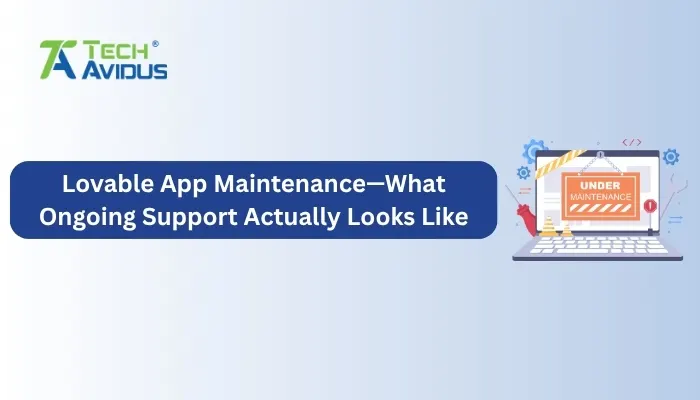
Launching an application with Lovable is only the beginning. Once an app reaches real users, ongoing support becomes essential for keeping features reliable, integrations stable, security controls current, and the codebase maintainable. Lovable app maintenance is the ongoing process of monitoring, fixing, improving, securing, and evolving a Lovable-built application after its initial development.
A prototype may work perfectly during early testing but encounter different challenges in production. Users may report that the Lovable app is not working, an integration may fail after an update, performance may decline, or new features may become harder to implement as the codebase grows.
For businesses moving from an MVP toward a dependable product, maintenance should therefore be treated as part of the application lifecycle—not as an emergency service used only when something breaks.
What Does Lovable App Maintenance Actually Include?
Lovable app maintenance typically combines bug fixing, performance monitoring, security reviews, dependency updates, refactoring, testing, and ongoing feature improvements.
The exact support required depends on the application's architecture, integrations, user base, and business goals. A simple internal application may require occasional troubleshooting, while a customer-facing SaaS product can require continuous monitoring and structured release management.
1. Bug Fixes and Production Troubleshooting
One of the most visible parts of maintenance is resolving problems that appear after deployment.
A Lovable app not working correctly can have many possible causes. The issue could involve frontend behavior, authentication, database queries, API integrations, environment variables, third-party services, or a recent code change.
Effective support begins with identifying the root cause rather than repeatedly applying temporary fixes. Logs, error messages, reproduction steps, affected workflows, and recent deployment changes can help developers isolate the underlying problem.
2. Lovable App Refactoring and Code Quality
As an application evolves, some code that was appropriate for an MVP may become difficult to maintain.
Lovable app refactoring involves restructuring existing code without changing its intended functionality. The objective is to make the application cleaner, easier to test, and easier to extend.
This becomes particularly important when teams build app with Lovable quickly and continue adding features over time. Without periodic code-quality reviews, duplicated logic, tightly coupled components, and inconsistent patterns can gradually increase maintenance effort.
3. Managing Lovable App Technical Debt
Lovable app technical debt is the accumulated cost of shortcuts, outdated implementations, duplicated logic, and architectural decisions that make future changes harder.
Technical debt is not automatically a sign of poor development. Early-stage products often prioritize speed and validation. The problem occurs when temporary solutions remain in place indefinitely.
A practical maintenance process can categorize technical debt by impact. Critical reliability or security issues should generally take priority, while lower-risk refactoring can be scheduled alongside normal feature development.
4. Security Reviews and Dependency Updates
Application security cannot stop when an application goes live.
Lovable app security should include appropriate authentication and authorization checks, secure configuration, dependency monitoring, secrets management, input validation, and review of third-party integrations.
OWASP recommends ongoing application security activities during operations, including patching, monitoring, vulnerability management, and controlled changes. Its guidance also emphasizes maintaining visibility into software dependencies and their security status.
This is particularly relevant when an application relies on external packages or services. An outdated dependency can introduce risk even when the application's business logic has not changed.
5. Performance and Reliability Monitoring
An application can function correctly while still delivering a poor user experience.
Maintenance teams can monitor page responsiveness, API performance, database behavior, error rates, failed requests, and other application-specific indicators. Monitoring helps distinguish isolated user issues from recurring technical problems.
The goal is not simply to react when users complain. It is to identify patterns early and address problems before they significantly affect users.
Why Does Ongoing Support Matter After Building an App?
A production application is constantly changing because its dependencies, users, integrations, business requirements, and security environment change.
For example, a company may initially use a Lovable-built MVP to validate an idea. After gaining traction, it may add payment processing, customer accounts, analytics, external APIs, administrative features, or role-based access.
At that stage, Lovable enterprise development requires a more structured approach to maintenance because reliability, security, scalability, documentation, and controlled releases become increasingly important.
Maintenance also creates an opportunity to improve the product rather than simply preserve it.
Where AI-Powered Website Development Fits
AI-Powered Website Development can accelerate application creation, but accelerated development does not eliminate the need for engineering oversight after launch.
AI-assisted development can help teams move quickly from an idea to a working application. However, production applications still require testing, architectural review, security validation, dependency management, and ongoing troubleshooting.
The practical approach is to use AI-assisted development for speed while maintaining disciplined engineering processes for reliability and long-term maintainability.
Pros and Limitations of Ongoing Maintenance
Advantages
Better reliability: Regular monitoring and preventive fixes can reduce recurring application problems and improve operational stability.
Easier future development: Refactoring and technical-debt management can make the codebase easier to understand when new features are introduced.
Improved security posture: Continuous reviews help teams respond to vulnerable dependencies, configuration issues, and emerging application risks.
Faster troubleshooting: Documentation, monitoring, and established support workflows make production incidents easier to investigate.
Limitations
Maintenance requires ongoing attention: Applications cannot realistically remain healthy without periodic technical review.
Some issues require deeper architectural work: A quick bug fix may not be appropriate when the underlying problem comes from a structural design limitation.
Updates can introduce new risks: Dependencies and integrations should be tested before production changes are released.
OWASP recommends controlled change management, regular scanning, patching, monitoring, and security processes throughout an application's operational lifecycle.
Real-World Scenario: From Lovable MVP to Production Product
Consider a startup that uses Lovable to create an MVP with authentication, a dashboard, a database, and several API integrations.
During the MVP stage, the application performs adequately. As usage increases, however, the team notices slower dashboard responses, occasional authentication errors, duplicated components, and difficulty adding new functionality.
Instead of rebuilding everything, a maintenance team can conduct an application audit.
The process might include:
- Reviewing the current application architecture and dependencies to identify outdated or unnecessary components.
- Reproducing reported bugs and separating isolated issues from recurring production problems.
- Reviewing authentication, permissions, environment variables, and integrations for security weaknesses.
- Identifying areas of Lovable code problems and prioritizing them according to business impact.
- Performing targeted Lovable app refactoring where the existing implementation makes future development unnecessarily difficult.
- Establishing regression testing before significant changes are deployed.
This approach allows the business to improve the existing product while preserving useful functionality.
Best Practices for Long-Term Support
Maintain a Clear Change Log
Document important application changes, dependency updates, configuration changes, bug fixes, and production incidents.
Good documentation reduces dependency on one developer's memory and makes future troubleshooting more efficient.
Prioritize Problems by Risk
Not every issue requires the same response. Security vulnerabilities, authentication failures, data integrity problems, and production outages generally deserve higher priority than minor visual defects.
A defined severity and escalation process helps teams make consistent decisions.
Review Dependencies Regularly
Third-party packages and services should not be treated as permanent, risk-free components.
OWASP recommends maintaining visibility into software components and monitoring dependencies for vulnerabilities and maintenance status.
Test Before Production Deployment
Regression testing is particularly important when fixing existing functionality or restructuring code.
A maintenance change should ideally verify both the new behavior and the workflows that could potentially be affected by it.
Treat Security as an Ongoing Process
Security requirements should evolve as the application evolves. OWASP recommends revisiting security requirements when new features are added and maintaining security activities throughout operations.
Plan Technical-Debt Reduction
Do not wait until technical debt prevents a major product update.
Small, planned improvements can gradually reduce complexity without requiring a disruptive rewrite.
Recap: What Should Ongoing Support Cover?
Lovable application maintenance is an ongoing engineering process that keeps a production application functional, secure, maintainable, and ready for future changes.
A strong support process should cover:
- Production bug fixing and troubleshooting.
- Code-quality reviews and targeted refactoring.
- Technical-debt identification and prioritization.
- Dependency and security management.
- Performance and reliability monitoring.
- Regression testing and controlled deployments.
- Documentation and change management.
- Continuous improvements based on evolving business requirements.
The right maintenance strategy depends on the application's complexity, architecture, integrations, users, and business importance.
Conclusion
Building an application quickly is valuable, but keeping it reliable as it grows is equally important. A structured maintenance strategy helps businesses address production issues, manage technical debt, improve security, and prepare the application for future requirements.
For teams that have built an MVP with Lovable and now need dependable production support, TechAvidus can help assess the existing application, identify code and architecture issues, strengthen security, and plan practical improvements.
Explore Lovable Development Services or request a free consultation to discuss your application's maintenance and improvement needs.

Bhavesh Ladva
Bhavesh Ladva specializes in MCP (Model Context Protocol) Server Development, helping businesses connect AI applications with external tools, APIs, databases, and business systems. His work focuses on building custom MCP servers that enable smoother tool execution, structured data access, and reliable AI integrations. By simplifying connections between AI models and existing workflows, Bhavesh helps teams reduce manual steps, improve process efficiency, and develop more practical AI-powered solutions. He prioritizes secure integrations, maintainable architecture, and scalable implementations aligned with real business requirements.