

Allow Google Analytics to measure how I use the site to enhance functionality and service.

Allows us to show personalized advertisements based on your browsing behavior.

Share my activity data with cookies for targeted advertising.

Customize my ad experience by allowing cookies to personalize the ads I see.
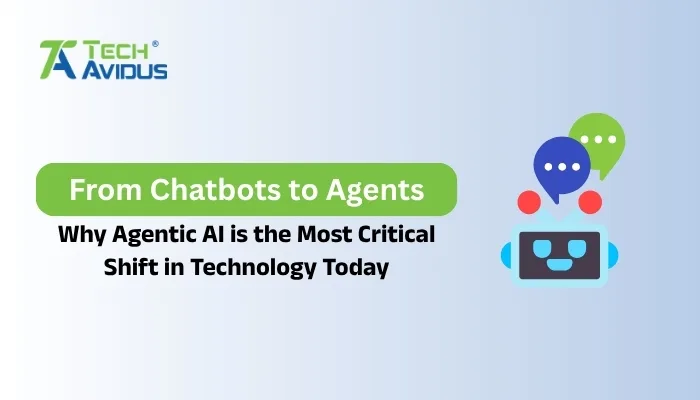
Artificial Intelligence has evolved rapidly over the last decade. Businesses first adopted automation tools, then conversational AI chatbots, and now the technology landscape is moving toward something far more transformative: Agentic AI. While chatbots changed how users interact with systems, AI agents are changing how systems think, decide, and act independently.
This shift from reactive AI to proactive AI is becoming one of the most significant technological revolutions since cloud computing and mobile transformation. Organizations across healthcare, finance, logistics, retail, SaaS, and enterprise software are already investing heavily in autonomous AI systems that can complete tasks, make decisions, learn continuously, and collaborate with humans.
For modern enterprises, Agentic AI is no longer a futuristic concept. It is becoming a competitive necessity.
At TechAvidus, businesses are increasingly exploring intelligent AI-driven systems to improve operational efficiency, customer experiences, and enterprise automation. Understanding the difference between traditional chatbots and autonomous AI agents is essential for organizations preparing for the next wave of digital transformation.

Traditional AI chatbots were designed primarily for conversation. Their role was limited to answering queries, retrieving information, or guiding users through predefined workflows. These systems depended heavily on scripts, intents, rules, and limited contextual understanding.
Modern AI agents, however, operate very differently.
Agentic AI systems are autonomous entities capable of reasoning, planning, decision-making, memory retention, and executing multi-step tasks with minimal human intervention. Instead of simply responding to commands, they can independently pursue goals.
For example, a chatbot might answer a customer’s question about order delivery. An AI agent can track the shipment, identify delays, communicate with logistics providers, notify the customer proactively, issue refunds if necessary, and update internal systems automatically.
This transition represents a major leap from conversational interfaces to intelligent digital workers.
Agentic AI refers to AI systems designed to act autonomously toward achieving defined objectives. These systems use reasoning models, contextual memory, planning frameworks, APIs, tools, and machine learning to perform actions rather than just generate responses.
Unlike standard generative AI tools, Agentic AI systems can:
In simple terms, chatbots talk. AI agents act.
This capability is what makes Agentic AI one of the most disruptive innovations in enterprise technology today.
The rise of Agentic AI is reshaping how businesses operate because it addresses a long-standing challenge in digital transformation: automation without constant human dependency.
Earlier automation systems required rigid workflows and manual monitoring. Agentic AI introduces adaptive intelligence capable of handling uncertainty, exceptions, and dynamic environments.
This matters because modern businesses generate enormous operational complexity. Managing workflows across departments, systems, vendors, customers, and data streams is increasingly difficult with conventional automation alone.
Agentic AI changes that equation.
Organizations can now deploy AI agents that monitor operations, analyze trends, optimize processes, and execute tasks continuously in real time.
The implications are massive:
According to research from McKinsey & Company, generative and autonomous AI technologies could contribute trillions of dollars annually to the global economy through productivity improvements and workflow automation.
The distinction between chatbots and AI agents is fundamental.
Chatbots are generally reactive systems. They wait for prompts and provide responses based on predefined training or retrieval mechanisms. Their memory is often limited, and they typically cannot execute complex actions independently.
AI agents are proactive systems. They can initiate workflows, interact with multiple applications, make contextual decisions, and complete objectives autonomously.
For example, in software development:
A chatbot can answer coding questions.
An AI agent can analyze requirements, generate code, run tests, detect bugs, deploy updates, and notify development teams automatically.
This operational autonomy is why Agentic AI is becoming essential in enterprise ecosystems.
The practical use cases for Agentic AI are expanding rapidly across industries.
In healthcare, AI agents help automate patient scheduling, medical documentation, diagnostics assistance, and treatment recommendations while supporting healthcare professionals with administrative tasks.
In finance, autonomous agents monitor transactions, detect fraud patterns, manage risk assessments, and automate compliance reporting.
In eCommerce and retail, AI agents manage inventory forecasting, personalize customer recommendations, optimize pricing, and automate customer service operations.
In software development, AI engineering agents are accelerating coding, testing, deployment, and maintenance cycles.
Customer support is also undergoing major transformation. Instead of static support chatbots, companies now deploy AI agents capable of resolving tickets end-to-end, escalating complex issues intelligently, and maintaining contextual memory across interactions.
This shift dramatically improves customer satisfaction while reducing support costs.
The advancement of Large Language Models (LLMs) such as those developed by OpenAI, Google DeepMind, and Anthropic has significantly accelerated the rise of Agentic AI.
LLMs brought major improvements in reasoning, language understanding, contextual awareness, and content generation. However, the real breakthrough occurred when developers began connecting these models with tools, APIs, memory systems, and autonomous workflows.
This combination enabled AI systems to move beyond static responses and begin interacting with real-world systems.
Modern AI agents can now:
This creates a new category of intelligent operational systems capable of functioning like digital employees.
Enterprise automation is evolving from robotic process automation (RPA) toward intelligent orchestration.
Traditional RPA systems struggled with variability because they relied on predefined rules. Agentic AI systems introduce adaptive decision-making into automation.
For enterprises, this means:
Companies implementing AI agents can automate entire business functions instead of isolated repetitive tasks.
For example, an AI-powered procurement agent can:
This level of automation fundamentally changes operational efficiency.

Despite its transformative potential, Agentic AI introduces important challenges that businesses must address carefully.
Autonomous systems require strong governance frameworks, ethical controls, data privacy safeguards, and transparency mechanisms.
Major concerns include:
Responsible AI implementation is critical.
Organizations should establish:
Technology leaders must balance innovation with accountability.
Businesses looking to adopt Agentic AI successfully should focus on strategic implementation rather than experimentation alone.
The first step is identifying high-value workflows where autonomous AI can deliver measurable efficiency gains. Repetitive operational tasks, customer support processes, data-heavy workflows, and decision-driven systems are ideal starting points.
Organizations should also prioritize:
It is equally important to train employees alongside AI adoption initiatives. The future workforce will increasingly collaborate with AI agents rather than compete against them.
Businesses that invest early in AI readiness will gain substantial long-term advantages.
The future of AI is increasingly autonomous.
Industry experts predict that AI agents will soon manage complex workflows across entire organizations. Multi-agent ecosystems may collaborate to handle operations, customer service, software engineering, cybersecurity, and strategic planning simultaneously.
Future AI systems are expected to become:
This evolution may fundamentally redefine productivity, enterprise management, and digital transformation.
The shift from software tools to autonomous digital agents represents one of the most important technological transitions of this generation.
Organizations delaying AI adoption risk losing competitive advantages in speed, efficiency, scalability, and innovation.
Businesses embracing Agentic AI today are already:
The companies leading the next decade will not simply use AI tools. They will build AI-powered operational ecosystems.
This is why the transition from chatbots to AI agents is not just another tech trend. It is a foundational shift in how modern organizations operate.
At TechAvidus, enterprises can explore advanced AI development solutions designed to support intelligent automation, scalable digital transformation, and next-generation business innovation.
The evolution from chatbots to Agentic AI marks a defining moment in technology history. While chatbots improved communication, AI agents are transforming execution.
Businesses are entering an era where autonomous AI systems can reason, plan, collaborate, and act independently across complex workflows. This transition has the potential to reshape every industry, from healthcare and finance to retail, SaaS, and enterprise software.
However, successful adoption requires more than technology investment alone. Organizations must focus on governance, infrastructure readiness, security, ethical AI practices, and long-term strategic planning.
Companies that embrace Agentic AI early will position themselves for significant competitive advantages in productivity, scalability, innovation, and customer experience.
The future of business is not just AI-assisted. It is AI-driven.
If your organization is exploring intelligent automation, autonomous systems, or enterprise AI transformation, now is the time to start building for the future.

Bhavesh Ladva is a seasoned AI Developer with over 10 years of experience in machine learning, deep learning, and NLP. He has built scalable AI solutions across industries, leveraging technologies like Python, TensorFlow, and cloud platforms. Bhavesh is passionate about ethical AI and constantly explores innovative ways to solve real-world problems.
Our Top 1% Tech Talent integrates cutting-edge AI technologies to craft intelligent, scalable, and future-ready solutions.
All Rights Reserved. Copyright © 2026 | TechAvidus