


Allow Google Analytics to measure how I use the site to enhance functionality and service.

Allows us to show personalized advertisements based on your browsing behavior.

Share my activity data with cookies for targeted advertising.

Customize my ad experience by allowing cookies to personalize the ads I see.
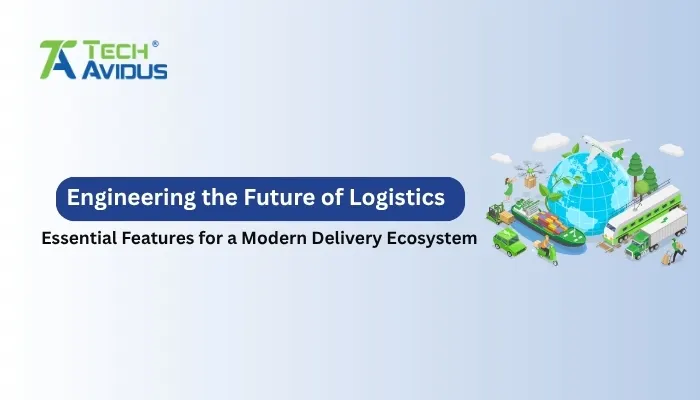
The logistics industry is undergoing a fundamental transformation driven by digital innovation, evolving consumer expectations, and the rapid growth of eCommerce. Today’s customers demand faster deliveries, real-time visibility, and seamless experiences across every touchpoint. To meet these expectations, businesses must move beyond traditional logistics models and embrace a modern, technology-driven delivery ecosystem.
Engineering such an ecosystem requires a strategic combination of advanced software, intelligent automation, and scalable infrastructure. According to insights from global organizations like the World Economic Forum and industry leaders such as McKinsey, digitization in logistics can reduce operational costs by up to 30% while significantly improving service levels. This shift is not optional—it’s essential for businesses aiming to stay competitive in a fast-paced market.
This blog explores the key features that define a modern delivery ecosystem, backed by expert insights, real-world applications, and best practices to help organizations future-proof their logistics operations.
A modern delivery ecosystem is an interconnected network of technologies, platforms, and processes that work together to optimize the movement of goods from origin to destination. It integrates real-time data, automation, and intelligent decision-making to improve efficiency, visibility, and customer satisfaction.
Unlike legacy logistics systems, which often operate in silos, modern ecosystems leverage cloud computing, APIs, IoT devices, and AI-driven analytics to create a unified and adaptive infrastructure. This allows businesses to respond dynamically to disruptions, demand fluctuations, and operational challenges.
1. Real-Time Tracking and Visibility
Real-time tracking has become a baseline expectation rather than a premium feature. Customers and businesses alike need accurate, up-to-the-minute updates on shipment status. Advanced tracking systems use GPS, IoT sensors, and mobile connectivity to provide continuous visibility across the supply chain.
This transparency not only improves customer trust but also enables proactive issue resolution. For instance, if a delay occurs, businesses can notify customers instantly and adjust delivery schedules accordingly.
2. AI-Powered Route Optimization
Route optimization is no longer limited to basic mapping. Modern systems leverage artificial intelligence and machine learning to analyze traffic patterns, weather conditions, fuel efficiency, and delivery priorities in real time.
By dynamically adjusting routes, companies can reduce delivery times, lower fuel costs, and improve fleet utilization. Studies show that AI-driven route optimization can reduce logistics costs by up to 20%, making it a critical component of any advanced delivery ecosystem.
3. Automated Dispatch and Fleet Management
Automation plays a central role in modern logistics. Intelligent dispatch systems assign deliveries based on driver availability, location, vehicle capacity, and delivery urgency.
Fleet management tools further enhance efficiency by monitoring vehicle health, driver behavior, and maintenance schedules. This not only reduces operational downtime but also ensures compliance with safety standards.
4. Seamless Integration with eCommerce and ERP Systems
A modern delivery ecosystem must seamlessly integrate with existing business systems, including eCommerce platforms, warehouse management systems, and ERP solutions.
API-driven integrations enable real-time data synchronization across platforms, ensuring accurate inventory levels, order processing, and delivery updates. This eliminates manual data entry, reduces errors, and enhances overall operational efficiency.
5. Advanced Analytics and Predictive Insights
Data is the backbone of modern logistics. Advanced analytics tools collect and process large volumes of data to generate actionable insights.
Predictive analytics can forecast demand, identify potential bottlenecks, and optimize resource allocation. Businesses can use these insights to make informed decisions, improve service levels, and reduce costs.
6. Contactless and Last-Mile Delivery Innovations
The last mile remains the most complex and expensive segment of the delivery process. Innovations such as contactless delivery, smart lockers, and autonomous vehicles are transforming this stage.
These technologies not only enhance convenience and safety but also reduce delivery times and operational costs. Companies that invest in last-mile innovation gain a significant competitive advantage.
7. Scalability and Cloud Infrastructure
Scalability is essential for handling fluctuating demand, especially during peak seasons. Cloud-based logistics platforms provide the flexibility to scale operations up or down as needed.
Cloud infrastructure also supports remote access, real-time updates, and seamless collaboration across teams, making it a cornerstone of modern logistics ecosystems.

Leading logistics and eCommerce companies have already embraced these technologies to great success. For example, global retailers use AI-driven systems to optimize delivery routes and reduce shipping times, while logistics providers leverage IoT-enabled tracking for end-to-end visibility.
A notable example is how major eCommerce platforms have implemented predictive analytics to anticipate demand spikes during festive seasons. By aligning inventory and delivery resources accordingly, they achieve faster fulfillment and higher customer satisfaction rates.
Similarly, third-party logistics providers are adopting automated dispatch systems to manage large fleets efficiently, resulting in reduced operational costs and improved delivery accuracy.
To successfully engineer a modern logistics ecosystem, businesses must adopt a strategic approach. First, prioritize customer experience by ensuring transparency, reliability, and speed across all delivery processes. Customer-centric design should guide every technological investment.
Second, invest in scalable and flexible technologies that can adapt to evolving market demands. Cloud-based solutions and modular architectures provide the agility needed for long-term growth.
Third, focus on data-driven decision-making. Collecting and analyzing data is not enough—businesses must translate insights into actionable strategies that drive measurable outcomes.
Fourth, ensure robust cybersecurity measures. As logistics systems become increasingly digital, protecting sensitive data and maintaining system integrity is critical.
Finally, collaborate with experienced technology partners like TechAvidus to design and implement customized logistics solutions that align with business goals.
The future of logistics lies in intelligent, connected, and scalable delivery ecosystems. Businesses that embrace digital transformation and invest in advanced technologies will not only improve operational efficiency but also deliver superior customer experiences.
Engineering a modern delivery ecosystem is not a one-time effort—it’s an ongoing journey of innovation and optimization. By integrating real-time tracking, AI-driven insights, automation, and scalable infrastructure, organizations can stay ahead of the competition and thrive in an increasingly demanding market.

Bhavesh Ladva is a seasoned AI Developer with over 10 years of experience in machine learning, deep learning, and NLP. He has built scalable AI solutions across industries, leveraging technologies like Python, TensorFlow, and cloud platforms. Bhavesh is passionate about ethical AI and constantly explores innovative ways to solve real-world problems.
Our Top 1% Tech Talent integrates cutting-edge AI technologies to craft intelligent, scalable, and future-ready solutions.
All Rights Reserved. Copyright © 2026 | TechAvidus



.jpg)