

Legacy systems—once the backbone of enterprise operations—are now among the biggest roadblocks to innovation. Aging code, obsolete frameworks, and security vulnerabilities increase maintenance costs while limiting scalability.
According to Gartner, over 60% of CIOs identify legacy modernization as a top priority for digital transformation. However, manual refactoring is often time-consuming, risky, and costly.
That’s where AI tools for legacy code modernization step in—empowering organizations to automate code analysis, refactoring, and migration while reducing human error and cost overheads.
This blog explores how enterprises are leveraging AI to modernize legacy systems, reduce risks, and future-proof their software ecosystems.
Understanding Legacy Code Modernization
Legacy code modernization refers to updating, refactoring, or reengineering outdated software systems to align with modern technologies such as cloud infrastructure, microservices, and AI-enabled automation.
Traditional modernization approaches often involve:
- Manual code analysis and rewriting
- Platform migration and re-architecture
- Rehosting or containerization
These approaches, while effective, require significant time, budget, and expertise.
AI-driven modernization, however, introduces a paradigm shift by using machine learning and natural language processing to automate many of these steps.
How AI Tools Are Transforming Legacy Code Modernization
AI tools bring automation, intelligence, and precision to a process that was once error-prone and labor-intensive. Here’s how:

Top AI Tools for Legacy Code Modernization (2025)
.png)
Source: Gartner, Forrester, IBM Developer Reports, Microsoft Build 2025.
Benefits of Using AI Tools for Legacy Code Modernization
- Cost Reduction:
AI automates code analysis, testing, and documentation—cutting modernization costs by up to 50%. - Risk Mitigation:
AI predicts potential failures and optimizes migration sequencing to avoid downtime. - Faster Time-to-Market:
Automation accelerates transformation, reducing project timelines by months. - Improved Code Quality:
Machine learning detects redundant or vulnerable code, ensuring maintainability. - Scalability & Cloud Readiness:
AI modernizes applications to align with microservices, containers, and APIs for seamless scalability.
Challenges and Limitations
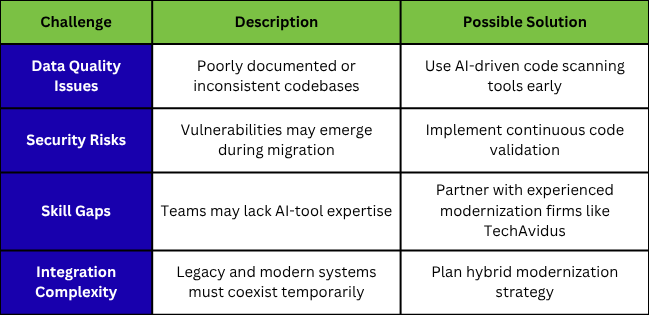
Real-World Example: AI in Enterprise Modernization
A global financial institution used IBM watsonx Code Assistant to migrate 40-year-old COBOL applications to Java.
- Result: Reduced manual effort by 70%
- Downtime: None during migration
- Outcome: Annual maintenance cost savings of over 40%
This case highlights how AI-driven modernization minimizes business disruption while achieving measurable ROI.
Best Practices for AI-Driven Legacy Code Modernization
- Start with a Code Audit
Use AI tools to analyze code dependencies, redundancy, and security vulnerabilities. - Prioritize Business-Critical Modules
Focus on modernizing systems that directly impact operations. - Adopt a Hybrid Approach
Combine AI automation with human expertise for accuracy and validation. - Leverage Cloud-Native Tools
Align modernization efforts with your future cloud strategy. - Partner with Experts
Collaborate with an experienced software development partner like TechAvidus for planning, execution, and AI tool integration.
Conclusion
Modernizing legacy systems is no longer optional—it’s essential for scalability, agility, and innovation.
AI tools for legacy code modernization offer enterprises a faster, safer, and more cost-effective path to modernization by automating complex tasks and mitigating migration risks.
At TechAvidus, we help organizations assess, plan, and execute AI-driven modernization strategies that align with their business goals.
👉 Get a free consultation to discover how AI can transform your legacy applications into modern, scalable systems.

Bhavesh Ladva
Bhavesh Ladva is an AI Developer and rapid product development expert with over 10 years of experience in AI, machine learning, deep learning, and NLP. He specializes in turning ideas into functional, scalable products using modern AI-powered development tools such as Lovable, Bolt, Claude, and other emerging AI platforms. His experience spans AI integrations, APIs, automation, cloud platforms, and intelligent workflows, enabling him to take products from concept to production efficiently.