

Allow Google Analytics to measure how I use the site to enhance functionality and service.

Allows us to show personalized advertisements based on your browsing behavior.

Share my activity data with cookies for targeted advertising.

Customize my ad experience by allowing cookies to personalize the ads I see.
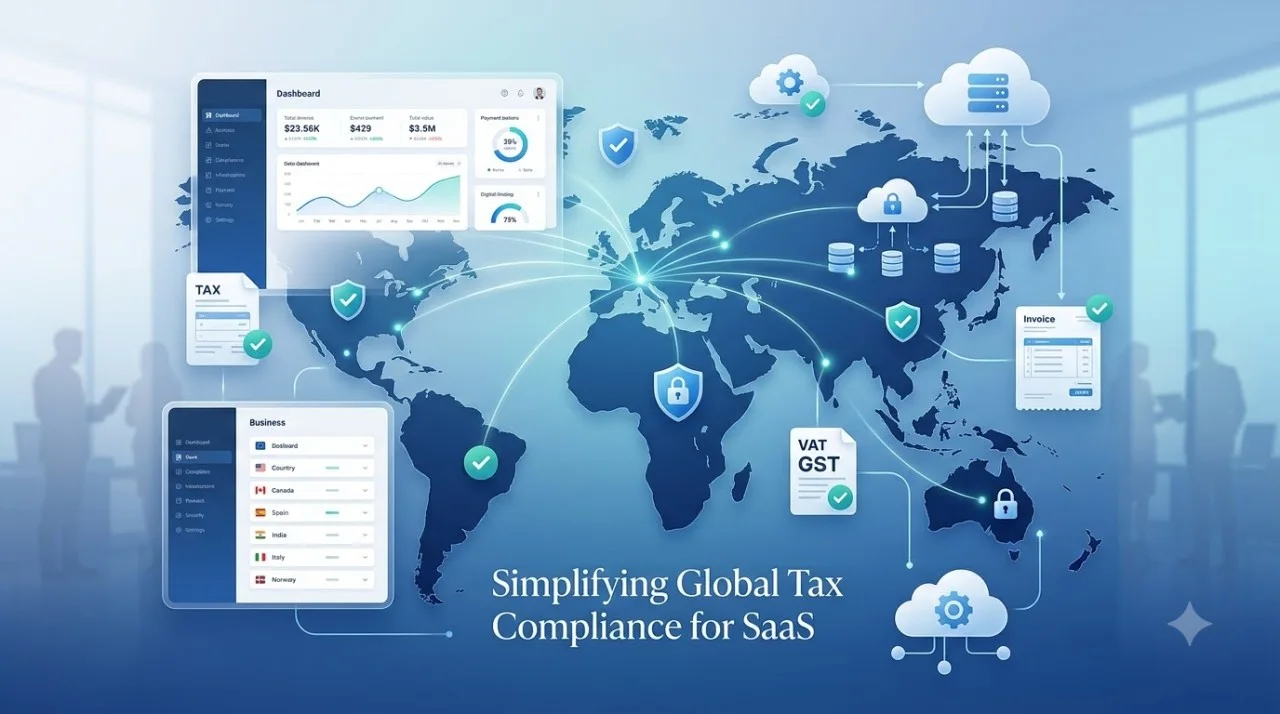
As SaaS companies expand into new markets, they run into a challenge that has little to do with their product and everything to do with geography: every country, and often every state or region within it, has its own rules for how digital services and subscriptions should be taxed. What starts as a straightforward pricing page quickly turns into a compliance problem involving VAT, GST, sales tax nexus, digital services taxes, and constantly shifting thresholds. For a growing SaaS business, deciding how to handle this is one of the more consequential operational decisions it will make.
A SaaS company selling only in its home country can usually manage tax with a standard accounting setup. The moment customers start signing up from other countries, that simplicity disappears. Tax obligations are triggered not by where a company is headquartered, but by where its customers are located and how much revenue it generates there. This means a SaaS platform could owe VAT in the EU, GST in countries like Australia or India, and sales tax across multiple U.S. states, often with different registration thresholds, filing frequencies, and documentation requirements in each one.
None of this is static either. Digital services tax rules have changed repeatedly over the past few years as governments update how they treat cross-border software revenue. A compliance setup that was accurate last year can quietly become outdated without anyone on the team noticing until an audit or a payment processor flags it.
Many SaaS teams default to building compliance internally, assuming it is a finance problem that can be handled with a spreadsheet and an accountant. In practice, it becomes an engineering problem as much as a financial one. Calculating the correct tax rate at checkout requires real-time logic tied to customer location, product classification, and jurisdiction-specific rules. Filing requires ongoing monitoring of thresholds across every market the business sells into. Remittance requires accurate records and timely payments to tax authorities who do not make exceptions for growing startups.
The cost of getting this wrong is not just financial penalties. It is engineering time diverted from the product roadmap, finance teams stretched across compliance work instead of forecasting and analysis, and legal exposure that grows every quarter revenue grows. For a lean SaaS team, this is often the point where global expansion starts to feel more like a liability than a growth milestone.
This is where a Merchant of Record model becomes relevant. Rather than treating tax compliance as something the SaaS company owns and manages piece by piece, a Merchant of Record takes on legal responsibility for the transaction itself, including tax calculation, collection, filing, and remittance across jurisdictions. Gapp Group's Merchant of Record solution is one of the best examples of this approach, where the provider manages payments, taxation, and compliance so the SaaS business does not have to build and maintain that infrastructure internally.
For a SaaS company, this shifts the responsibility from "we need to track tax law changes in twenty markets" to "our provider handles that as part of how transactions are processed." Engineering resources that would have gone into building and maintaining tax logic can go back into the product. Finance teams get accurate, jurisdiction-specific handling without hiring specialized in-house expertise for every market the company enters.
Not every SaaS company needs a Merchant of Record on day one. A useful way to think about the decision is to look at three factors: how many markets the business currently sells into, how quickly that number is expected to grow, and how much internal engineering and finance capacity is available to maintain compliance logic as rules change.
A SaaS company selling in one or two countries with stable rules may be fine handling compliance internally for now. A company selling across a dozen markets, or actively expanding into new ones, is usually better served by outsourcing this function early rather than retrofitting it after a compliance issue forces the conversation. The cost of getting ahead of this tends to be far lower than the cost of untangling it later.
Some SaaS teams only realize their tax compliance setup is inadequate after something goes wrong, but there are usually earlier warning signs worth paying attention to. If finance or legal cannot say with confidence which countries the business is currently registered to collect tax in, that is a sign compliance tracking has not kept pace with growth. If engineering has an open backlog item to "fix tax calculation" that keeps getting deprioritized in favor of product work, that is another indicator the current approach is not sustainable. Customer complaints about being charged the wrong tax rate, or support tickets asking why a price differs from what was expected at checkout, often point to the same underlying gap.
Another common signal is a payment processor or banking partner raising questions about tax documentation during a routine review. This tends to surface compliance gaps that had been quietly accumulating, sometimes for years, without anyone flagging them internally. Teams that wait until this point to address compliance usually end up doing so under time pressure, with less room to evaluate providers carefully or negotiate favorable terms.
Recognizing these signs early gives a SaaS business more options. It can evaluate a Merchant of Record on its own timeline, run a proper migration, and avoid the scramble that comes from fixing compliance reactively after a provider or regulator raises the issue first.
Global tax compliance is not a problem SaaS companies can out-execute with a good spreadsheet or a one-time engineering sprint. Rules change, markets multiply, and the operational burden compounds quietly until it becomes visible in an audit or a blocked payment. Treating compliance as infrastructure to be outsourced, rather than a feature to be built, lets SaaS teams stay focused on product and growth while leaving the regulatory complexity to a partner built specifically to manage it.

Keshu Keshvala is the Chief Marketing Officer at TechAvidus — a trusted software development company based in India, specializing in AI-powered web, mobile, and custom software solutions. With 10+ years of experience in the IT and software development industry, Keshu has played a key role in delivering enterprise-grade digital solutions that help clients reduce costs, improve efficiency, and achieve optimal results tailored to their business needs.
Our Top 1% Tech Talent integrates cutting-edge AI technologies to craft intelligent, scalable, and future-ready solutions.
All Rights Reserved. Copyright © 2026 | TechAvidus