


Allow Google Analytics to measure how I use the site to enhance functionality and service.

Allows us to show personalized advertisements based on your browsing behavior.

Share my activity data with cookies for targeted advertising.

Customize my ad experience by allowing cookies to personalize the ads I see.
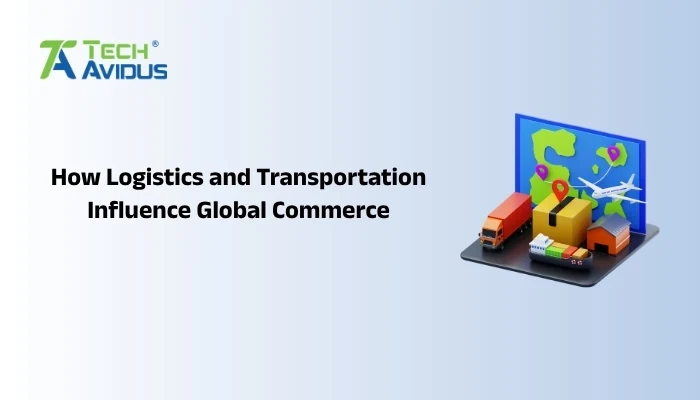
Global commerce has evolved into a highly interconnected ecosystem where businesses, suppliers, manufacturers, and consumers operate across borders every day. At the centre of this ecosystem lies logistics and transportation — the backbone of international trade and supply chain management. From raw material sourcing to last-mile delivery, logistics systems determine how efficiently goods move around the world.
Today, businesses no longer compete solely on product quality or pricing. Speed, reliability, transparency, and customer experience have become equally important. This is why logistics and transportation play a crucial role in shaping global commerce. Whether it is an eCommerce company shipping products internationally, a manufacturer importing components from another country, or a retailer managing inventory across continents, logistics directly impacts operational success and customer satisfaction.
According to the World Trade Organization and the World Bank, efficient logistics infrastructure significantly contributes to economic growth, trade competitiveness, and business scalability. As global demand continues to rise, companies increasingly rely on digital transformation, AI-driven supply chains, IoT tracking, and advanced transportation systems to streamline operations and reduce inefficiencies.
For technology-driven companies like TechAvidus, logistics innovation represents a massive opportunity to build intelligent, scalable, and data-driven solutions that support modern commerce.

Logistics refers to the planning, implementation, and management of the movement and storage of goods, services, and information throughout the supply chain. Transportation, on the other hand, focuses specifically on moving products from one location to another using roadways, railways, airways, or maritime routes.
Together, these functions create a seamless system that enables international trade. Without reliable transportation networks and logistics coordination, global commerce would slow dramatically, increasing costs, delays, and operational risks.
Modern logistics includes inventory management, warehousing, freight forwarding, customs clearance, route optimisation, fleet management, and last-mile delivery. Transportation acts as the physical engine that powers these activities.
Businesses today depend heavily on integrated logistics technology to gain real-time visibility into shipments, optimise delivery schedules, and reduce disruptions caused by weather, geopolitical events, or fluctuating fuel costs.
Efficient logistics systems help businesses expand beyond local markets and participate in international trade. Companies can source materials globally, manufacture products in cost-effective regions, and deliver finished goods worldwide.
One of the biggest ways logistics influences global commerce is by reducing operational friction. Faster shipping, optimised warehousing, and automated inventory systems improve overall efficiency while lowering operational expenses.
Global companies such as Amazon, FedEx, and DHL have demonstrated how advanced logistics infrastructure can become a major competitive advantage.
For example, same-day and next-day delivery expectations have transformed customer behaviour worldwide. Consumers now expect rapid order fulfilment, shipment tracking, and transparent delivery communication. Businesses that fail to meet these expectations risk losing customers to competitors with better logistics capabilities.
Additionally, logistics supports globalisation by enabling businesses to access international suppliers and customers. This interconnected trade ecosystem allows companies to scale faster and diversify revenue streams.
Transportation is one of the most visible components of global commerce. Every industry depends on transportation networks to move products efficiently and safely.
Air freight enables fast delivery of high-value or time-sensitive goods such as electronics, pharmaceuticals, and medical equipment. Maritime shipping remains the backbone of international trade, carrying the majority of global cargo volume. Rail and trucking networks support domestic distribution and regional commerce.
The quality of transportation infrastructure directly affects a country’s trade competitiveness. Nations with advanced ports, highways, railways, and airports typically experience stronger economic growth and higher foreign investment.
Transportation also impacts pricing strategies. High shipping costs can reduce profitability and make products less competitive in global markets. Businesses therefore invest heavily in route optimization, fuel efficiency, and digital transportation management systems.
Technology is rapidly transforming transportation operations. GPS tracking, telematics, predictive analytics, and AI-powered route planning help businesses improve delivery accuracy while reducing fuel consumption and transit times.
Digital transformation has revolutionised logistics and transportation over the last decade. Emerging technologies are making supply chains smarter, more connected, and highly efficient.
Artificial intelligence is helping logistics providers forecast demand, automate warehouse operations, and optimise delivery routes. Machine learning algorithms analyse historical shipping patterns to improve inventory planning and reduce delays.
The Internet of Things enables real-time shipment monitoring through smart sensors and GPS devices. Businesses can track temperature-sensitive goods, monitor vehicle conditions, and receive instant alerts about disruptions.
Cloud computing allows global teams to access centralised logistics data from anywhere. This improves collaboration between suppliers, warehouses, distributors, and transportation providers.
Blockchain technology is also gaining attention in supply chain management because it improves transparency, traceability, and fraud prevention. Companies can securely verify shipment records and streamline customs documentation processes.
For software development companies like TechAvidus, these innovations create opportunities to develop advanced logistics management platforms, transportation software, warehouse automation systems, and AI-powered analytics solutions.
The explosive growth of eCommerce has dramatically increased the importance of logistics and transportation. Online retailers depend entirely on efficient fulfilment systems to meet customer expectations.
When a customer places an online order, multiple logistics processes begin immediately. Inventory systems verify stock availability, warehouses prepare shipments, transportation providers schedule pickups, and tracking systems update customers in real time.
Even small delivery delays can negatively impact customer satisfaction and brand reputation. This is why companies invest heavily in automated warehouses, fulfilment centres, and last-mile delivery optimisation.
Cross-border eCommerce has added another layer of complexity. International shipping requires customs documentation, tax compliance, and efficient international transportation partnerships.
Businesses that successfully manage these complexities can expand globally and reach new customer markets faster than ever before.
Despite technological advancements, the logistics industry continues to face several major challenges.
Supply chain disruptions caused by pandemics, geopolitical tensions, natural disasters, and labour shortages have exposed vulnerabilities in global trade systems. The COVID-19 pandemic demonstrated how quickly transportation bottlenecks can affect international commerce.
Fuel price volatility remains another major concern. Rising transportation costs directly affect shipping rates and product pricing.
Environmental sustainability is also becoming increasingly important. Governments and consumers are pressuring businesses to reduce carbon emissions and adopt eco-friendly transportation methods.
Cybersecurity risks have grown alongside digital transformation. Logistics systems connected through cloud platforms and IoT devices are vulnerable to cyberattacks that can disrupt supply chain operations.
To address these challenges, businesses are adopting diversified supplier strategies, predictive analytics, sustainable transportation initiatives, and advanced cybersecurity frameworks.

Businesses that succeed in global commerce typically follow several logistics best practices.
Investing in technology is one of the most important strategies. Companies that use AI, automation, and real-time analytics gain better visibility and operational control.
Supply chain diversification helps reduce dependency on single suppliers or transportation routes. This improves resilience during disruptions.
Data-driven decision-making allows businesses to forecast demand accurately, optimise inventory levels, and reduce unnecessary transportation costs.
Strong partnerships with logistics providers and carriers improve reliability and scalability. Businesses should evaluate transportation partners based on performance, technology integration, and global network capabilities.
Sustainability initiatives are becoming essential for long-term competitiveness. Electric vehicles, optimised delivery routes, and eco-friendly packaging can help reduce environmental impact while improving brand perception.
One of the best examples of logistics transforming global commerce is Amazon. The company’s investment in fulfilment centres, automated warehouses, AI-powered inventory systems, and advanced transportation networks has enabled ultra-fast delivery services across multiple countries.
Similarly, companies like Maersk use digital logistics platforms to improve shipping visibility and optimise cargo transportation worldwide.
These examples show that logistics is no longer just an operational function. It has become a strategic business driver that directly influences customer experience, profitability, and market expansion.
The future of global commerce will be shaped heavily by intelligent logistics ecosystems. Autonomous vehicles, drone deliveries, AI-powered forecasting, robotics, and smart warehouses are expected to redefine supply chain operations.
Sustainability will also become a central focus. Governments worldwide are implementing stricter environmental regulations, pushing companies toward greener logistics solutions.
Digital supply chains will continue to evolve with greater automation and predictive capabilities. Businesses that embrace innovation early will gain a strong competitive advantage in global markets.
Technology companies, especially software development firms like TechAvidus, will play a major role in enabling this transformation by building scalable logistics software, automation platforms, and data-driven transportation systems.
Logistics and transportation are the foundation of modern global commerce. They enable businesses to connect with suppliers, manufacturers, and customers worldwide while improving efficiency, reducing costs, and supporting economic growth.
As global trade becomes increasingly digital and customer expectations continue to rise, businesses must invest in advanced logistics technologies and intelligent transportation systems to remain competitive.
From AI-powered supply chains to real-time shipment tracking and sustainable transportation initiatives, the future of commerce depends on innovation in logistics operations.
Companies looking to modernise their logistics infrastructure can benefit significantly from custom software solutions, automation technologies, and data analytics platforms. TechAvidus helps businesses build scalable digital solutions that streamline logistics operations, improve supply chain visibility, and support long-term growth in the global marketplace.

Bhavesh Ladva is a seasoned AI Developer with over 10 years of experience in machine learning, deep learning, and NLP. He has built scalable AI solutions across industries, leveraging technologies like Python, TensorFlow, and cloud platforms. Bhavesh is passionate about ethical AI and constantly explores innovative ways to solve real-world problems.
Our Top 1% Tech Talent integrates cutting-edge AI technologies to craft intelligent, scalable, and future-ready solutions.
All Rights Reserved. Copyright © 2026 | TechAvidus