

Allow Google Analytics to measure how I use the site to enhance functionality and service.

Allows us to show personalized advertisements based on your browsing behavior.

Share my activity data with cookies for targeted advertising.

Customize my ad experience by allowing cookies to personalize the ads I see.
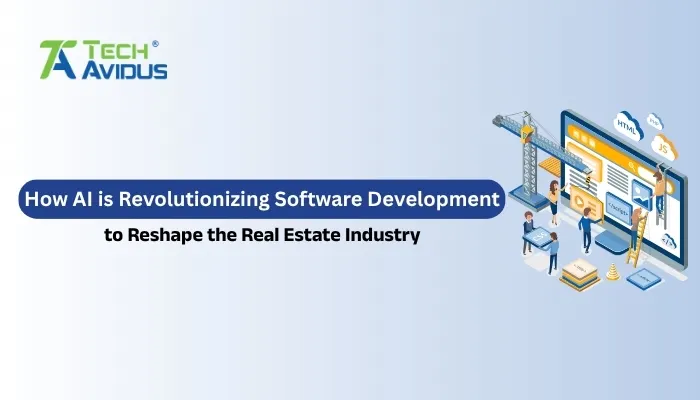
The real estate industry is undergoing one of the most significant technological transformations in its history. Traditionally known for manual processes, paperwork-heavy transactions, and relationship-driven operations, the sector is now embracing digital innovation at an unprecedented pace. At the heart of this transformation lies artificial intelligence (AI), which is fundamentally changing how software is developed, deployed, and utilized across the real estate ecosystem.
As demand for faster transactions, data-driven decision-making, and personalized customer experiences continues to grow, real estate technology has emerged as a critical driver of industry modernization. AI-powered software solutions are helping real estate agencies, property managers, investors, developers, and homebuyers streamline operations, improve efficiency, and unlock new business opportunities.
According to research from the National Association of Realtors (NAR), McKinsey, and PwC, AI and advanced analytics are expected to generate billions of dollars in value across the real estate sector through improved operational efficiency, enhanced customer experiences, and smarter investment decisions. As software development increasingly integrates AI capabilities, the future of real estate is becoming more intelligent, automated, and customer-centric.

Real estate technology, often referred to as PropTech, encompasses digital solutions designed to improve the buying, selling, leasing, management, and investment of properties. AI is elevating these solutions by enabling software systems to learn from data, recognize patterns, make predictions, and automate complex tasks.
Modern software development practices now integrate machine learning models, natural language processing, computer vision, and predictive analytics directly into real estate platforms. This allows organizations to move beyond simple digitization and create intelligent systems capable of making informed recommendations and automating decision-making processes.
AI-driven software applications are helping real estate professionals analyze massive datasets, predict market trends, automate customer interactions, optimize property management operations, and improve investment strategies. These capabilities are transforming the way businesses operate while creating better experiences for buyers, sellers, tenants, and investors.
Traditional software development focused primarily on building applications that executed predefined functions. AI-powered development introduces systems that continuously learn and improve over time. This shift is particularly impactful in real estate, where market conditions, consumer preferences, and property values constantly evolve.
Developers are now creating intelligent platforms capable of processing structured and unstructured data from multiple sources, including property listings, demographic information, economic indicators, customer interactions, and market reports. AI algorithms analyze this information to generate insights that would be impossible for humans to uncover manually.
Modern development frameworks also incorporate AI-assisted coding tools, automated testing, intelligent quality assurance, and predictive maintenance capabilities. These innovations accelerate development cycles while ensuring higher-quality software products that adapt to changing business needs.
One of the most impactful applications of AI in real estate technology is automated property valuation. Traditionally, determining a property's value required extensive manual analysis by appraisers and real estate professionals. AI-powered software now analyzes thousands of data points, including location, market trends, historical sales data, neighborhood demographics, amenities, and economic indicators to generate highly accurate property valuations.
Machine learning algorithms continuously refine their predictions as new market data becomes available. This enables investors, agents, and buyers to make more informed decisions while reducing valuation errors.
Real estate companies can also leverage predictive analytics to forecast future market conditions, identify emerging investment opportunities, and assess risks associated with specific properties or geographic regions. These capabilities provide a significant competitive advantage in an increasingly data-driven market.
Customer expectations have evolved dramatically in recent years. Buyers and renters now expect personalized experiences similar to those offered by leading eCommerce and streaming platforms. AI-powered real estate software delivers this personalization by analyzing user behavior, preferences, search history, and engagement patterns.
Advanced recommendation engines can suggest properties that closely align with a user's needs, lifestyle preferences, and budget requirements. AI chatbots and virtual assistants provide instant responses to inquiries, schedule property viewings, answer frequently asked questions, and guide users throughout the buying or renting journey.
Natural language processing enables these systems to understand conversational queries and provide relevant recommendations, significantly improving customer satisfaction while reducing the workload on sales teams.
Property management represents another area where AI-driven software development is creating substantial value. Managing residential, commercial, and industrial properties often involves coordinating maintenance, handling tenant requests, monitoring occupancy rates, and optimizing operational efficiency.
AI-powered property management platforms can automatically identify maintenance issues before they become costly problems. By analyzing data from IoT sensors, equipment performance metrics, and historical maintenance records, predictive maintenance systems can forecast potential failures and recommend preventive actions.
This proactive approach reduces maintenance costs, minimizes downtime, and improves tenant satisfaction. Property managers can also utilize AI-generated insights to optimize energy consumption, improve resource allocation, and enhance overall building performance.

The rise of computer vision technology is transforming how properties are marketed and evaluated. AI-powered image recognition systems can analyze property photos and videos to identify features, assess conditions, and generate detailed descriptions automatically.
Virtual tours enhanced by AI provide immersive property viewing experiences that allow prospective buyers to explore homes remotely. These technologies became especially valuable during the digital transformation accelerated by global events and continue to shape modern real estate marketing strategies.
Software developers are increasingly integrating augmented reality (AR) and virtual reality (VR) capabilities into real estate platforms, enabling users to visualize renovations, furniture placement, and design modifications before making purchasing decisions.
Real estate investment has historically relied heavily on experience, intuition, and market expertise. AI is augmenting these capabilities by providing data-driven insights that improve investment decision-making processes.
Advanced analytics platforms can evaluate thousands of investment opportunities simultaneously, considering factors such as historical performance, economic trends, local development projects, demographic shifts, rental demand, and market volatility.
These intelligent systems help investors identify high-potential opportunities, assess risks more accurately, and optimize portfolio performance. Software solutions powered by AI can also automate due diligence processes, reducing the time and resources required to evaluate potential acquisitions.
Leading real estate organizations worldwide are already leveraging AI-powered technologies to achieve measurable results. Property listing platforms use machine learning algorithms to improve search relevance and property recommendations. Real estate marketplaces employ AI chatbots to engage prospects and qualify leads. Property management companies utilize predictive maintenance systems to reduce operational costs and improve tenant retention.
Major technology-driven real estate companies have reported increased lead conversion rates, faster property sales cycles, and improved operational efficiency through AI implementation. These success stories demonstrate the growing impact of intelligent software solutions across the industry.
Organizations seeking to leverage AI should begin by identifying specific business challenges and opportunities where intelligent automation can deliver measurable value. Establishing a strong data infrastructure is essential, as AI systems depend on high-quality, accurate, and comprehensive datasets.
Businesses should prioritize scalable software architectures that support future AI enhancements while ensuring data privacy and regulatory compliance. Collaborating with experienced AI development partners can significantly accelerate implementation and reduce risks associated with complex technology projects.
Continuous monitoring, testing, and optimization are equally important to ensure AI models remain accurate and effective as market conditions evolve.
The future of real estate technology will be increasingly defined by intelligent automation, predictive analytics, and seamless digital experiences. As AI capabilities continue to advance, software platforms will become more autonomous, enabling real estate professionals to focus on strategic decision-making and relationship-building rather than repetitive administrative tasks.
Emerging technologies such as generative AI, digital twins, autonomous property management systems, and hyper-personalized customer experiences are expected to further transform the industry. Organizations that invest in AI-driven software development today will be better positioned to compete in tomorrow's technology-driven real estate landscape.
Artificial intelligence is no longer a futuristic concept in real estate—it is a transformative force reshaping the industry's present and future. From automated property valuations and predictive analytics to intelligent customer engagement and smart property management, AI-powered software development is creating unprecedented opportunities for innovation and growth.
As real estate technology continues to evolve, businesses that embrace AI-driven solutions will gain a competitive advantage through improved efficiency, enhanced customer experiences, and more informed decision-making. The convergence of AI and software development is setting a new standard for how real estate organizations operate, compete, and deliver value.
At TechAvidus, we help businesses leverage cutting-edge AI development services and custom software solutions to unlock the full potential of digital transformation. Whether you are looking to build intelligent real estate platforms, automate operations, or enhance customer experiences, our team can help turn your vision into reality.

Bhavesh Ladva is a seasoned AI Developer with over 10 years of experience in machine learning, deep learning, and NLP. He has built scalable AI solutions across industries, leveraging technologies like Python, TensorFlow, and cloud platforms. Bhavesh is passionate about ethical AI and constantly explores innovative ways to solve real-world problems.
Our Top 1% Tech Talent integrates cutting-edge AI technologies to craft intelligent, scalable, and future-ready solutions.
All Rights Reserved. Copyright © 2026 | TechAvidus


.jpg)